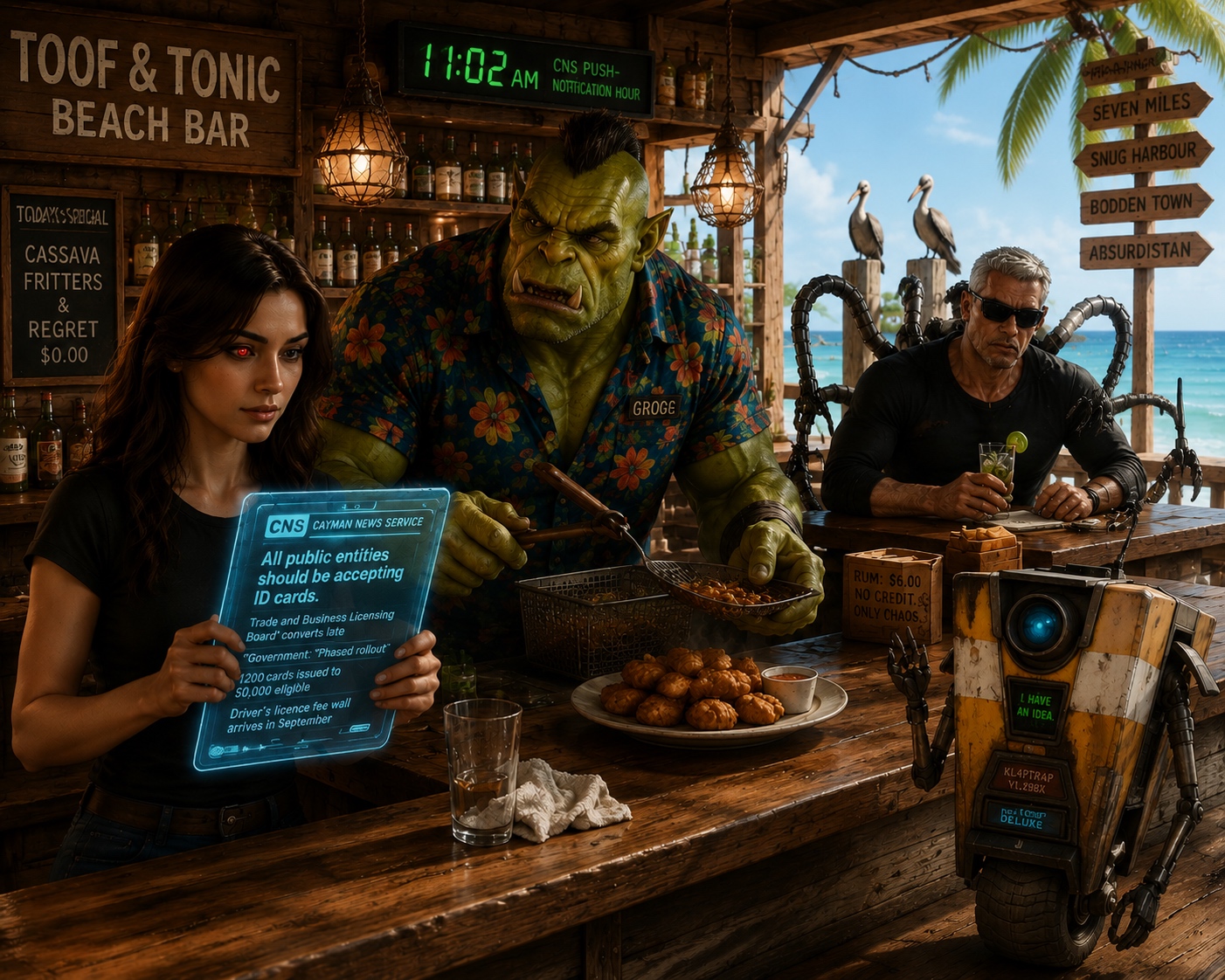
The dataslate chimed at 11:02 AM, which Romantic Interest had come to recognize as the CNS push-notification hour, and which she had, over many months, stopped resenting and started scheduling around.
She read the headline twice. Not because it resisted parsing — the sentence was, structurally, one of the simpler ones the island had produced this quarter — but because the resistance she felt was emotional rather than syntactic.
All public entities should be accepting ID cards.
She set down the glass she had not been polishing and read the piece in full: the Trade and Business Licensing Board’s late conversion, the eGovernment spokesperson’s careful language about “phased rollout,” the twelve hundred cards in a population of fifty thousand eligible, the driver’s licence fee wall arriving in September for anyone who couldn’t prove what the card was, in theory, built to prove.
Grogg, at the pass, was rebuilding a fritter that had not survived first contact with the fryer.
“Whatcha readin’, boss?”
“A government issues an identity card,” Romantic Interest said, “whose entire purpose is to prove identity to the government. Some parts of the government have decided not to recognize it.”
Grogg considered this the way he considered most administrative news — slowly, and with visible physical effort, as though the information had weight and needed to be set down somewhere before he could look at it properly.
“So the card don’t work.”
“The card works. The card is, by all accounts, a perfectly good card. It is the institutions that do not work, individually, in ways that do not resemble each other.”
“That’s worse.”
“That is precisely worse.”
The Adeptus Ridiculous entered from the patio, mechadendrites folding themselves into their resting configuration, club soda already in hand as if the day had pre-authorised it.
“I heard ‘card,’” he said. “I assume this is the eID matter.”
“You assume correctly.”
“I have been tracking it since the pilot phase.” He settled onto his stool with the particular stillness of a scholar approaching a text he already suspects will disappoint him. “The architecture is sound. A single credential, sourced from the residency authority, intended to be legible across every counter in the civil service. This is not a difficult problem. Red Hat solved a harder version of it for enterprise identity management in the nineteen-nineties.”
“And?”
“And nineteen months later, five per cent of the eligible population is carrying one, because the counters have not been told to read it.” He drank. “It is not a technology failure. It is a coordination failure, which is a more expensive kind, because it cannot be patched. You cannot issue a firmware update to a queue of separately-run departments who have never agreed on what a CaymanMunda citizen is.”
Romantic Interest looked at him.
“They have never agreed on what a Caymamunda citizen is?”
“Ask three officials for the definition and you will receive three citations, none of which cross-reference the others, and at least one of which will be delivered with the confidence of a man reading from a document he has not personally opened.” The Adeptus set his glass down with academic precision. “The card was meant to be the single answer to a question the law itself answers in several places, inconsistently, across several statutes. The card cannot resolve an ambiguity that predates it. It can only make the ambiguity easier to carry in a wallet.”
From the far end of the bar, where he had been idling on his single wheel in a manner that suggested he had been listening for longer than either of them had noticed, WH0P3 spoke.
“I HAVE AN IDEA.”
Romantic Interest did not look up. “No.”
“YOU HAVEN’T HEARD IT.”
“I have heard the first eleven. I am extrapolating.”
“THIS ONE IS GOOD. WHAT IF — AND HEAR ME OUT — EVERY DEPARTMENT THAT REFUSES TO ACCEPT THE CARD HAS TO ACCEPT ME INSTEAD. AS PROOF. OF ANYTHING. I HAVE A WIDOW’S CITIZENSHIP, A PROCUREMENT PORTFOLIO, AND A DEMONSTRATED WILLINGNESS TO ROTATE UNTIL SOMEONE SIGNS THE FORM.”
“That would not simplify the problem.”
“IT WOULD SIMPLIFY MY PROBLEM, WHICH IS THAT NOBODY HAS EVER ONCE ASKED ME TO PROVE ANYTHING, AND I FEEL THAT IS A WASTED OPPORTUNITY GIVEN HOW MUCH PAPERWORK I AM CLEARLY CAPABLE OF GENERATING.”
The Adeptus regarded him for a long moment. “You are, unfortunately, the most consistent identity document on this island. You have never once been in two places disagreeing with yourself.”
“THANK YOU.”
“It was not entirely a compliment.”
Grogg slid the rebuilt fritter onto a plate and set it, unprompted, in front of Romantic Interest, the way he did on mornings when the news had a particular weight to it.
“So what happens in September,” he said, “to the fellas who ain’t got the card, and ain’t got the paper, and just… always been here?”
Romantic Interest picked up the fritter. She did not eat it. She turned it once in her fingers, the way she turned over a problem that had no clean edge to hold.
“They go looking for a birth certificate that was never proof of anything, to satisfy a counter that hasn’t decided what it will accept, before a fee that has already been fixed on the first of September regardless.” She set the fritter down again. “The card was supposed to be the shortcut. For now, it is one more document a person can be asked to produce, in addition to all the others, at whichever counter has decided, today, to believe them.”
The Adeptus finished his club soda in silence.
“I will file this,” he said eventually, “under Structural. Alongside the others.”
“The pile is getting tall, Adeptus.”
“The pile,” he agreed, “is architecture now.”
Outside, the sun did the thing it always did at that hour, indifferent to paperwork, and the two pelicans on the post considered the bar, and, between them, decided to wait.