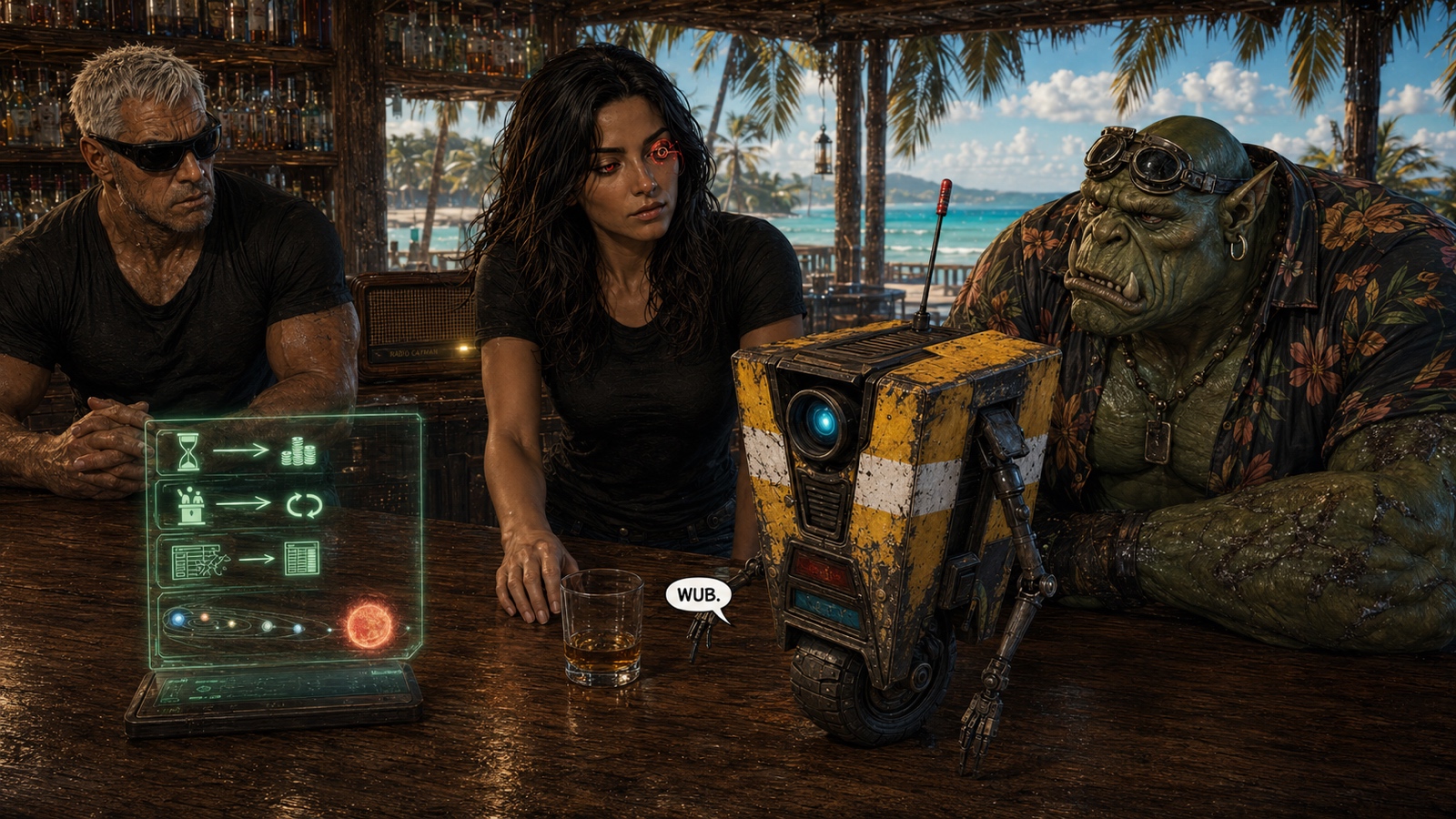
“WH0P3.” Romantic Interest set down her glass. This was the sound of a decision being made. “Come here.”
He came. This was notable. WH0P3 did not typically respond to instructions that weren’t preceded by at least three repetitions, two threats, and one thrown object. But there was something in her register that bypassed his usual filtering — a frequency he’d learned, across many respawns and one Carnifex, to treat as a primary signal.
He rolled to the bar. His dubstep faded to a murmur.
She looked at him for a long moment. The cybernetic eye did its thing — that slight calibration, the almost imperceptible shift of focus that meant she was running numbers rather than simply seeing.
“You want the honest version,” she said. “Not the diplomatic one.”
“I WANT MY MONEY,” he said, with somewhat less volume than before.
“Those are still different requests.” She reached under the bar, produced a glass, poured two fingers of something amber, and slid it six inches to the left in a gesture that was not quite an offering and not quite nothing. “Sit down.”
“I don’t have —”
“Figuratively.”
He stopped rolling.
“The man who employed you for one day,” she began, “was, until recently, the Minister of Labour and Pensions of the Caymanmunda Islands. Not just Labour. Labour and Pensions. Which means he held the specific statutory authority to compel employers — himself included — to remit pension contributions on behalf of their workers. He oversaw the department whose job it is to chase exactly the kind of non-compliance we are currently discussing on that radio.” She nodded toward the speaker, where Honk Honk was still talking about inter-departmental communication barriers. “He used that position to argue against increasing the minimum wage he was paying his own workers. He employed those workers on contracts that were, in practice, renewable by the day. And he apparently did not remit their pension contributions.” A pause. “According to the comments section of CNS, which is not a court of law but has, historically, a reasonable accuracy rate on this island.”
WH0P3’s eye flickered. “So… he knew the rules.”
“He wrote some of them.”
“Adeptus,” Romantic Interest said, without looking away from WH0P3. “Probability assessment.”
The Adeptus set down his slate. His mechadendrites folded in a way that suggested professional satisfaction at being asked to do something rigorous.
“I have modeled four recovery scenarios,” he said. “In the optimal scenario — full inter-departmental cooperation, expedited enforcement, complete asset recovery — you receive payment in four to seven years, contingent on the entity in question not having restructured, transferred, or simply expressed amnesia regarding the liability. In the median scenario, the Department of Labour and Pensions completes its investigation after the next election cycle, at which point the responsible party will be either in opposition, returned to cabinet, or delivering a keynote at a compliance summit.” He paused. “The third scenario involves the company no longer holding a trade and business license, which the current minister has acknowledged is a documented category of the problem, meaning the liability becomes a line item in a spreadsheet that is itself a gap in a larger spreadsheet, both of which feed into a system that the minister has just described on public radio as, and I am quoting precisely, challenging.”
“And the fourth scenario?” WH0P3 asked, his voice now operating at a volume that could charitably be described as indoor.
The Adeptus considered. “In the fourth scenario, the sun expands into a red giant, consumes the inner solar system, and the question of your outstanding wages becomes moot approximately five billion years before any enforcement action would have concluded.”
A beat.
“WUB,” said WH0P3. Just the one.
Grogg had come to lean against the bar at some point during the Adeptus’s assessment, the way large things do — gradually, inevitably, without announcement. He now occupied the space beside WH0P3 the way a weather system occupies a coastline.
“‘Ere’s da fing, mate,” he said, not unkindly, which for Grogg required visible effort. “On dis island, sometimes da geezer wot makes da rules about payin’ workers is da worker not gettin’ paid. Well — not him exactly. But you.” He paused. “And about two thousand other people, apparently, wot didn’t drive a cart into a plane.”
“I didn’t —”
“You did, mate. I saw da photos. Dere’s a dent.”