“You know what I find genuinely extraordinary about this situation?” the Harlequin continued. “Not the hypocrisy. I have seen hypocrisy at a scale that would give this island an inferiority complex. Not the non-compliance. Not even the excavator.” She paused. “What I find extraordinary is you.”
WH0P3’s eye cycled. “ME?”
“You worked one day. You were paid nothing. The man responsible is a former minister with an extensive public record of arguing against the interests of the workers he was employed to protect, while employing workers under conditions specifically designed to prevent them from complaining about it.” She looked at him with something that had started as theatrical amusement and quietly become something else — not softer exactly, but more pointed. “And you are going to file a complaint anyway.”
“OBVIOUSLY —”
“Despite a near-zero probability of resolution before the heat death of the solar system.”
“FIVE BILLION YEARS IS STILL A DEADLINE —”
“Despite the fact that you have, by any actuarial measure, far better employment right here.” She glanced at Romantic Interest. “With hazard pay. Full time.”
“I STILL WANT WHAT I’M OWED —”
“Yes,” the Harlequin said. “Exactly.” She was quiet for a moment, in the way that ancient things are occasionally quiet — not emptily, but with the weight of everything they’re choosing not to say. “The workers in that company — the ones who can’t file complaints because their contracts run day to day, whose work permits evaporate if they make trouble, who calculated the risk and said nothing — they want what they’re owed too. They’re just not in a position to say so.”
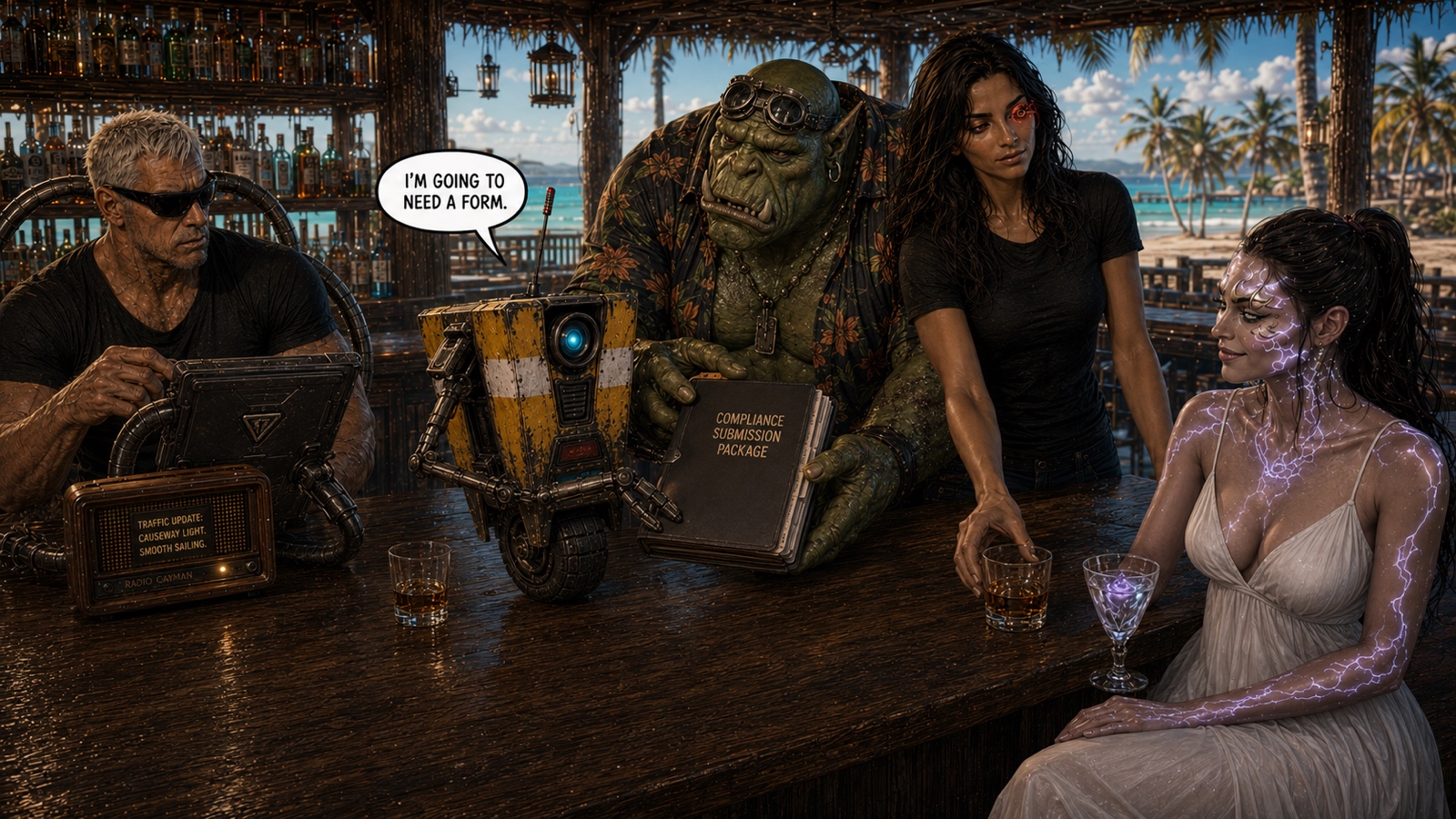
The bar was very quiet. The radio had moved on to something about traffic.
“You,” she said, “are impossible to fire. Impossible to deport. Impossible to significantly damage for longer than the respawn cycle. You have the job security of a force of nature and the legal standing of a Caymanmundaian citizen who is also, technically, a widower.” She tilted her head. “If you don’t file the complaint, who exactly does?”
A long, strange silence.
WH0P3’s dubstep, which had gone entirely quiet at some point during this speech, began to rebuild from somewhere deep in his chassis. Not the aggressive bass line of grievance. Something slower. More considered. The musical equivalent, if such a thing could be said of dubstep, of a decision being made.
“I’m going to need a form,” he said.
“The Department of Labour and Pensions has forms,” the Adeptus confirmed. “I have pre-downloaded all forty-seven relevant compliance reporting documents, cross-referenced with the applicable sections of the National Pensions Act, and have prepared a submission package.” A mechadendrite produced a precisely organised document wallet. “I had not identified a suitable plaintiff until now.”
WH0P3 stared at the document wallet. His eye was doing the pink thing again.
“You’re giving me the forms,” he said.
“I am providing you with the optimally structured submission package,” the Adeptus said, “because if it is going to be filed, it should be filed correctly, and your historical relationship with paperwork suggests external assistance is advisable.”
“THAT ONE TIME WITH THE CUSTOMS FORM —”
“You submitted it in dubstep notation.”
“IT WAS EXPRESSIVE —”
“It was inadmissible.”
Grogg reached over and placed the document wallet in WH0P3’s manipulator claw with the careful delicacy of someone handling something that might explode, which with WH0P3 was always a reasonable precaution.
“Der ya go, mate,” he said. “File da ting.”
WH0P3 held the wallet. His dubstep had settled into something steady and low. His eye was blue — the good blue, not the distressed blue.
Then, because he was WH0P3 and the moment could not be allowed to pass without escalation: “AND THEN I’M GOING TO FILE SEVENTEEN MORE ON BEHALF OF EVERYONE ELSE HE UNDER-PAID AND THEN I’M GOING TO —”
“One at a time,” Romantic Interest said.
“BUT —”
“One. At a time.” She looked at him. “File yours first. Do it correctly. Let the Adeptus check it. Then we’ll talk about the others.”
Another of those silences. Not long. But real.
“Okay,” WH0P3 said, in a voice that was almost — almost — quiet.
Romantic Interest turned to the Harlequin. The expression on her face was not gratitude exactly. It was the expression of someone acknowledging a debt in a currency she hadn’t known she was spending.
“You could have stayed in the corner,” she said.
“I could have,” the Harlequin agreed. “I’ve watched worse situations from more comfortable positions.” She picked up her drink. “But he’s going to file a complaint against a former minister on behalf of himself and approximately two thousand other people who can’t, and he’s going to do it because it is correct to do it regardless of probability.” She paused. “I have lived long enough to understand that there are very few things in the universe that improve anything. That is, unfortunately, one of them.” She took a sip. “Also, a donkey with a chiropractor’s bill the length of Seven Mile Beach is simply not a thing I was prepared to let pass without remark. There are limits.”
Grogg made a sound that was, by his standards, a laugh. It rattled three glasses.
Romantic Interest reached under the bar and poured a second glass of bourbon. She placed it — without ceremony, without announcement — in front of the Harlequin’s existing drink.
The Harlequin looked at it. Then at Romantic Interest. A brief exchange of the kind that does not require words, conducted between two people who have independently arrived at the conclusion that the world is, largely, terrible, and have each chosen, for their own reasons, to remain in it anyway.
“Thank you,” the Harlequin said.
“Don’t make it a habit,” said Romantic Interest, which, in the specific dialect of the Toof & Tonic, meant the opposite.