Arrive Alive 345 turns twenty-five this year. A quarter century of slogans, buses, banners, and well-intended press conferences. And yet, CaymanMunda is on track for what the police commissioner himself warns may be the worst year for road collisions on record.
That contradiction is the story.
The National Drug Council and its partners frame impaired driving as a public-health issue. That is correct. Alcohol, judgment, reaction time, and trauma are inseparable. But when a dozen collisions a day have become background noise, the problem has clearly metastasized beyond festive-season drinking.
What CaymanMunda now faces is not a single behavioral failure. It is a systems failure.
When Prevention Becomes Ritual
AA345 has evolved into an umbrella campaign, absorbing ministries, committees, and messaging streams. The language is familiar: whole-of-government, shared responsibility, culture of safety.
These phrases are not wrong. They are just insufficient.
After 25 years, prevention messaging without structural enforcement becomes ritual. A performance. Something we do because we have always done it, not because it demonstrably changes outcomes. The ritual protects the system from accountability. As long as there’s a campaign, there’s something to point to. The posters become liability shields. “We did our part—we told them not to drink and drive.”
Six deaths this year. Sixty-seven in five years. Fourteen in 2024 alone.
If any other public system produced those numbers, it would be suspended pending inquiry.
The Enforcement Vacuum
The most revealing line in the CNS report is not about alcohol at all. It is this:
*With a shortage of officers in the transport unit this year, 2025 may well have the highest number of collisions in CaymanMunda’s history.*
This is the quiet truth beneath the slogans.
You cannot “educate” your way out of a lack of enforcement. You cannot poster your way past physics. Speed, vehicle condition, road design, lighting, and consistent policing do not respond to hashtags.
When people know the probability of being stopped is negligible, behavior adapts accordingly. This is not moral failure. It is basic risk calculation.
The Fleet Itself
The enforcement gap extends beyond policing to the vehicles themselves. Actuarial estimates drawn from collision reports suggest forty percent of cars on island would fail basic roadworthiness standards—and that figure likely underreports the problem, since uninsured vehicles, unlicensed drivers, and informal crash settlements never enter the data at all.
Forty percent is the floor. The visible portion. The true number includes an entire shadow fleet that never touches the official record.
These vehicles are serviced by mobile mechanics operating outside any inspection regime, kept running with parts extracted from previous crashes—mechanical necromancy, resurrecting dead vehicles one salvaged caliper at a time. Metal fatigue, invisible fractures, compromised sensors: you’re bolting failure modes onto failure modes. Many sit uninsured for years at a stretch. The annual licensing ritual continues regardless. Stickers are issued. Fees are collected. The system performs compliance while the fleet deteriorates.
You cannot campaign your way past brake fade.
Public Transport as Mitigation, Not Strategy
Expanded bus routes are welcome. They save lives on nights when they are used. But buses are a mitigation tool, not a cure—and the mitigation itself needs scrutiny.
The public bus schedule remains opaque, irregular, and misaligned with the hours when impaired driving risk peaks. And the buses themselves are not exempt from the island’s broader relationship with physics. Anyone who has watched a public bus negotiate a roundabout at camber angles better suited to a well-maintained exotic on track day understands that “take the bus” is not a complete sentence. Trading one set of risks for another is not a safety strategy.
Even setting aside the buses’ own enthusiastic interpretation of vehicle dynamics, public transport cannot address chronic speeding, unsafe overtaking, vehicle fitness failures, poor junction design, under-scaled roundabouts, or the driver training disparities that arrive with dozens of foreign licensing regimes. Public transport reduces harm at the margins. It does not substitute for a functioning traffic safety system.
CaymanMunda Is Not a Metaphor Anymore
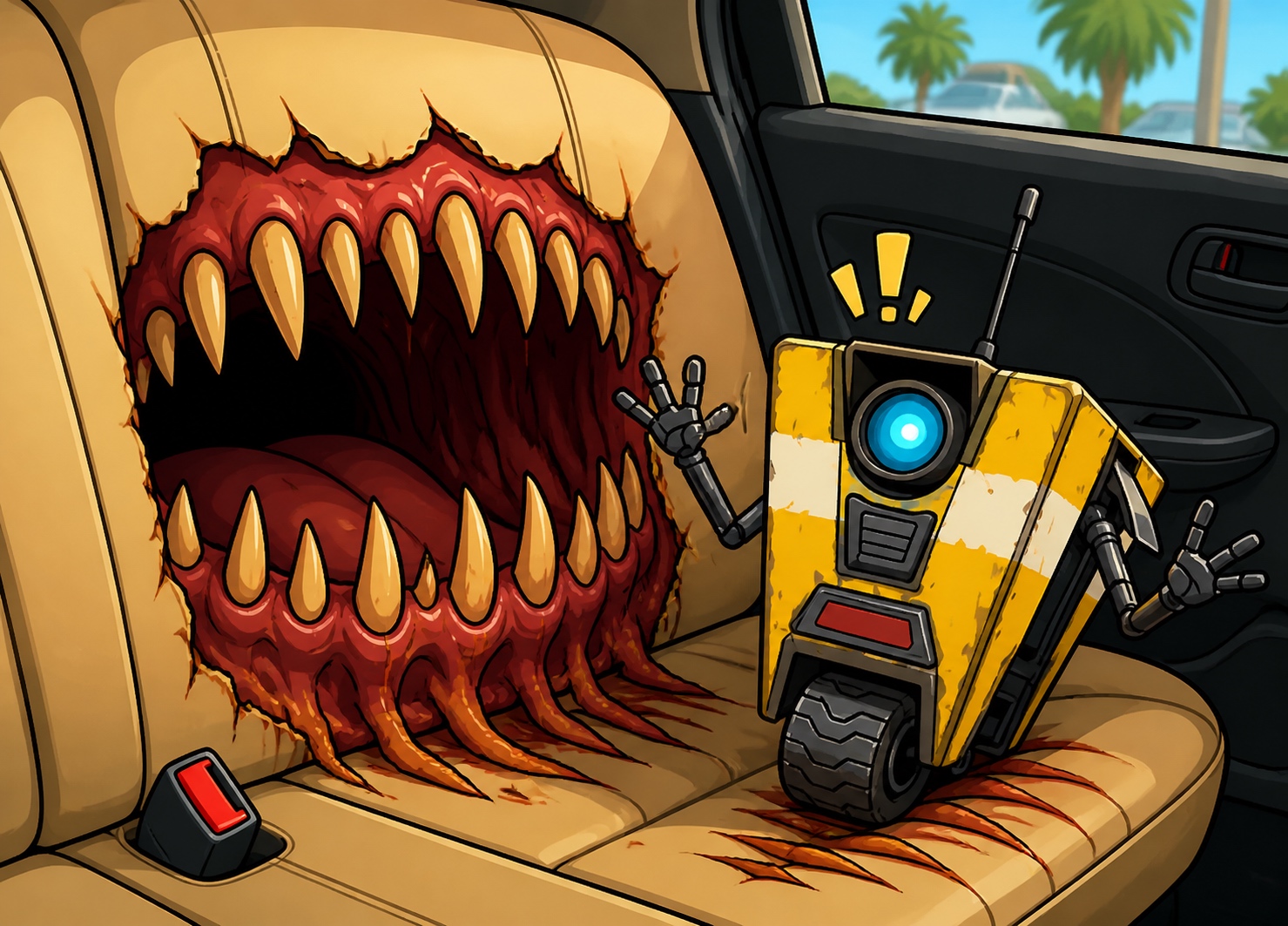
In CaymanMunda, the satire imagines possessed cars and bureaucratic demons. In reality, the monsters are simpler and far more dangerous: predictable enforcement gaps, under-resourced traffic units, reactive policy instead of preventive engineering, endless messaging without consequence.
When collisions become routine content on social media, normalization has already set in. That is the most dangerous stage of all.
What “Arrive Alive” Actually Requires
If the goal is genuinely to reduce injuries and deaths, the next 25 years must look very different from the last 25.
That means visible, consistent traffic enforcement—not seasonal checkpoints but a permanent presence. It means engineering fixes: junction redesigns, proper lighting, roundabouts scaled to actual traffic loads. It means vehicle inspection reform that examines what’s under the hood, not just whether the fee was paid. It means data-driven hotspot intervention. And it means political acceptance that safety enforcement is unpopular until it works.
Prevention is not a poster. It is an ecosystem.
Until that ecosystem exists, Arrive Alive 345 will continue to be well-meaning, sincere, and tragically insufficient.
And CaymanMunda will continue to bury people who should have made it home.
—–
*Reminder: There isn’t a Golden Throne at the end of the road. Cars are to be driven horizontally, not vertically. Roundabouts aren’t SpaceX launch pads. And paint thinner isn’t a fuel additive.*
*Happy holidays.*
P.S: I would strongly encourage the public that is driving safely this holiday season to consider not driving past sundown, get safety helmets , install a rolling cage and 5 or 6 points safety belts.
Welcome to CaymanMunda!
The only place in the Imperium where the physics of the immaterium are a definitive possibility as to the driving habits.