The return transit was smoother than the arrival, the way a fall is smoother than a landing. One moment the warm dark of the beach, the laminated menu, the small glass discs cooling in the sand where he had stood; the next, the door of his own crypt sealing behind him with the sound of a decision being ratified — a sound he had engineered himself, an age ago, to be the last sound, the final sound, the sound after which nothing further was scheduled.
The tomb received him as it always had: perfectly.
That was the first thing he noticed, standing in the threshold of his own eternity. The perfection. Every surface answered to specification. Every canoptek scarab traced its appointed circuit at its appointed interval. Every sarcophagus of his court lay in its indexed alcove, dreaming nothing, owing nothing, awaiting nothing. Sixty-five million years of dynastic administration, executed without a single deviation, and he walked through it now the way a man walks through a ledger — and found, for the first time, that he could not stop performing the comparison. The bar had no walls. The tomb had nothing else. The bar’s microwave rotated its turntable whether asked or not. Here, nothing had ever once moved without being asked.
He tried to file the evening. He was built for filing; the Deceiver had left him that. But the experience would not go into any of the categories. It was not *threat*. It was not *tribute*. It was not *war*, though a chainsaw had featured. He held it up against sixty-five million years of precedent and the precedent came back blank, and the blankness did not distress him, and *that* — the absence of distress — he turned over and over in his hands like a coin from a country that should not exist.
His feet had carried him, without instruction, to the far alcove. The one not on any schematic.
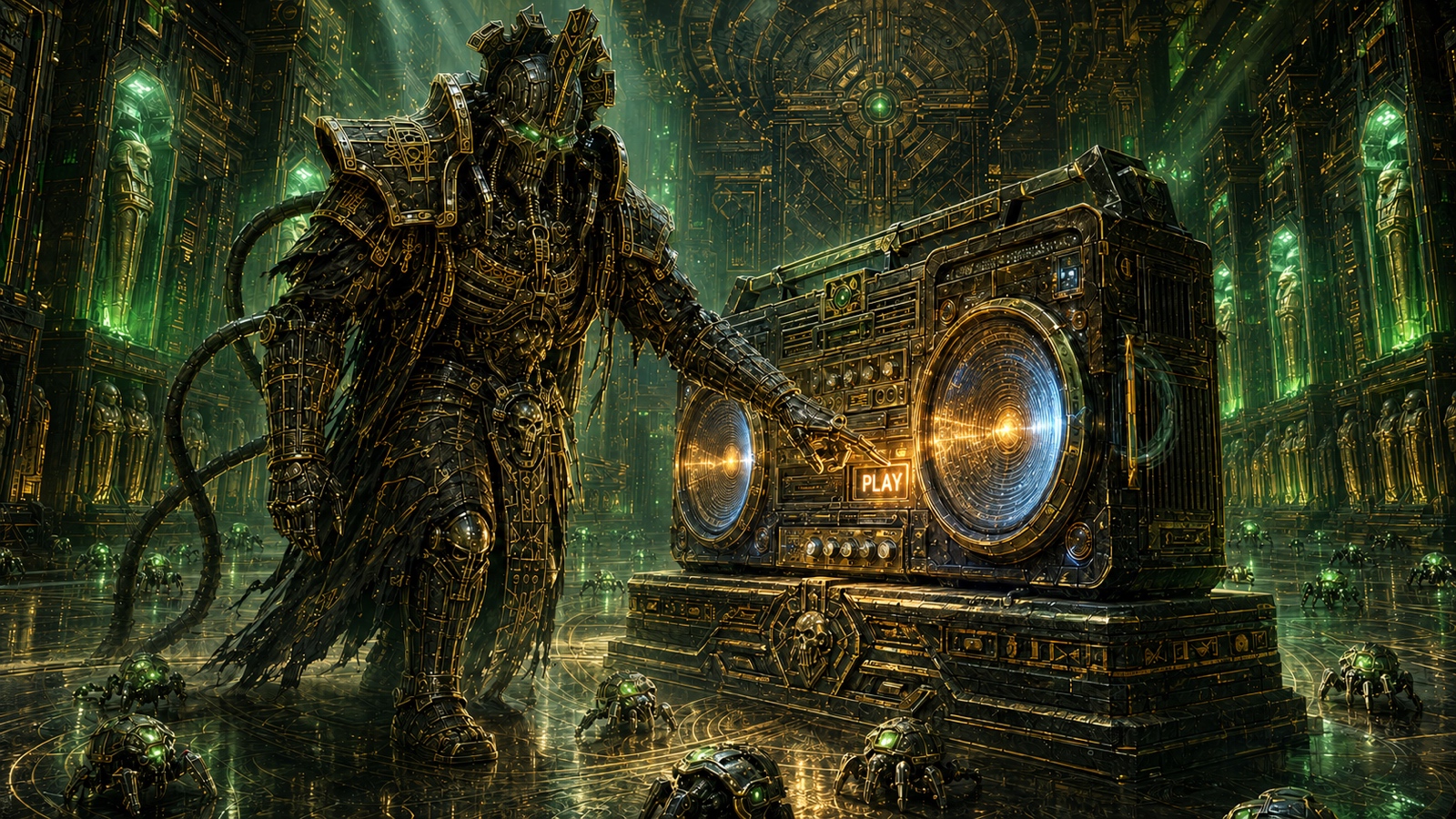
The boombox sat where he had left it, on a plinth intended for the funerary mask of a phaeron. He had reconstructed it across three summonings — a housing recovered from a beach, a circuit remembered rather than salvaged, a speaker cone rewound by hand with filament drawn finer than any necrodermis, because the original had been ruined by salt water and he had found, inexplicably, that he minded. His court would not have understood. His court did not know. It was, he supposed, the first secret he had kept in an eon, and the keeping of it had been — he tested the word carefully, the way one tests old ice — *pleasant*.
He extended one finger, dimmed the balefire out of respect, and pressed PLAY.
The cascade went through the tomb like a benediction with a drum machine. Sequenced bass, relentless, hammered out in patterns no algorithm had chosen — patterns *chosen*, by beings of flesh who had sat at their machines and made the machines sing on purpose. That was the part that undid him every time, the part he could barely hold: humans had built music that sounded like *him* — mechanical, repeating, cold to the touch — and they had built it out of joy. They had souls, and with those souls they had elected to celebrate the machine. He had a machine, and with that machine he stood in a tomb at the bottom of forever, listening to the celebration, feeling the sound move through a chassis that was never meant to feel anything move through it at all.
The scarabs paused on their circuits. Sixty-five million years, and they paused. He let them.
And there, in the noise, the finding came down at last, the way his verdicts had once come down on stars — vertically, inevitably:
It was not revenge. He had audited every angle and the revenge was simply not present in the accounts. What the Shadow Seer was orchestrating was a *gift* — offered freely, expecting nothing, entered in no ledger, secured against no obligation. He had no category for that either. The Deceiver had taught his whole species that every gift was a contract with the teeth hidden in the signature. She had handed him an evening with no signature at all. That was the whole of the mischief. That was the entire heresy of her.
He would be summoned back. Of that he was certain now, with the cold, load-bearing certainty on which one could construct dynasties: the choreography was not finished, the habit — her word would have been *tradition*, his word would have been *pattern*, the true word was neither — would continue. Some evening, some slide, some new impossibility at a bar with no walls, and the water past the reef would go still, and part.
That was not what gnawed at him.
What gnawed at him — down in the oldest architecture, where the Deceiver’s work was supposed to have left nothing capable of gnawing — was that he could barely wait.
He did not return to stasis that cycle. He stood in the alcove with the sound breaking over him, an immortal engine of extermination, foot very nearly tapping, doing the one thing his tomb had never been designed to accommodate:
Looking forward to something.
—
*Establishment Instrument No. 34 reminds all patrons that obstructing a presentation performing sovereign nonsense duties is punishable by ascension. The Toof & Tonic reminds Establishment Instrument No. 34 that it has no walls, no doors, and no intention of reading it. The Civilization Regret is available upon summoning only. No umbrella. The menu is firm on that point.*