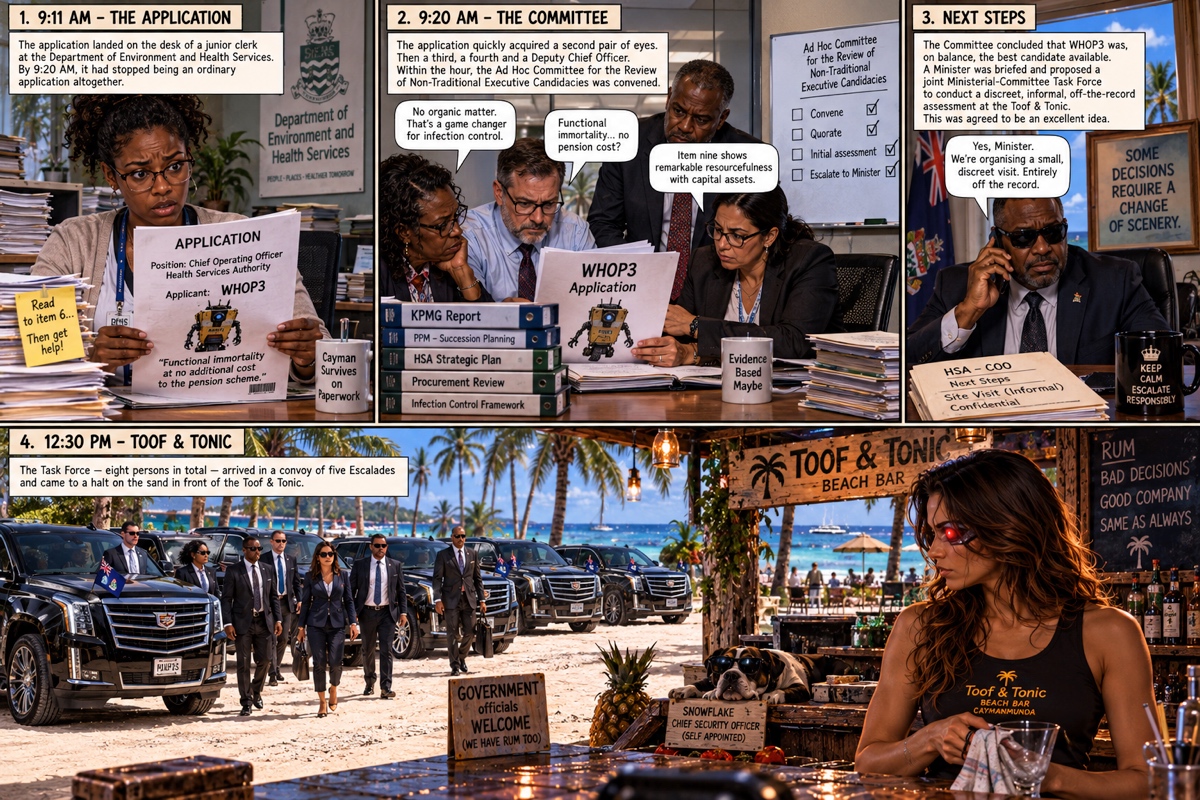
The application landed, by the ordinary mechanics of the civil service, on the desk of a junior clerk at the Department of Environment and Health Services at eleven minutes past nine the following morning, and by twenty minutes past nine it had stopped being an ordinary application altogether.
Nobody afterward could quite reconstruct how it had happened so fast. The clerk, to her credit, had read exactly as far as item six — functional immortality, no additional cost to the pension scheme — before deciding this was a document that required a second pair of eyes, and by the time it had acquired a third, a fourth, and a Deputy Chief Officer, it had also acquired a name: the Ad Hoc Committee for the Review of Non-Traditional Executive Candidacies, convened, minuted, and quorate before the coffee machine on that floor had finished its first cycle of the day.
The Committee’s initial view, reached with a speed that would have made the transport ministry weep with envy, was that WH0P3 represented, on paper, an extraordinarily strong candidate. Item four alone — no organic matter for a pathogen to colonise — was, one member noted, precisely the kind of infection-control innovation the KPMG report had been gesturing toward without quite having the imagination to specify. Item six solved, at a stroke, the succession-planning clause the PPM had been so insistent on. Item nine, several members agreed, spoke to a resourcefulness with capital assets that the Authority’s own procurement function had never once demonstrated.
Nobody on the Committee raised item seven. Item seven was, by unanimous and entirely unspoken consent, filed under Further Consideration Not Required At This Stage.
Within the hour, the Committee had concluded that WH0P3 was, on balance, the best candidate presently available for the role, and had done what any properly functioning arm of government does upon reaching a conclusion of this magnitude: it escalated. A Minister was briefed. The Minister, sensing correctly that a decision of this consequence could not simply be made, but had to be seen to have been considered, proposed the formation of a joint Ministerial-Committee Task Force, whose first order of business would be a discreet, informal, entirely off-the-record assessment of the candidate in his natural working environment.
This was agreed to be an excellent idea. Discretion, everyone concurred, was of the essence.
It was in the service of this discretion that the Task Force — the Minister, four Committee members, the Deputy Chief Officer, a note-taker, and a communications officer whose presence nobody could later explain but whose expenses were, in any case, already filed — assembled at midday in the Department’s forecourt, eight persons in total, and departed for the Toof & Tonic in a convoy of five saloon-sized Escalades.
The convoy arrived a little after half past twelve, engines idling in formation on the sand in a manner that suggested less a lunch reservation than a diplomatic incursion, and came to a halt within full view of the bar’s entirely wall-less, entirely door-less, entirely unobstructed frontage — at which point Romantic Interest, drying a glass behind the counter, looked up, looked at the five vehicles, looked at the eight suits now disembarking from them with the practised gravity of people who believed themselves unseen, and said nothing at all.