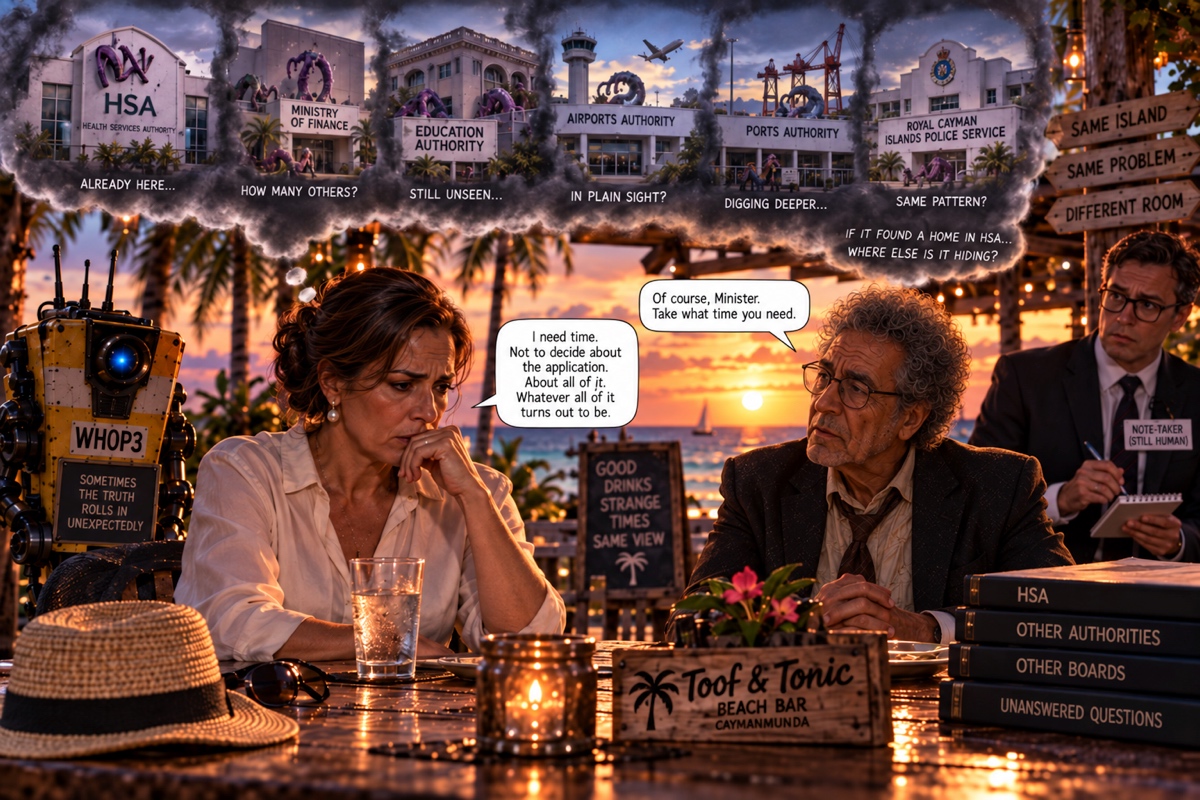
She did sit with it. She sat with it for rather longer than the Secretary, or anyone else on the terrace, had apparently expected her to, the water in her glass going warm untouched, the note-taker — the real one, the one who had not melted through the floorboards — hovering nearby with a pad he had, for once in his career, no earthly idea how to fill.
The trouble, she found, was not the obvious part. The obvious part — that three of her colleagues had not been her colleagues, that the Health Services Authority’s own governance review had, in some indirect and entirely unintended fashion, walked a one-wheeled applicant directly into the one gap in the island’s institutions apparently large enough for something like that to hide inside — was, if anything, almost containable. Alarming, yes. Career-ending, quite possibly, if it ever surfaced in a form anyone could act on. But containable, in the narrow sense that it had a shape, a location, and, as of this afternoon, three fewer members than it had possessed at breakfast.
The trouble was the second thought, arriving some minutes behind the first, in the entirely unwelcome way that the worst thoughts always did: that WH0P3’s application had not created this. It had merely tripped over it — stumbled, by accident, by the sheer dumb luck of a one-wheeled unit’s non-consensual scanning habit, into something that had plainly been sitting inside the HSA’s own structures for long enough to have found the time to embed itself at board level, to survive a KPMG review without so much as a footnote, to walk into a Ministerial delegation’s own lunch table wearing three of her own people’s faces.
If it had found that much room inside the Health Services Authority — an authority that had just been audited, at considerable public expense, by consultants who had somehow missed the fact that a portion of its senior stakeholders had been replaced — the question she could not, sitting on that terrace with her jacket still abandoned somewhere behind her, put back down again once she had picked it up, was how many other authorities, how many other boards, how many other quietly under-scrutinised corners of this government’s own architecture, might be harbouring exactly the same thing, unnoticed, for exactly the same reason: because the mechanisms built to notice it had, somewhere along the way, stopped being able to.
HSA was not the problem. HSA was the room the problem happened, this particular afternoon, to be sitting in.
She looked up, finally, at the Secretary, who had waited through all of this with the patient, undemanding stillness of a man who had clearly watched a great many officials arrive at this exact realisation before her, and who did not, she noted, look remotely surprised that it had taken her this long.
“I need time,” she said, and was faintly, distantly surprised by how steady her own voice came out. “Not to decide about the application. About all of it. Whatever all of it turns out to be.”
“Of course, Minister,” the Secretary said, in the tone of a man who had heard this exact sentence, in this exact register, more times than either of them would find comfortable discussing. “Take what time you need.”
He did not say what both of them, by then, understood perfectly well: that time, on this particular stretch of coastline, was the one resource the problem had never once shown any sign of running short of — and that whatever she decided to do with hers, it would be doing something with its own, quietly, in the meantime, in whichever room she was not currently watching.