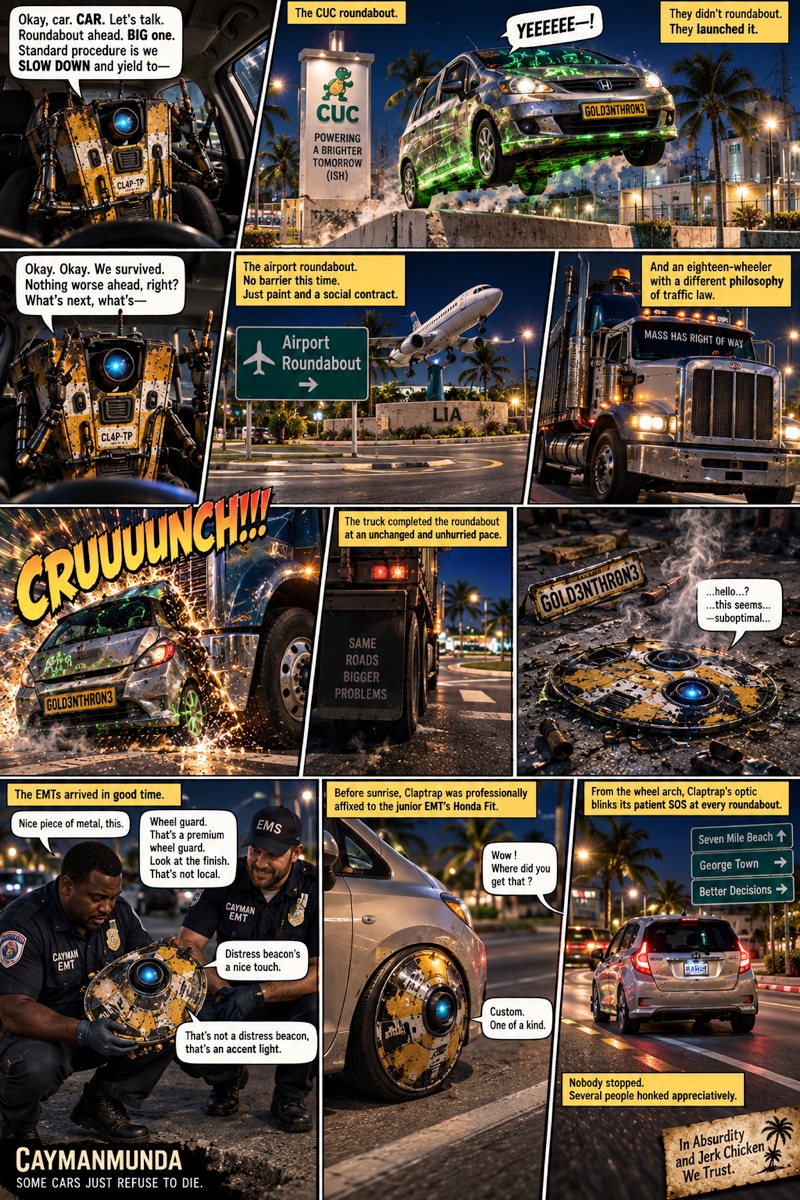
The CUC roundabout announced itself the way it announces itself to everyone: suddenly, and with concrete.
WH0P3 saw it coming from the passenger seat, which was the problem — he saw everything coming from the passenger seat, at Mach speed, with eighteen-speaker clarity and no pedals in his life. His desperation had matured past panic into something more entrepreneurial: he was now actively auditioning exits. The door handle (fused). The window (laughed at him, in runes). The sunroof (there was no sunroof; the Fit had absorbed it).
“Okay, car. CAR. Let’s talk. Roundabout ahead. BIG one. The one with the BARRIER. Standard procedure is we SLOW DOWN and yield to—“
The Fit did not yield. The Fit did not, strictly speaking, roundabout. It took the CUC roundabout as a launch ramp, met the concrete barrier at full speed, and cleared it — cleanly, contemptuously, with air beneath all four wheels and its G0LD3NTHR0N3 plate catching the streetlight like a heraldic device. For one long, floating moment, Grand CaymanMunda’s power grid infrastructure passed serenely beneath a possessed Honda Fit, and WH0P3’s scream achieved a purity of tone the sound system he’d recently lived in would have envied.
They landed. The suspension, forged in Absurdistan to tolerances best described as emotional, took it.
“Okay,” panted WH0P3, who did not breathe but had opinions about drama. “Okay. We survived. We cleared it. Nothing worse ahead, right? What’s next, what’s—“
The airport roundabout.
One lane. No barrier. No raised centre. Just markings on the ground — paint, essentially, paint and social contract — the roundabout that exists only insofar as everyone agrees to believe in it.
And entering it from the other side, at that exact moment, was the eighteen-wheeler.
The truck deserves description. It was a machine from an older, simpler covenant. Its indicators dated from the early nineties and had last functioned in the same decade; they were retained now as ornament, the way a warship retains a figurehead. Its driver held a philosophy of right of way that predated traffic law and would outlast it: precedence follows mass. Traffic lights were advisory. Lane markings were folklore. The airport roundabout, being made entirely of paint, did not exist for him at all. He was not breaking the rules of the road. He was operating under an entirely different physics, one in which he was correct.
The Fit — fifty thousand RPM of green-glowing Absurdistani conviction, freshly consecrated, undefeated against chickens, crabs, cameras, and small robots — entered the roundabout believing itself the apex predator of the island’s road network.
The truck entered it believing nothing, because the truck did not register the Fit as an event.
The cage match was brief.
Witnesses at the gas station described “a sound like a church bell being fed into a compactor,” followed by silence, followed by the truck completing the roundabout — such as it was — at an unchanged and unhurried pace. The Fit did not bounce off. The Fit did not spin away. The Fit was simply encrusted into the truck’s chassis, absorbed into the undercarriage like a barnacle onto a whale, its green glow flickering once, twice, and settling into something that could only be described as chastened. G0LD3NTHR0N3 folded neatly in half. SP33D4L1F3 remained legible, which everyone agreed was the crueller outcome.
The driver noticed nothing. The driver would discover the Fit at his next weigh-in and log it as “road debris, minor.”
And WH0P3—
WH0P3 had, at the moment of impact, occupied the precise interface between an unstoppable force and an indifferent mass, and had resolved the ancient paradox by becoming two-dimensional. What remained on the tarmac was round, flat, rim-edged, and gently steaming: a dinner plate with an eyestalk, its single optic still swivelling, its voice module compressed to a register only dogs and lawyers could hear.
The EMTs arrived in good time — for CaymanMunda — and assessed the scene with professional thoroughness. No human casualties. One truck, unbothered, already gone. One Honda Fit, location unclear, technically still in motion somewhere on the road network as cargo. And one flattened disc of unknown provenance, gleaming under the streetlights.
The senior EMT picked it up. Turned it over. Tapped it.
“Nice piece of metal, this.”
“Wheel guard,” said his partner, with the certainty of a man who has customized three cars and ruined two. “That’s a premium wheel guard. Look at the finish. That’s not local.”
“Distress beacon’s a nice touch.”
“That’s not a distress beacon, that’s an accent light.”
It was a distress beacon. WH0P3’s optic was cycling through every emergency pattern in his library — SOS, mayday, the universal signal for contractual dispute in progress — and it was doing so beautifully, which was the problem. Aesthetics had once again defeated semantics.
Which is how, before sunrise, WH0P3 came to be professionally affixed — torqued to spec, the EMTs were not animals — to the front left wheel arch of another Honda Fit: the junior EMT’s own vehicle, his sixth-hand pride and joy, resprayed twice and lowered once, now upgraded with a gleaming custom guard whose “accent light” pulsed distress into the Caribbean night.
The Fit’s owner drove home the long way, to show it off.
From the wheel arch, at every roundabout — taken, it must be said, correctly, at legal speed, with indicators — WH0P3’s optic blinked its patient SOS at every passing car.
Nobody stopped. Several people honked appreciatively.
One driver rolled down a window and asked where he could get one.