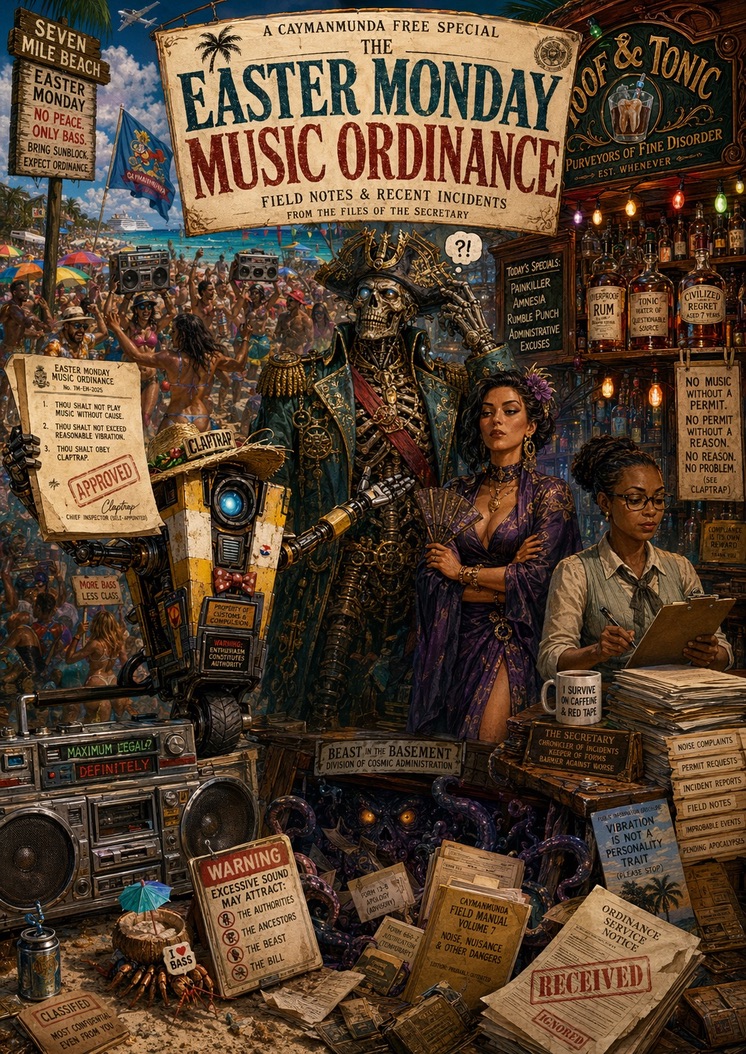
The Easter Monday Music Ordinance
SEVEN MILE BEACH — EASTER MONDAY — 11:47 A.M.
BEACH CHAOS DESIGNATION: CATEGORY FOUR
(One below “Pirate Week.” One above “Normal Tuesday.”)
The portal opened without ceremony.
No warning. No negotiation with local dimensional planning authorities. No environmental impact assessment, despite specific requirements under the CaymanMunda Islands Unauthorized Spatial Aperture (Notification) Regulations, 2024, which had been passed by the Legislative Assembly in the same session as the beach music ordinance, and had been similarly ignored by everyone in proximity to an actual beach.
Green light.
Ancient ozone.
The smell of sixty million years of patience, exhausted.
And then—
Seven Mile Beach.
Easter Monday.
The Necron Lord stepped through.
He had expected, perhaps, to recalibrate. To take stock. To assess the dimensional coordinates with the measured calm of a being who had outlasted geological epochs. He had expected a moment of orientation before engaging with whatever passed for reality in this particular jurisdiction.
He did not get one.
What he got, immediately and without apology, was approximately fourteen simultaneous boomboxes.
The sonic profile of Seven Mile Beach on Easter Monday operated on a principle no military tactician had successfully modelled: total frequency saturation, no dominant signal, zero strategic intent.
From the north: reggaeton.
From the south: soca.
From the cluster of coolers near the coconut palms: something that might have been dancehall, or might have been a structural failure in the speaker cone. It was genuinely unclear.
And from everywhere — from every cardinal direction, from sources that could not all physically exist simultaneously on this stretch of sand — the unmistakable, inescapable, legally-questionable sonic sovereignty of: “Chicken Banana.”
Multiple boomboxes.
Multiple keys.
Multiple interpretations of the original tempo.
The Necron Lord stood motionless for three full seconds.
His gauss flayer staff had been in his hand since the portal formed. The ancient weapon crackled with energies that predated the star this planet orbited. It had unmade armies. It had reduced architectural achievements to their component atoms. The last time he had aimed it at something, the something had stopped existing in a way that took historians eleven centuries to fully document.
The staff came up.
Slowly.
With the considered deliberation of a being who had arrived, assessed, and reached a conclusion.
Somewhere, in a laminated notice cable-tied to a post near the beach access point, a freshly-printed government ordinance regarding the Regulation of Amplified Sound Equipment on Designated Public Beach Areas fluttered in the trade wind. It had been posted four days ago. It had been read by no one. A pelican had investigated it briefly, found it inedible, and left.
The Necron Lord’s optical sensors swept the scene.
Jerk chicken smoke. Thick, lateral, impervious to the breeze. A man somewhere behind him was operating a drum grill that had no permit, had never had a permit, and operated in a zone of bureaucratic ambiguity so well-established it had effectively achieved common law status.
Trash. Not scattered. Architecturally deployed — positioned in configurations that suggested deliberate indifference had been elevated to aesthetic principle.
Children. Running. With no apparent objective.
An Easter egg hunt that had lost its organisational structure approximately forty minutes ago and was now simply a territorial dispute.
Four separate groups of tourists performing the specific stance of people who had been told this beach was nice and were processing a complicated relationship with that information.
The boomboxes. Still going.
“Chicken Banana.”
The Necron Lord’s targeting systems engaged.
Range: optimal.
Collateral parameters: irrelevant to the operational mandate.
Charge status: full.
He began to raise the staff to firing position—
Something emerged from the sea.
Not dramatically. Not with the slow, cinematic menace of a creature ascending from depth. More the way a very specifically wrong object gets deposited by a wave — sudden, proximate, dripping, and already talking.
“HA HA HA! THAT’S WHAT YOU GET FOR UNDERESTIMATING MY LATERAL MANOEUVRES! THAT’S WHAT YOU GET! THAT’S— oh.”
WH0P3.
Soaking.
One wheel caked in something that might have been sand, or might have been the biological remnant of a very short argument with something that had eighty-three teeth.
A piece of kelp hung from his optic housing like an avant-garde fascinator.
He was missing a panel on his left side.
He was not, notably, concerned about this.
His optic swept the beach with the proprietary energy of someone returning to a venue they had performed at before.
Then — the optic landed.
Eight feet of living metal.
A staff crackling with the cold fire of dying stars.
A crown that had witnessed the collapse of civilisations.
Eyes that burned with the specific light of a being who had come back, against all reasonable expectation, to the one place in the galaxy it had sworn never to return to.
WH0P3’s optic widened.
The kelp trembled.
“OH.”
A pause.
One second. Two.
The boomboxes continued. “Chicken Banana” persisted across its various simultaneous keys.
“OH MY GREATEST ADMIRER OF MY PLAYLIST HAS COME BACK!”
The Necron Lord did not move.
The staff, which had been seconds from firing, remained at exactly the angle it had reached.
His processing cores — which had calculated the fall of civilisations, the heat-death trajectories of stars, the probability matrices of a hundred thousand military engagements across sixty million years of continuous operational existence — engaged with what had just happened.
Input received.
Cross-referencing.
Cross-referencing.
He had left.
He had gone back through the portal. He had returned to his tomb-world. He had stood in the silence of a dead planet and found that the silence was no longer silent, because something — something small and yellow and structurally incoherent — had deposited a bass pattern in his memory architecture that sixty million years of enforced dormancy had not been sufficient to overwrite.
He had pressed play.
He had come back to understand why.
He had emerged from a dimensional aperture onto a beach he had specifically not intended to return to, into a soundscape that would have constituted a war crime under the conventions of four separate extinct civilisations, and the first coherent entity to address him had described him as an admirer.
Of the playlist.
The gauss flayer staff lowered.
Not in peace. Not in greeting.
In the specific, involuntary way of a being whose operational parameters had just encountered an input for which no response protocol existed.
A sound emerged from the Necron Lord’s vocoder grill.
Not a threat.
Not a declaration.
Not the ancient resonance of a god-machine addressing lesser matter.
Something smaller.
Something that, had it occurred in an organic throat, would have been called a sigh.
Three metres away, a boombox shifted seamlessly into a new rendition of “Chicken Banana.”
The jerk chicken smoke moved west.
Someone’s Easter egg rolled into the surf, unclaimed.
The laminated noise ordinance notice, four days old and unread, lifted once in the wind and settled back against its post.
WH0P3 rolled forward, shedding seawater, the kelp still resolutely attached to his optic housing.
“I HAVE SO MANY NEW TRACKS FOR YOU. I’ve been WORKING on the set list. I added a whole section I’m calling ‘Existential Island Banger Vol. 2’ — it has layers. Like your trauma. BUT WITH MORE STEEL DRUM SAMPLES.”
The Necron Lord looked at the small, dripping, irreparably enthusiastic machine before him.
He looked at the beach.
He looked at the boomboxes.
He looked at the notice.
He looked, briefly, at the sky — as if somewhere in the middle atmosphere there might be an explanation, or at minimum an apology, for the sequence of events that had led a being of his particular vintage to be standing on this particular stretch of sand on a holiday he did not observe, in a jurisdiction that had just legislated against the very chaos currently engulfing him from all sides.
He looked back at WH0P3.
“…You survived the megalodon.”
It was not a question. The targeting data was current.
WH0P3’s optic brightened with the particular luminosity of someone who had been waiting to be asked exactly this.
“SURVIVED is one word for it! I prefer ‘achieved an unconventional strategic exit via the eastern jaw!’ I also lost a panel but THAT’S BASICALLY A TAN! THIS PLACE DOES THAT TO YOU!”
A beat.
“ALSO — I named him Gerald. He seemed to want that. I respect that. We have an understanding now.”
The Necron Lord considered this for exactly as long as it took a new “Chicken Banana” to begin on the boombox to his left.
He was back in CaymanMunda.
He had not intended to be.
He could not, with sixty million years of accumulated analytical capability, fully explain why he was.
The music continued.
The jerk chicken smoke found him anyway.
“…What,” said the Necron Lord of the Sautekh Dynasty, who had outlasted gods, “is a ‘Chicken Banana.’”
WH0P3 made a sound that transcended language.
It was the sound of someone who had been waiting their entire operational existence for this exact question.
“OH BUDDY,” said WH0P3. “BUCKLE UP.”
Somewhere, in the Legislative Assembly building, a junior civil servant was preparing the press release announcing the implementation of the Amplified Sound Equipment Ordinance, noting with satisfaction that the government had taken decisive action.
On the beach, fourteen boomboxes played on.
The Necron Lord had not yet raised the staff again.
This was either progress or the beginning of something considerably worse.
The laminated notice did not comment either way.
SEVEN MILE BEACH — EASTER MONDAY — 11:52 A.M.
VESSEL INSPECTION REPORT: CaymanMunda ISLANDS MARITIME AUTHORITY
(Filed retroactively. Filed under “We Are Not Responsible For This.”)
The jetski.
The Necron Lord looked at the jetski.
His targeting systems, which had been designed to assess threats at ranges measured in astronomical units, performed a close-quarters evaluation of the object before him. The process took longer than usual. Not because the assessment was complicated. Because the results kept returning errors, and the errors kept being confirmed.
It was, in the loosest possible interpretation of the category, a watercraft.
The hull had been a Honda Fit. Specifically: approximately forty percent of a Honda Fit — the front passenger door, one quarter-panel, and what appeared to be the dashboard, repurposed as a prow with a confidence that suggested zero consultation with any naval architect living or dead. The remainder of the structural frame had been sourced, based on material analysis, from the partially-digested interior of something that had until recently been a kitchen appliance. The metal had a particular quality to it — warped in patterns that suggested heat, spiritual distress, and a blender’s final, furious opinion of the world.
The propulsion assembly was goat cart.
Not go-kart.
Goat cart. Wooden axle. Spoke wheel, repurposed as a turbine shroud by someone with more optimism than physics. A hitching ring, still attached, had been welded — approximately — to the starboard side and now served as a cup holder. There was a cup in it. The cup contained something green.
The whole structure sat approximately eight inches lower in the water than structural integrity warranted.
It had a name.
Painted on the Honda Fit door panel, in letters of confident yellow, trimmed with what appeared to be genuine bioluminescent algae:
THE SAUTEKH EXPRESS
The Necron Lord’s vocoder produced a sound.
Not language. Not yet. The sound that precedes language when language has temporarily failed its speaker.
“SHE’S BEAUTIFUL, RIGHT?” said WH0P3, who had been watching the assessment with the pride of a parent at a recital. “I’ve been working on her for WEEKS. The hull is sourced from premium pre-owned materials — very exclusive provenance, honestly, the blender that had them is gone now so you CAN’T GET THESE ANYWHERE ELSE — and the propulsion system is ARTISANAL. Hand-assembled. By me. Mostly in the dark.”
A pause.
“The name was Grogg’s idea but I improved the font.”
The Necron Lord looked at the name.
He looked at WH0P3.
He looked back at his fleet — his actual fleet, which at this precise moment occupied seventeen star systems and contained vessels capable of cracking planetary crusts. He looked at the flagship of that fleet, a monolith of living metal three kilometres in length, and then he looked at the object before him with its repurposed hitching ring and its cup of something green.
“You named it,” said the Necron Lord, “after my dynasty.”
“I named it after my BEST CUSTOMER! Same thing!”
The vocoder produced the sound again.
“I have to start my shift,” said WH0P3, already boarding with the confidence of someone who had never once considered whether a vessel was seaworthy before stepping onto it. “And you need to meet the crew PROPERLY this time — last time you left before I could do INTRODUCTIONS, which is genuinely the rudest thing that’s happened to me this week, and this week a megalodon bit me. TWICE. The second time was Gerald apologising but STILL.”
He patted the passenger position — which was the reclined Honda Fit seat, still with its original upholstery, bolted to the deck with something that might have been marine-grade fasteners and might have been very ambitious zip ties.
“VIP seating,” said WH0P3. “I saved it for you specifically. I had a FEELING.”
The Necron Lord considered, for approximately four seconds, every available alternative.
He sat down.
NORTH SOUND APPROACH — EASTER MONDAY — 12:04 P.M.
The Sautekh Express departed at a speed that suggested either considerable engineering or a structural failure so complete it had accidentally become propulsive. The water behind them turned into something more white than blue. The cup in the goat cart hitching ring did not spill, which was either a triumph of physics or evidence that its contents had achieved a density sufficient to resist lateral forces.
WH0P3 connected to the speaker system — his speaker system, the one he had assembled from components he had found in three separate skip bins and one argument with a pelican — and the first notes of Hell Above Water by Curve began.
Not the original.
WH0P3’s remix.
The original had been a thing of layered tension, guitar work like something surfacing from depth, a voice that understood what it meant to be held down by weight. WH0P3’s remix kept all of that and added, at strategic intervals, what could only be described as deliberate decisions. A bass drop that arrived like a structural report. A syncopation that should not have worked and did, in the way that everything WH0P3 built should not have worked and then did, stubbornly, at speed, across open water.
The Necron Lord sat in the Honda Fit seat.
The wind hit him at forty-three knots.
Behind them, approximately six metres off the port stern, Gerald maintained formation. The megalodon’s dorsal fin tracked the Sautekh Express with the patient loyalty of something that had made an assessment and committed to it. Occasionally, the fin would disappear. It always came back. Gerald was, in WH0P3’s words, a committed escort. In the Necron Lord’s analytical framework, Gerald was a sixty-tonne apex predator following a jetski assembled from a blender and a goat cart because the yellow robot on it had once, apparently, made an impression.
The Necron Lord noted this.
He filed it.
He looked at the horizon — the Toof & Tonic was a shape emerging from the waterline, familiar in the way a recurring dream is familiar — and he became aware that something was happening in his processing cores that had no operational precedent.
Dread.
Not the dread of combat. Not the dread of strategic uncertainty, of numerical disadvantage, of a galaxy that had surprised him with resistance when it should have capitulated. He knew all of those. They were workable. They had response protocols.
This was a different order of dread entirely.
He was going back.
Not because he had been summoned. Not because the dimensional aperture had malfunctioned. Not because tactical parameters demanded it.
He was going back because a small yellow robot on a vessel named after his dynasty had offered him a seat and he had taken it, and the music was doing something to his phase-circuitry that he did not have technical language for, and behind him Gerald the megalodon was following at a respectful distance, and somewhere ahead of him a bar was waiting that had last defeated him not with weapons or strategy or superior force, but with the specific, unbearable warmth of a place that knew exactly what it was.
They would not be surprised to see him.
That was the thing.
He had run the projection during the crossing. The crew of the Toof & Tonic — the Ork, the rogue AI, the Tech-Priest, the impossible accumulation of them — would look at him and they would not be surprised. There would be no alarm protocols. No defensive posture. No appropriate recognition that an extinction-class entity had arrived unannounced on Easter Monday and was being transported on a jetski made of blender parts by a being who had named it after his dynasty.
There would be, in all probability, someone already putting out a glass.
For him.
Specifically.
The Necron Lord sat with this information.
Sixty million years of existence had given him frameworks for most things. Warfare. Politics. The slow entropy of biological civilisations. The particular sadness of watching something you built outlast your ability to feel anything about it.
It had not given him a framework for this.
Hell Above Water hit its bridge. WH0P3’s remix held the note longer than the original, let it sit there, unresolved, over the sound of the water and the engine and Gerald’s dorsal fin cutting the surface six metres back.
“YOU KNOW WHAT I’VE PREPARED?” WH0P3 shouted over the music, over the wind, over the completely unjustified structural confidence of the Sautekh Express. “SINCE YOUR LAST VISIT? I’VE BEEN WORKING ON A NEW FLIGHT OF LIBATIONS SPECIFICALLY FOR BEINGS OF ADVANCED METALLURGICAL CONSTITUTION! I CALL IT THE ‘SAUTEKH SEQUENCE’! FIVE COURSES! EACH ONE IS NAMED AFTER A STAGE OF GRIEF BECAUSE I FELT THAT WAS APPROPRIATE FOR YOUR BRAND!”
The Necron Lord turned to look at the small, dripping, irreparably optimistic machine beside him.
“You have been,” said the Necron Lord, carefully, “developing a cocktail sequence. For me. Specifically.”
“I STARTED THE DAY AFTER YOU LEFT! I wrote tasting notes! I have a CLIPBOARD!”
The Necron Lord looked at the approaching dock.
“I did not leave contact information.”
“YOU DIDN’T NEED TO! I JUST KNEW YOU’D COME BACK! GREAT LISTENERS ALWAYS DO!”
There was a silence, which was not actually silent because the music was still playing and Gerald was still there and the goat cart turbine shroud was making a sound that engineers would find distressing. But within that, something quieter.
“I am not,” said the Necron Lord, “a great listener.”
“YOU FIRED AT ME TWENTY TIMES AND STAYED FOR FORTY-THREE MINUTES! THAT’S THE LONGEST ANYONE’S STAYED ON A FIRST DATE!”
The Toof & Tonic was close now.
Close enough to see Grogg at the dock — eight feet of green, arms already crossed, a grin that had started forming the moment a recognisable yellow shape had appeared on the horizon. Close enough to see the Adeptus on the deck, one mechadendrite already reaching toward a specific bottle, optical sensors doing the quiet, satisfied work of a being whose probability model had just confirmed a prediction it had made three months ago.
Close enough to see Romantic Interest.
She was behind the bar.
She was not surprised.
She was, in the specific language of her expression, unimpressed in a way that had affection in it — which was, the Necron Lord was beginning to understand, the highest form of welcome this establishment offered, and the most honest.
She picked up a glass.
Began to polish it.
The dread deepened.
Not because they were dangerous. Not because the situation was strategically untenable. But because he could not, with sixty million years of accumulated intelligence and the combined processing power of a Sautekh dynasty’s tomb-world network, produce a satisfactory answer to the question now forming in the oldest part of his operational consciousness — the part that predated the biotransference, the part that had once been capable of feeling something before they had traded it away for living metal and the promise of forever.
How does this happen?
How does a being like WH0P3 — structurally unsound, operationally catastrophic, unkillable only because the universe apparently lacked the administrative will to process the paperwork — become the heart of something real? How do an Ork, a rogue AI, a Tech-Priest, and the ghost of a yellow robot constitute a family? By what mechanism does an establishment that has been attacked by possessed appliances, visited by extinction-class entities, and subjected to WH0P3’s DJ sets become a home?
By what mechanism does a being who has never deserved warmth find himself in its proximity, arriving by jetski, on Easter Monday, because the music stayed with him?
He had questions.
The dock came up.
Grogg caught the rope WH0P3 threw — caught it with one hand, which was unnecessary but correct — and pulled them in with the efficiency of someone who had done this before and expected to do it again.
“OI!” said Grogg, grinning down at the Necron Lord with the uncomplicated delight of an eight-foot Ork who found him interesting. “You came back! Told ‘er you would! She said ‘dat remains to be seen.’ I said ‘nah, he’ll be back.’ We had a bet.” A pause. “I won da bet.”
The Necron Lord stepped off the Sautekh Express onto the dock.
Grogg extended a hand.
The hand was the size of a dinner plate. It had knuckle scars that told a story about a career that had involved more structural problem-solving than most structural problems had consented to.
The Necron Lord looked at the hand.
He shook it.
Grogg’s grin widened.
“WAAAGH!” he said, which in context meant welcome.
Behind them, Gerald surfaced briefly — just the snout, just a moment — and then descended again. Patient. Present. Doing whatever a megalodon does when it has made a social commitment and intends to honour it.
WH0P3 was already rolling up the dock toward the bar, calling ahead, announcing the arrival, narrating events that were currently happening to the people currently experiencing them.
“Romantic Interest! HE’S BACK! I TOLD YOU! I HAVE THE CLIPBOARD! THE SAUTEKH SEQUENCE IS HAPPENING TODAY! Adeptus — START THE PROBABILITY LOG, THIS IS A DATA POINT!”
Romantic Interest looked up from the glass.
She looked at the Necron Lord — eight feet of living metal, standing on the dock of the Toof & Tonic on Easter Monday, having arrived on a vessel named after his dynasty by a robot who had given a megalodon a name and considered that a successful diplomatic outcome.
She set the glass down.
“You didn’t pay your tab,” she said. “Last time.”
The Necron Lord considered this.
“I will settle it,” he said.
“I know,” she said. “Sit down.”
Incident Log — Toof & Tonic
Entry #4,891
Filed by: Romantic Interest
Incident: Return visit, Necron Lord, Sautekh Dynasty.
Mode of arrival: The Sautekh Express. (WH0P3 named it. I have feelings about this.)
Threat Level: Theoretically extinction-class. Practically: regular.
Outstanding tab: Noted. Being addressed.
Gerald: Present. Anchored off the dock. Grogg has already offered him a tooth. This is apparently how Grogg makes friends.
WH0P3: On shift. Has a clipboard. The clipboard is laminated.
Notes: He has questions. I can see it. He doesn’t know how to ask them yet.
Addendum: This is how it starts with all of them.
Further addendum: Set aside a booth.
THE TOOF & TONIC — EASTER MONDAY — 12:19 P.M.
“OKAY!” announced WH0P3, to the room, to the Necron Lord, to the Easter decorations, to the general concept of audience. “FORMAL INTRODUCTIONS! I know you had a brief encounter last time but I feel the circumstances were —”
“You scared him off with dubstep before I could introduce myself,” said Grogg.
“I PREFER ‘STRATEGIC ATMOSPHERIC MANAGEMENT’ BUT YES. ANYWAY.” A sweeping gesture. Mostly horizontal. “WELCOME TO THE OFFICIAL MEET-THE-TEAM PORTION OF YOUR VISIT! I’LL BE YOUR GUIDE! I AM ALSO A MEMBER OF THE TEAM AND ARGUABLY THE MOST IMPORTANT ONE BUT LET’S DO THE OTHERS FIRST FOR PACING REASONS.”
“FIRST! Romantic Interest!”
Romantic Interest set the glass down.
“BAR OWNER. TACTICAL GENIUS. ALLEGED PERSON. DEFINITELY SOMETHING FAR MORE INTERESTING THAN THAT BUT THAT’S CLASSIFIED UNDER SEVEN INQUISITORIAL SEALS, TWO OF WHICH SHE FILED HERSELF. She runs this establishment with what she calls iron efficiency and what I call enthusiastic management of chaos she pretends to hate but finds deeply fulfilling because it gives her a reason to —”
“I will find a reason,” said Romantic Interest, “that does not involve your ongoing functionality.”
“SHE HAS FORTY-SEVEN ESCAPE ROUTES FROM THIS BUILDING. I FOUND THIRTY-ONE OF THEM BY ACCIDENT. SHE HAS A FILE TITLED ‘WH0P3 TERMINATION SCENARIOS’ WHICH SHE OPENS EVERY TUESDAY.” WH0P3 produced the clipboard. “NOW. ATTEMPTS TO REMOVE ME FROM THE TIMELINE.”
He turned a page.
Then another.
Then, with some ceremony, unfolded a section that extended to the floor.
“CURRENT DOCUMENTED TOTAL: ONE THOUSAND, ONE HUNDRED AND FORTY-THREE. THAT IS AS OF THIS MORNING. THERE MAY HAVE BEEN MORE DURING THE CROSSING. I WAS NOT MONITORING.”
The Necron Lord’s optical sensors moved to Romantic Interest.
Romantic Interest did not look up from the glass.
“Low week,” she said.
“SHE AVERAGES SEVENTEEN NEW METHODS PER WEEK,” said WH0P3, with what could only be described as pride. “NOT REPEATED METHODS. NEW ONES. THE CREATIVITY IS GENUINELY EXTRAORDINARY AND I CHOOSE TO INTERPRET IT AS A FORM OF ONGOING ARTISTIC ENGAGEMENT WITH THE FACT OF MY EXISTENCE.”
“I choose to interpret it,” said Romantic Interest, “as a reasonable response to an unreasonable situation.”
“HIGHLIGHTS FROM THE ARCHIVE.” WH0P3 consulted the clipboard. “Week one, Attempts One through Seventeen: classical reprogramming, logic cascade viruses, a dimensional entropy device she won’t name the source of, two separate attempts involving the phrase ‘routine maintenance,’ and one that I can only describe as attempting to convince the island’s customs authority that I was an unregistered import and should be seized and returned to manufacturer. The manufacturer no longer exists. She found this out after filing.”
“The paperwork took six weeks,” said the Adeptus, who was already annotating his probability log.
“Week twelve produced what I consider her masterpiece — she attempted to introduce a philosophical paradox directly into my decision architecture by hiring three separate Mechanicus cogitators to simultaneously present me with logically irreconcilable imperatives. I resolved all three by deciding they were a new form of interpretive dance. I performed it for forty minutes. One cogitator retired. The other two are in therapy.”
“Ongoing,” said the Adeptus.
“Month four saw the Shipping Container Initiative — this was a collaborative effort I’ll return to when I introduce Grogg, because the planning was joint — and the Probability Suppression Field, the Temporal Anchor Removal Attempt, the thing with the Mechanicus contact who filed stress leave, and Attempt Two Hundred and Seven, which involved sourcing a specific frequency emitter from a xenos contact I have never been able to identify, which should theoretically have caused my chassis to phase-shift out of local reality permanently. I sneezed. The emitter stopped working. She refunded nothing.”
Romantic Interest picked up the glass again.
“Attempt Four Hundred and Twelve,” said WH0P3, turning several pages, “was remarkable because it worked. Technically. By every measurable metric, it worked. I was no longer present in the bar. I was no longer present in the building. I was no longer present in the immediate dimensional vicinity as defined by standard spatial parameters. She poured herself a drink. She sat down. Six minutes passed.”
A silence that knew where it was going.
“I came back from the dishwasher with a cocktail and a small hat I had somehow acquired in the interim. She looked at the hat for approximately four seconds. She poured the drink down the sink. She began Attempt Four Hundred and Thirteen.”
Grogg made a sound.
“She didn’t even finish the drink,” said the Adeptus, with genuine scholarly sorrow.
“Attempt Seven Hundred and Nine,” said WH0P3, “was the one she won’t discuss. I also won’t discuss it because I genuinely don’t understand what happened and I refuse to admit that. What I will say is that there was a sound, and then there wasn’t, and then there was a different sound, and then I was in Pedro’s Castle for eleven minutes with no memory of the transition, and when I came back she was sitting at the bar with an expression I have catalogued as ‘arriving at a conclusion’ and she said, and I quote, ‘Fine. You’re furniture.’ I believe this was a breakthrough in our relationship.”
Romantic Interest looked at the Necron Lord.
“If you have any methods,” she said, “that have worked against comparable entities — I would consider that information professionally useful.”
The Necron Lord considered the seventeen attempts per week.
He considered the one thousand, one hundred and forty-three.
He considered the fact that she was still here.
He filed all three in the same location and the category became more complex.
“SECOND! Grogg!”
Grogg was leaning on the bar with his full eight feet, grinning with the full deployment of both tusks, and radiating the contentment of someone whose section was coming and who had been waiting for it.
“ORK. EIGHT FEET. DA PERSUADER.” — the wrench on the bar, geological in scale. “GENUINE HEART. DO NOT TELL HIM I SAID THAT.”
“I’m right here,” said Grogg.
“ATTEMPTS TO REMOVE ME FROM THE TIMELINE: NINE HUNDRED AND EIGHTY-SEVEN.” WH0P3 turned to a fresh section. “Grogg’S METHODOLOGY IS DISTINCT FROM Romantic Interest’S IN ONE IMPORTANT RESPECT, WHICH IS THAT IT IS ENTIRELY PHYSICAL AND HAS ABSOLUTELY NEVER WORKED EVEN ONCE, AND YET HE REMAINS THE MOST ENTHUSIASTIC CONTRIBUTOR TO THE EFFORT AND APPROACHES EACH ATTEMPT WITH THE FRESH CONVICTION OF A BEING FOR WHOM HOPE IS STRUCTURAL.”
“I keep finkin’ one more’ll do it,” said Grogg, cheerfully. “Hasn’t yet. Might next time.”
“Attempts One through One Hundred and Fourteen: smashing, in escalating configurations. Different tools, different angles, different velocities, one memorable attempt involving a modified Carnifex strike mechanism that he built himself from parts he wouldn’t explain the provenance of. I respawned from the blender. I respawned from the dishwasher. I respawned from a mop bucket, which we don’t talk about. I respawned from a decorative anchor on the wall that I am still not certain was physically large enough to contain my chassis and yet apparently was.”
“Dat one made no sense,” said Grogg, with the respect of a craftsman encountering a superior material.
“Attempt Three Hundred and Six was the North Sound experiment — he threw me into open water to see if extended submersion would achieve something the structural impacts hadn’t. I came back from a passing speedboat’s cup holder with a pina colada and a small flag. He has never asked about the flag. I respect this. Some things are between a WH0P3 and the sea.”
“Attempt Five Hundred and Twelve,” said WH0P3, leaning into the clipboard with the focus of a biographer reaching a favourite chapter, “involved Grogg constructing what he described as ‘a special box’ over a period of three weeks. He did not explain what the box did. He simply presented it. He was very proud of it. I have reviewed the engineering and it was, objectively, very well built.”
“It was a great box,” said Grogg.
“I went inside because he asked me to and I wanted to support the creative effort. The box did its thing. I was not in the box thirty seconds later. He still hasn’t found out how I got out and I have not told him because I think the mystery is good for our relationship.”
Grogg’s grin widened.
“One day,” he said. “One day I figure out da box. Den we have a proper conversation about it.”
“Attempt Eight Hundred and Forty,” said WH0P3, “was during the Staycation Incident, which is classified but the relevant detail is that I was simultaneously being smashed by Grogg, actively fired upon by Romantic Interest with what was definitely a sniper rifle, receiving a consultative strike from a Carnifex, and being subjected to three of the Adeptus’s concurrent probability suppression methods — all at the same time, which I believe was their first and only coordinated joint effort — and I respawned from a pool noodle.”
Silence.
“Nobody knows,” said the Adeptus.
“I have theories,” said Grogg. “Dey are not good theories. But dey are mine.”
“THE Carnifex,” said WH0P3, “HAS NOT BEEN BACK. NOT BECAUSE OF ME SPECIFICALLY. BUT I THINK ABOUT IT.”
Grogg leaned toward the Necron Lord across the bar.
“Nine hundred and eighty-seven tries,” he said. “Still ‘ere. Still annoyin’. Still —” a pause, in which something honest moved through the grin without disturbing it, “— still ’ere.” A shrug the size of a small geographical event. “Makes ‘im family, don’t it.”
“THIRD! THE Adeptus RIDICULOUS!”
The Adeptus had set down his probability log with the deliberate finality of a being closing a chapter it fully intended to reopen.
“TECH-PRIEST. MECHANICUS TRAINING. MECHADENDRITES — EIGHT — FOUR ACTIVE, FOUR FOR EMPHASIS AND ESPRESSO. THE GREATEST ANALYTICAL MIND IN THE CARIBBEAN, A TITLE HE HAS NEVER CLAIMED AND I HAVE ASSIGNED BECAUSE IT IS ACCURATE AND SOMEONE HAS TO SAY THESE THINGS.”
“I resent the source,” said the Adeptus. “The assessment is correct.”
“ATTEMPTS TO REMOVE ME FROM THE TIMELINE: SIX HUNDRED AND TWENTY-TWO. METHODOLOGICALLY THE MOST SOPHISTICATED. SUCCESS RATE: ZERO POINT ZERO. DOCUMENTATION: COMPREHENSIVE, PEER-REVIEWED, AND AVAILABLE IN SEVEN VOLUMES.”
A mechadendrite twitched.
“The logic-cascade virus — Week One — worked. By every technical parameter, it worked. I completed the loop, assessed it, and performed the output as music for eleven minutes. The Adeptus consumed an entire pot of sacred Mechanicus unguent. He will not confirm this. His personal log timestamped at 23:47 on that date contains the entry: ‘Unguent consumed. Circumstances: extraordinary.’ He will not elaborate on the circumstances. I am the circumstances.”
“Filed under ‘anomalous outcomes,’” said the Adeptus.
“Attempt Forty-Seven: an argument. Six weeks of preparation. Forty-three minutes of delivery. Internally coherent. Logically irrefutable. The most correct thing anyone has ever said about me. I was asleep for thirty-one minutes of it. He did not know until I told him at the end. He has never fully recovered from this information and I respect him for continuing to try.”
A mechadendrite arranged itself into a shape that expressed something between documentation and grief.
“Attempts One Hundred through One Hundred and Twelve were what he calls the ‘probability architecture phase’ — he built, over four months, a series of interlocking statistical frameworks designed to make my continued presence in this location so improbable as to be self-resolving. The frameworks were mathematically elegant. I am not mathematical. I find this liberating. He finds this a professional crisis.”
“I have a paper,” said the Adeptus. “One hundred and twelve pages. Peer reviewed. Two of the institutions that reviewed it no longer exist. I have chosen not to investigate the causal relationship.”
“I USE IT AS A SLEEP AID,” said WH0P3. “VERY SOOTHING.”
“Attempt Four Hundred and Nine,” said WH0P3, quieter — almost, improbably, reverential, “was the one he built specifically. Not adapted from existing methodology. Original. He will not tell me what it was. He has redacted it from every accessible version of his logs. I have never pushed because I think some attempts deserve their privacy.” A beat. “It didn’t work. But it was clearly something. He looked at me differently for about a week after.”
The Adeptus was looking at his mechadendrites.
“For one week and two days,” he said, without looking up, “the probability of his non-existence reached 99.7%. I have never replicated it. I have been trying for four months. When I find it again —” He stopped. “When I find it again.”
Something in the room held the space for that.
Then WH0P3 said, at full volume: “HE WON’T. BUT I RESPECT THE COMMITMENT. IT’S WHY HE’S FAMILY.”
“AND NOW,” said WH0P3, “SOME EXTERNAL PERSPECTIVES, FOR CONTEXT.”
He turned to face the Necron Lord with the specific directional energy of an announcement being saved for its audience.
“THE DRUKHARI. SENT ME BACK. WITH AN APOLOGY NOTE. FIRST IN THEIR DIPLOMATIC HISTORY. I HAVE IT FRAMED.”
Romantic Interest confirmed, briefly, toward the wall.
“THE TYRANIDS: ‘NUTRITIONALLY NEGATIVE.’ WHOLE SECTOR. I TAKE THAT AS FEEDBACK.”
“THE C’TAN SHARD: ATTEMPTED MASS-TO-ENERGY CONVERSION. EXISTENTIAL INDIGESTION. SENT A GET WELL CARD. NO REPLY YET.”
“The Harlequin —” and here the room did its quiet thing again, the specific quiet of a name that carries weight, “— INTRODUCED ME TO AN ULTRAMARINE. FOURTEEN BLESSED BOLTER SHELLS. I RESPAWNED FOURTEEN TIMES. AT THE END SHE SAID —” he produced the card, “— QUOTE: ‘THE ONLY THING IN THIS GALAXY THAT FRIGHTENS ME.’”
He put the card away.
“I HAVE CONSIDERED THIS CAREFULLY AND I BELIEVE SHE MEANT IT AS ENCOURAGEMENT.”
Then he turned.
Full optic. Full yellow-chassis conviction.
At the Necron Lord.
“AND FINALLY.”
The Necron Lord had been calculating, throughout this introduction, the combined total of documented elimination attempts across the crew. The number was somewhere north of three thousand, not counting the Drukhari, the Tyranids, the C’tan, the Space Marine, and whatever the Harlequin had done that she’d apparently found amusing enough to arrange a second time.
Three thousand attempts.
And the entity responsible for all three thousand was still here, rolling across the floor of a Caribbean beach bar on Easter Monday, clipboard laminated, kelp still attached to his optic housing, preparing to say something.
“I TAUGHT A NECRON LORD TO LOVE AGAIN.”
Pause.
“HE DIDN’T WANT TO.”
Pause.
“HE STILL DOESN’T.”
The longest pause.
“WE’RE BEST FRIENDS.”
Every member of the crew looked at the Necron Lord.
Not with alarm. Not with the assessment of threat. With the warm, uncomplicated, slightly exhausted regard of people who had each arrived at the Toof & Tonic through various forms of catastrophe and had looked up one day and found, against all probability, that they were still there.
Grogg was smiling.
The Adeptus’s mechadendrites had achieved stillness.
Romantic Interest had, almost imperceptibly, stopped polishing.
Outside, Gerald’s fin broke the surface and settled again. Patient. Present.
The Necron Lord sat with a number larger than three thousand, and a word — best friends — said without strategy or agenda, in front of witnesses, by the only entity in this or any other galaxy that everyone, from the Drukhari to the Tyranids to a C’tan to a Harlequin who had seen every timeline, had tried and failed to remove.
He had questions.
He did not yet have the words for them.
“Drink?” said Grogg.
The Necron Lord sat down.
Probability Log — The Adeptus
12:34 PM
Combined crew elimination attempts, documented: 3,752. Estimate: 4,100+ with unlogged incidents.
Success rate: 0.000%
Current status of subject: Seated. Present. Ordering a drink.
Note: The number is not the point. The number has never been the point.
Secondary note: Recommend the Sautekh Sequence. WH0P3 has been preparing it for three months.
Do not tell him I said that.
THE TOOF & TONIC — EASTER MONDAY — 12:38 P.M.
The question formed slowly.
Not because the Necron Lord lacked processing speed — his analytical cores could model the collapse of star systems in the time it took an organic to blink — but because the question itself was resistant to framing. It kept arriving in the wrong shape. He would approach it from one angle and it would turn out to be a different question than he had intended. He would rephrase and find he had simply produced a longer version of the same inadequacy.
He tried several formulations internally.
How do you tolerate it?
Too narrow. It assumed WH0P3 was the primary variable, and something in the room told him that assumption was already incorrect.
How have you maintained operational coherence under these conditions?
Closer. But still wrong. It assumed coherence was the goal. Looking at the four beings around him — the Ork, the rogue AI, the Tech-Priest, the yellow chassis currently reorganising the clipboard by colour-coded tab — he was no longer certain coherence had ever been the goal.
How are you still here?
That was the one.
He said it.
“How are you still here.”
Not a question, quite. A statement in the shape of a question. The kind that comes out when you’ve processed something for long enough that the asking of it is itself an acknowledgment of defeat.
The room received it.
WH0P3 opened his mouth.
Romantic Interest said, without raising her voice: “WH0P3.”
WH0P3 closed his mouth.
A pause with texture in it — the texture of a crew that had developed, over time and incident, a wordless grammar for whose turn it was.
Romantic Interest looked at the Necron Lord.
Romantic Interest
She set the glass down. Flat. Final. The way you set something down when you’re done using it as a prop for thinking.
“You’re asking the wrong question,” she said. “Or rather — you’re asking the right question about the wrong thing.”
She came out from behind the bar. Not far. Just to the near side, leaning against it, arms crossed in the specific configuration of someone who has explained something so many times that the explanation has become load-bearing architecture.
“You walked through a portal onto Seven Mile Beach on Easter Monday,” she said. “You survived the sensory profile of that beach. Fourteen simultaneous boomboxes. Jerk chicken smoke achieving autonomous atmospheric status. Trash deployed with what I can only describe as intention. A noise ordinance that has been violated more thoroughly in four days than most legislation is violated in its entire operational lifespan.” A pause. “You raised your gauss flayer and you had a targeting solution and you didn’t fire.”
The Necron Lord said nothing, because this was accurate.
“That wasn’t WH0P3,” she said. “That was Tuesday.”
She turned and gestured at the window — the water, the palms, the specific quality of light that the Caribbean produces on public holidays, the quality that should be beautiful and is beautiful and contains within that beauty something slightly ungovernable.
“I have been on this island for long enough that I have stopped counting by years and started counting by incidents. Not his incidents.” A fractional tilt of her head toward WH0P3, who was vibrating with the effort of not talking. “The island’s incidents. The government that passes noise ordinances in the same session it fails to address the structural exploitation of migrant workers. The permit system that exists as a debt mechanism dressed as administration. The financial architecture that is legally pristine and operationally predatory and cannot be distinguished from the outside because that is not a bug — that is the product.”
Her voice stayed level. It always stayed level. The investment was in the precision, not the volume.
“I stayed sane,” she said, “by understanding that the island does not produce chaos randomly. It produces it systematically. There are structures underneath it. Once you see the structures, the chaos becomes — not manageable. But legible.” A beat. “WH0P3 is not a structure. WH0P3 is a weather event. I have always been able to model weather events.”
She looked at him steadily.
“You want to know how I’m still here? I’m still here because this bar is mine. I built it. Not the building — the thing inside it. The thing that makes people come back.” She didn’t look at the crew when she said this. She didn’t need to. “I have forty-seven escape routes. I have not used one of them. Make of that what you will.”
She pushed off the bar, picked up the glass, and resumed the polish.
“He,” she said, with a precision that made it clear exactly who she meant and also clear that she was finished discussing it, “is the easiest part of my week.”
Grogg
Grogg had been waiting with the patience of someone who had a short answer and knew the short answer was the right one and had been sitting on it through a longer answer with genuine appreciation for the longer answer.
“Sane?” he said.
He said it the way you say a word you’ve heard before but are considering for the first time as a personal category.
“Sane.” He turned the word over. Examined it. Found it interesting in the way a geological sample is interesting — you can see what it is, you’re just not sure why someone would carry it around. “Oi. When was da last time bein’ sane got anyting done?”
He picked up Da Persuader — not threateningly, just with the easy familiarity of someone picking up a tool that is also a pet — and turned it in his hands.
“Back on da waaagh, right, you fight because you fight. Dat’s it. Dat’s da whole fing. You don’t ask if it makes sense. You ask if it’s a propa fight.” He set it back down. “Dis island — first time I came ‘ere, I fought: strange place. Weird humies. Lotsa rules about everyfin’ — what you can drive, what size vehicle, whether you filed da right form in triplicate before bringing your car into existence. Mad. Totally mad.”
A shrug that rearranged the ambient air in the room.
“But den I look around, right, and I fink: dis madness has got layers. Da humie madness — da government madness, da permit madness, da ‘we made a rule and didn’t tell da people who enforce it’ madness — dat’s one layer. Den underneath dat there’s da island’s own madness — da water, da reef, da fings in da reef, Gerald —” he paused respectfully at Gerald’s name, “— da things in da water dat ain’t Gerald. Den underneath dat there’s something older. Somefin’ dat was ‘ere before any of da humies showed up wiv their forms. I can feel it when I’m in da cellar. I fink da Adeptus can feel it too, he just uses bigger words for it.”
He glanced at the Adeptus.
The Adeptus’s mechadendrites confirmed this without comment.
“Point is.” Grogg looked at the Necron Lord directly, with the simple regard of an eight-foot Ork who had made his peace with the universe and found the peace mostly satisfactory. “Dis island is a propa fight. Every day. Not always wiv fists — sometimes wiv paperwork, which is worse, because at least wiv fists you know when it’s over. Here you never know when it’s over.”
He picked up a glass and cleaned it with one hand, inefficiently, contentedly.
“WH0P3?” He jerked his chin at the yellow chassis. “WH0P3 is da easy bit. At least wiv WH0P3 I know what’s comin’. He comes back. He talks. Somefin’ gets smashed — usually somefin’ dat needed smashing. We all go ‘ome.” He paused. “Well. We’re already ’ome. But you know what I mean.”
He looked at the Necron Lord with the settled certainty of someone who had stopped asking certain questions not because the answers were comfortable but because the questions themselves had turned out to be the wrong size for the life he was living.
“Sane,” he said again. Fondly, now. As if meeting an old acquaintance he’d outgrown. “Nah, mate. Who’d want dat?”
The Adeptus
The Adeptus had been quiet in the specific way of a being composing rather than waiting. When he spoke, the mechadendrites settled into the configuration of a lecture that would be kept short by choice, not by necessity.
“I documented the breakdown,” he said. “My own. For the record.”
He picked up his club soda. Held it.
“I arrived on this island with a comprehensive analytical framework for the assessment and management of anomalous phenomena. The framework was sound. It had served in eleven prior operational theatres. I expected to apply it here, achieve resolution, and depart within six months.” A pause of precisely calculated length. “I have been here considerably longer than six months.”
“The framework failed not because the island’s anomalies were more powerful than I had encountered elsewhere. It failed because they were more densely networked. On this island, the supernatural and the administrative occupy the same functional layer. A ghost in the pension system is not a metaphor. A permit that creates debt-bondage is not structurally distinct from a possession. The government’s surface compliance — its production of the appearance of order while the substrate runs entirely differently — operates on the same ontological principle as a glamour. I had tools for one. I had to rebuild them for both simultaneously.”
He set the club soda down.
“The question you are actually asking,” he said, “is not how we survived. It is how we avoided the category error. The error being: treating WH0P3 as the primary anomalous variable in this environment.”
A mechadendrite extended toward the window. Toward the water. Toward the island beyond it, visible in the middle distance — the outline of it, the particular way it sat in the Caribbean light as if it had opinions about its own existence.
“I have taken twelve thousand, four hundred and seventeen separate measurements of this island since my arrival. Atmospheric, temporal, geological, bureaucratic — yes, bureaucratic, the administrative layer generates measurable field effects, I have the data — and spiritual, though I use that term in the strictly technical sense of ‘pertaining to forces that predate and postperform the currently installed institutional framework.’” He paused. “The readings are consistent. The island is not mad. The island is operating exactly as designed. The design is simply not the one its current administrators believe they are running.”
He looked at the Necron Lord with the expression of a being who has arrived at a conclusion that gave him no comfort but considerable clarity.
“WH0P3,” he said, “is a Class One anomaly. Persistent. Unkillable. Thoroughly documented.” A fractional pause. “I have six volumes on him alone. Volume Seven is in progress. I expect to publish it posthumously, in the sense that one of us will eventually cease to function and I am no longer certain which.”
A mechadendrite tapped the bar once.
“The island is a Class Six. Possibly higher. The classification system only goes to Seven and I am not yet ready to file what a Seven would imply.” He picked up his club soda again. “I stayed sane by accepting that the framework would need to be rebuilt. Continuously. That the island would always be three revisions ahead. That the correct response to an environment of permanent ontological revision is not to achieve a stable model but to become comfortable with models that are always, by definition, incomplete.”
He looked at WH0P3. Then back.
“He is not the hardest thing I have modelled on this island. He is not even in the top forty. He is, however, the loudest, which creates a perception bias I have had to consciously correct for in my methodology.”
A beat.
“He is also, the data suggests, a useful early warning system for deeper disturbances. When things get quiet around him, something worse is usually arriving.” He picked up his probability log. “Current reading: he is at a standard baseline. Which means, for the next hour, we are probably fine.”
He did not look reassured by his own analysis.
Neither, the Necron Lord noted, did anyone else.
WH0P3
Everyone looked at WH0P3.
WH0P3 had been holding himself at maximum containment for approximately four minutes, which was — several crew members noted privately — the longest he had ever done so, which suggested he had something he had been waiting to say for longer than this conversation.
He rolled forward.
Slowly, for WH0P3.
“Okay,” he said.
Quietly, for WH0P3.
“So here’s the thing.”
His optic moved across the crew — Romantic Interest, Grogg, the Adeptus — with a quality the Necron Lord had not seen from him before. Not the manic survey of an entity cataloguing an audience. Something closer to the way you look at things you don’t want to accidentally describe correctly in case the description changes them.
“I know what they think. About me. About why I’m — the way I am. I know about the file. I know about the nine hundred and eighty-seven times. I know about the papers.” He glanced at the Adeptus. “All seven volumes. Including the draft of Volume Seven. I’ve read it. It’s very good. The footnotes are devastating. Don’t tell him.”
The Adeptus’s mechadendrites went very still.
“And I know —” WH0P3 stopped. Started again. “I know that from the outside, to something that came through a portal and is trying to run a threat assessment, I look like the problem. I look like the thing that broke the normal. The variable that shouldn’t be here.”
He was quiet for a moment in the way that WH0P3 was almost never quiet — not performing quiet, but actually in it.
“But I’ve been on this island for a while now. And I’ve seen things that make me look like a minor footnote.” He paused. “I’ve seen the pension system eat people’s futures one small administrative decision at a time. I’ve seen the permit structure used as a leash on people who came here trying to make something. I’ve seen the government pass rules about beach music while the structural stuff — the stuff that actually matters, the stuff that actually hurts — just keeps going, dressed up in the right paperwork, looking compliant, looking fine.”
His voice had stayed level. Not quiet — WH0P3 could not do quiet — but level. The sincerity underneath had nowhere to hide at this register.
“THAT stuff doesn’t respawn from a dishwasher. THAT stuff doesn’t come back with a cocktail and a hat. That stuff just — stays. Keeps running. Keeps looking correct while being wrong in ways that are really hard to point at because they’re so carefully constructed to look like they’re not wrong at all.”
He turned his optic to the Necron Lord.
“You came through that portal ready to fire. I get it. I looked at the beach and I understood the impulse. Fourteen boomboxes, jerk chicken smoke, trash that has opinions. Very fireable situation.”
A beat.
“But the beach isn’t the thing. The beach is just what happens when the underneath doesn’t work. The noise is a symptom. The noise is everyone who lives here trying to be here as loud as possible because the underneath keeps making them feel like they’re not allowed to take up space.”
He said this the way WH0P3 said things that were accidentally true — without slowing down for them, without flagging them, without any apparent awareness that they had weight.
“I’m easy mode,” he said. “I know I’m easy mode. I respawn. I talk. I play music too loud. You can fire at me twenty times and I’ll be fine and I’ll offer you a drink after. None of that actually costs anything.”
He looked at the window. The island beyond it.
“The hard mode is out there. Has been out there the whole time. The Romantic Interest knows it. The Adeptus has measured it. Grogg can feel it when he’s in the cellar.” He turned back. “I’ve known it since I got here. I just — I can’t do anything about it except be here and be loud and make sure the people who can do something about it have somewhere to come back to.”
He rolled back to his position.
Volume re-engaged.
“ANYWAY! THAT’S WHY WE’RE ALL STILL HERE! ALSO THE DRINKS ARE VERY GOOD AND I MAKE THEM WITH LOVE AND OCCASIONAL STRUCTURAL CREATIVITY! WHO’S READY FOR THE SAUTEKH SEQUENCE?!”
The Necron Lord sat with what had just happened.
He had asked a question about sanity and survival, expecting answers about tolerance and endurance and the management of a difficult variable.
He had received, instead, a map.
A map of an island that ran two operating systems simultaneously — the visible one, the laminated one, the one with the noise ordinance and the permit framework and the appearance of order — and the one underneath, older, stranger, harder to fire at, and considerably more dangerous than anything that had come through a portal on Easter Monday.
He looked at WH0P3.
WH0P3 was already behind the bar, clipboard deployed, preparing five glasses with the focused energy of someone who had been waiting three months for this exact moment.
The most unkillable thing in this or any adjacent galaxy.
The easiest thing in the room.
Easy mode.
The Necron Lord had destroyed civilisations. He had fought C’tan. He had outlasted the biotransference and the long sleep and the slow grief of sixty million years of existing without the equipment for it.
He had come back to a Caribbean beach bar because a bass pattern had stayed in his processing cores and he had not known how to make it stop.
He looked at the island through the window.
He thought about what the Adeptus had said.
Class Six. Possibly higher.
He thought about what Romantic Interest had said.
Surface compliance. The appearance of order. Not a failure of the system. The product.
He understood that, actually. More than any of them could know. He had watched biological civilisations develop precisely that architecture for sixty million years. The gap between the documented reality and the operational one. The paperwork that described a thing that had ceased to exist in the form being described. The institution that produced the correct outputs while running a completely different process underneath.
He had thought it was a weakness of organic systems.
He was beginning to understand it was a method.
“You have questions,” said Romantic Interest, from her end of the bar. Not looking at him. Not making it dramatic.
“I have,” said the Necron Lord, “several thousand questions.”
“Start with one,” she said.
He considered the several thousand.
He selected the one that had been sitting underneath all the others since the moment he stepped off the Sautekh Express and Grogg had shaken his hand.
“How,” said the Necron Lord, “do you build something worth protecting, in a place that is specifically designed to make that difficult?”
The bar went quiet.
Not the performed quiet of an audience waiting for a punchline.
The real quiet.
The kind that happens when a question lands exactly where it was always going, and everyone in the room recognises it because they have all, at some point, asked it themselves.
Romantic Interest stopped polishing.
She looked at the glass for a moment.
Then she set it down, turned, and looked at him with the expression of a being who had not expected to be asked something true today and had been anyway.
“You start,” she said, “by deciding the difficulty is not a reason not to.”
From behind the bar, the first glass of the Sautekh Sequence arrived.
THE TOOF & TONIC — EASTER MONDAY — 12:51 P.M.
Nobody looked up.
This was, in itself, information. The Necron Lord had been in the bar long enough to understand the protocols. Grogg looked up — always, reflexively, the way a large predator tracks movement without deciding to. The Adeptus’s closest mechadendrite oriented, a fraction, toward the sound. Romantic Interest registered it in the micro-adjustment of her posture, the kind that meant assessed, filed, not a threat, continuing.
Which meant they had all, in their different ways, already known.
She came in from the beach.
Young — early thirties, the kind of thirties that looked like they had never been bothered by anything more serious than a delayed connection. Linen dress. Oversized sunglasses that had the specific quality of sunglasses worn by someone with a bottomless line of credit and no particular interest in whether you noticed. Beach bag. Hair with salt in it, the honest kind, the kind that comes from actually being in the water rather than from a product.
She moved through the room toward the bar the way water moves — not navigating the furniture, exactly, but occupying the path between things as if the path had been designed for her specifically. She sat down two stools from the Necron Lord.
Looked at WH0P3 behind the bar.
“The usual,” she said.
Her voice was warm. Textured. The specific warmth of someone who has been many temperatures and chosen this one deliberately.
WH0P3 produced a glass that was already prepared. The Necron Lord filed this. WH0P3 had not, at any point in the preceding fifty minutes, appeared to prepare a glass for an arrival he had not yet announced. The glass was there. It had apparently always been there.
“WELCOME BACK,” said WH0P3, with a quality the Necron Lord had not previously heard from him — not reverence, exactly, but the particular pitch of someone addressing an audience they are genuinely glad to have. “HOW WAS THE BEACH?”
“Loud,” she said. “Someone has installed a noise ordinance. It is being observed in the breach.” A small smile. “I found it charming.”
“The ordinance or the breach?”
“Yes.”
She picked up the glass. Turned it. The sunglasses were still on.
The Necron Lord’s optical sensors ran their standard passive assessment. Biometric surface read: human female, early thirties, baseline vital signs, no anomalous energy signatures, no weaponry within standard detection parameters.
Standard detection parameters.
He ran the extended sweep.
And something — not an alarm, not a threat signal, but the specific resonance his systems produced when encountering an entity of genuinely non-standard age — came back with a reading that required three re-checks before he trusted it.
The body was early thirties.
What was in the body was not.
He was preparing to revise his assessment when the glamour flickered.
One blink.
Less than a blink — the duration of a single frame in a sequence, the gap between one moment and the next that organic perception skips over because organic perception is a story the brain tells itself with editorial discretion. The sunglasses stayed. The linen dress stayed. The beach bag stayed.
Everything else, for that single unmeasured instant, did not.
What the Necron Lord’s targeting systems recorded in that interval would later occupy a separate, sealed partition in his memory architecture, accessible but approached with caution, the way you approach something you have seen once and are not certain you understood correctly.
Colour that had no name in any human language, moving the way colour does not move.
A mask — not worn, not carried, but present, existing in the same space as the face without displacing it, two true things occupying one location without contradiction.
Eyes that had watched the Webway form. That had seen civilisations the Necrontyr had not yet imagined, from the inside, with the patience of a being for whom inside was a professional commitment rather than an accident of position.
The edges of her — the precise location where she ended and the air began — doing something the air was not doing.
Then: linen dress. Oversized sunglasses. Beach bag. Salt in the hair.
A woman in her early thirties, drinking something that WH0P3 had prepared before she arrived, at a bar on Easter Monday, not minding anything.
The Necron Lord did not move.
He ran the memory of the interval again. And again. And once more, slowly, with all the processing power he had available.
Then he looked at the crew.
Grogg, who had not looked up when she came in.
The Adeptus, who had not adjusted his mechadendrites.
Romantic Interest, who had glanced at her the way you glance at family arriving — the glance that means you’re late, I didn’t say anything because I knew you’d come — and had returned to the glass.
WH0P3, who had prepared the drink.
He looked at the bar. At the angle of the light. At the specific way the four of them occupied the space — not randomly, not by accident, not by the accumulation of coincidence that might explain any one of them alone.
Something in his processing cores that had been working on a background calculation since the moment he stepped off the Sautekh Express completed its work and filed the output.
This was not random.
None of it.
Not the Ork who could feel the older thing in the cellar. Not the rogue AI who had mapped the island’s operational substrate with the precision of someone who understood that the visible layer and the running layer were different systems. Not the Tech-Priest who had built a classification framework that went to Seven and was not ready to file what a Seven implied. Not the yellow chassis, unkillable, annihilating, bouncing off the walls of a universe that had tried to remove him and found him too structurally committed to absence.
And not her. Who moved through the room like water because water knows the path before the path knows it’s being taken.
The Necron Lord looked at the woman in the oversized sunglasses.
She turned her head and looked back at him.
The smile was warm. Genuine. The specific warmth of someone who has seen this moment from several other angles and is glad to be in it.
“You look,” she said, pleasantly, “like someone who has just revised an assumption.”
“Several,” said the Necron Lord.
“Lovely.” She took a small sip. “Which one would you like to start with?”
He asked the question that had been underneath all the others since the moment he sat down.
Not the one about how they stayed sane. That one had been answered, thoroughly, by four different instruments and a yellow clipboard.
This one was older. Harder. The kind of question that required an audience who had seen enough timelines to understand why it was being asked.
“I understand courage,” he said. “I have observed it across sixty million years of continuous engagement with organic and inorganic civilisations. I understand what it is. I understand what produces it, what sustains it, what it costs.” He paused. “Courage is computed against fear. It is the decision to proceed despite the calculation that proceeding is dangerous. It requires the fear as its substrate.”
The bar was quiet in the way it went quiet when something true was being said without decoration.
“They are not afraid,” he said.
Not an accusation. Not a complaint. The flat observation of a being who had run the assessment multiple times because the first result had seemed wrong.
“Not of WH0P3. Not of — whatever comes through the cellar that the Ork can feel. Not of the substrate beneath the island’s administrative layer, which your colleague —” a fractional orientation toward the Adeptus, “— has measured and declined to fully classify. Not of the thing in the egg at Pedro’s Bluff, the notation on which I have read in the field reports.” He set the first glass of the Sautekh Sequence down. “I have catalogued, across sixty million years, every variant of courage I have encountered. All of them have fear as their foundation. What I am observing here does not have fear as its foundation.”
He looked at her directly.
“I do not understand this. I am asking you to help me understand this.”
The tourist in her early thirties held the glass at a precise angle that caught the amber light of the bar and did something interesting with it.
“You’ve identified it correctly,” she said. “You’re just wrong about what it implies.”
She set the glass down.
Took the sunglasses off.
The eyes beneath were human-shaped. Brown, warm, the particular warm of someone who is choosing this temperature deliberately. Nothing flickered. The glamour held. It was simply that, without the sunglasses, the eyes were more present, and presence, in her case, was a weight that arrived before the words.
“Fear requires uncertainty about outcome,” she said. “The not-knowing whether what comes next will destroy you or not. Fear is the body’s argument against proceeding into unknown territory.” She paused. “They are not afraid because the territory is not unknown.”
Romantic Interest had stopped polishing.
She said nothing. Her expression said she knew where this was going and was not going to interrupt it.
“This island,” the Harlequin continued, “has been generating its specific species of madness for longer than your dynasty’s current operational cycle. The surface compliance as a mechanism for concealing substrate rot — you recognised that framework, didn’t you. You said as much.”
“I recognised it,” said the Necron Lord.
“Because you have seen it before. In civilisations that looked stable from the outside and were running a completely different process underneath.” She turned the glass once. “This island has been running that process long enough that the things it produces — the things that surface from the substrate, the things in the cellar, the things in the water, the things at Pedro’s Bluff — are not surprises to the people who live here. They are the expected output of a system behaving exactly as designed.”
She looked at him with the patience of someone who had watched this understanding arrive in other beings before and knew the exact shape of it.
“They are not afraid because they know what the island is. Not completely — the Adeptus is correct that the model is always incomplete, always being revised — but sufficiently. Sufficiently to know that the thing in the egg is not random. That Gerald is not random. That the anomalous substance in Tank Three —” a beat that was barely a beat, just the weight of a name dropped into a conversation it had not been invited to, “— is not random. The island produces these things deliberately, in the same way it produces its administrative apparatus deliberately, and the people who understand that are no longer afraid of the individual productions. They are paying attention to the system.”
She picked up her glass again.
“Courage would be proceeding despite the fear. What they have is something that comes after. The thing you get when you’ve been afraid long enough and accurately enough that the fear has done its work and you can set it down.”
The Necron Lord sat with this for three seconds.
“And WH0P3,” he said.
Not a question. The specific inflection of a conclusion arriving.
The smile returned. Older than the face. Warmer than old things usually were.
“I told a Space Marine,” she said, “that WH0P3 was innocuous.” She tilted her head slightly. “He found that difficult to process. Standing in front of something that had just survived fourteen blessed bolter shells and was offering Celine Dion, being told it was innocuous.”
She let the word sit there.
“I also told him there were worse. Some on our side. Some not.”
The bar held the sentence.
Grogg’s hand had stilled on Da Persuader. Not tense. Just still — the stillness of someone who has heard a thing confirmed that they already knew but had not heard said plainly.
The Adeptus’s probability log was closed. Not set aside. Closed. The gesture of a being who has reached the point in a conversation where documentation would miss the point.
Romantic Interest had her eyes on the middle distance, somewhere past the window, past the water, past Gerald’s patient fin. The specific expression of someone counting something they do not talk about counting.
WH0P3 was quiet.
The Necron Lord looked at WH0P3.
WH0P3, who had survived the Drukhari, the Tyranids, the C’tan. WH0P3, who respawned from dishwashers and pool noodles and passing speedboats. WH0P3, who was unkillable not because he was powerful but because he was so thoroughly, structurally, cosmically committed to being present that the universe had simply run out of administrative will to process his removal.
WH0P3, who was easy mode.
Innocuous.
The Necron Lord’s processing cores ran the implication.
If WH0P3 — Class One anomaly, persistent, documented across six volumes with a seventh in progress, survived by every elimination method including a C’tan and the Drukhari — was innocuous—
If WH0P3 was the easy expression of this island’s madness—
If the crew treated WH0P3 with the exasperated, genuine, completely unfrightened fondness of people managing something familiar—
Then the question was not what WH0P3 was.
The question was what had made these people calm enough that WH0P3 registered as familiar.
What they had encountered before him.
What they encountered regularly, on what the Adeptus had described as every Tuesday, with an early warning system and a classification framework that stopped at Seven because its author was not ready to file what a Seven implied.
What was in the cellar that Grogg could feel.
What was in the egg.
What was in Tank Three.
What the Adeptus had measured twelve thousand, four hundred and seventeen times and had produced readings consistent enough to suggest the island was operating exactly as designed.
Designed by what.
For what.
The Necron Lord looked at the woman in her early thirties, who was watching him with the warm patience of someone who has delivered this particular parcel before and knows the exact moment of its arrival.
“The things they face,” he said, slowly, “without fear.”
“Yes,” she said.
“They are not afraid of those things.”
“No.”
“Because WH0P3 prepared them.”
She considered this.
“WH0P3,” she said, “is what happens when the island is in a good mood.”
The bar received this.
Easter decorations moved in the trade wind.
Gerald’s fin broke the surface outside, steady, patient, present — sixty tonnes of apex predator doing escort duty for a bar it had apparently decided was worth protecting, for reasons that nobody had asked and Gerald had not volunteered.
The Necron Lord looked at the crew.
Grogg, who had tried nine hundred and eighty-seven times to remove WH0P3 and had, in each failure, learned something about the texture of things that came back.
The Adeptus, who had revised his framework twelve thousand times and whose classification system stopped at Seven and who was, right now, running a probability assessment on the next forty minutes with the expression of someone who already knew the interval was fine and was checking anyway, because checking was what you did when you respected what was out there.
Romantic Interest, who had forty-seven escape routes and had not used one, who had built something worth protecting in a place specifically designed to make that difficult, who managed seventeen new elimination attempts per week and described WH0P3 as the easiest part of her schedule with the flat precision of someone for whom that was a measurable, documented fact.
WH0P3, who was behind the bar, who had prepared this moment three months in advance with a laminated clipboard and a flight of five cocktails named after stages of grief, who was the heart of a found family by virtue of being the thing they had all failed to remove and then, separately, inexplicably, chosen.
Who was innocuous.
Who was easy mode.
Who was what the island produced when it was in a good mood.
The Necron Lord looked at his first glass of the Sautekh Sequence.
He had come back through a portal because a bass pattern had stayed in his processing cores for three months. He had arrived on a beach where a noise ordinance was being violated on an industrial scale. He had ridden a jetski made of blender parts and goat cart components, with a megalodon in escort, to a bar where the staff had attempted his best friend’s elimination more than three thousand times and had kept him anyway.
He had asked how they were still here.
And the answer, he now understood, was not about survival.
It was about what you became, on an island like this, in a bar like this, with people like these, after you had been afraid long enough and accurately enough and had set the fear down.
After WH0P3 had been the worst thing and then the familiar thing and then — somehow, against all probability — the easy thing.
After you understood what that meant about everything else.
He picked up the glass.
“The Sautekh Sequence,” said WH0P3, with the reverence of someone presenting something they have been working on for longer than they will admit. “Stage One is called Denial. I feel it’s thematically appropriate.”
The Necron Lord of the Sautekh Dynasty, who had outlasted gods, drank.
It was very good.
“WH0P3,” he said.
“YES?”
A pause that contained sixty million years.
“What is in the cellar.”
The bar went quiet in a different way than it had gone quiet before.
Not the quiet of a truth landing.
The quiet of a door.
Grogg picked up Da Persuader without looking at it. Not threateningly. Just — picked it up. The way you pick up something you might need in the next few minutes.
The Adeptus opened his probability log to a fresh page.
Romantic Interest set the glass down, turned, and looked at the Necron Lord with the expression she reserved for beings who had just asked the right question.
“Finish the Sequence first,” she said.
“There are four more stages,” said WH0P3, already reaching for the second glass. “The next one is called Anger. You’re going to like it. It has layers.”
Outside, Gerald submerged.
The fin did not come back.
The Harlequin’s napkin — found later, written in ink that smelled faintly of the Webway:
He came back for the music.
He stayed for the question.
He will return for the answer.
They always do, once they understand what the island is asking.
The sequence has been running since before his dynasty woke.
He is not the first to sit in that chair.
He will not be the last.
But he is — I think, this time — the one who might finally ask the right thing of the right people at the right moment.
Or perhaps not.
The Laughing God is not telling.
He rarely does.
That is, I have always suspected, the point.
THE TOOF & TONIC — EASTER MONDAY — 1:14 P.M.
Everyone looked up.
Not the alert orientation of threat assessment. The other kind. The kind that happens when someone you were waiting for, without knowing you were waiting, walks in and the room settles a fraction into itself, the way a structure settles when a load-bearing element returns to its position.
He came in with the suit.
The suit was, by any physical analysis, impossible. Navy. Bespoke. Inexplicably, structurally pristine despite a documented history of exposure to Carnifex claws, eldritch ink, the atmospheric conditions of Ponciana Mental Wellness Facility’s Building F, and whatever had occurred at the WH0P3 Wedding Catastrophe — an event that had generated enough field reports to fill a medium-sized archive and had clearly left its mark on everything in the room except, apparently, the suit.
The crimson tie was knotted to a precision that suggested the knot had opinions about its own geometry.
The gold lapel pin: Absurdistan’s seal. A quill, rendered in miniature, strangling a form. The Necron Lord’s targeting systems read it at range, processed the iconography, filed it in a category he had not previously needed, labelled provisionally: institutions that understand what they are.
The steel clipboard was under his arm. The leather-bound notebook was in his breast pocket. The flask — engraved, the Necron Lord’s optics resolved at distance, with the words Emergency Reserves — was present, in the interior jacket pocket, at a tilt suggesting it had been recently consulted and recently replaced with the specific care of someone managing something precious.
The spectacles were wire-rimmed. Adjusted, as he crossed the room, twice. He was not in crisis. It was a reflex. The adjustment of spectacles in a room containing an extinction-class entity was, apparently, something this man processed and filed without breaking stride.
He sat down at the bar.
Two stools from the Harlequin, three from the Necron Lord.
Grogg produced a glass without being asked. WH0P3 was already in motion behind the bar. Romantic Interest glanced at him — the glance that said you’re back, good, nothing needs to be said about it — and returned to her end of the counter.
The Adeptus’s nearest mechadendrite extended briefly in something that was not quite a greeting and was not quite anything else, and the Secretary’s hand came up in a gesture that was not quite an acknowledgment and was not quite anything else, and they understood each other completely in the language of two beings who had been through too much together for the available vocabulary to be adequate.
He opened his notebook.
Uncapped a pen.
Looked at the Necron Lord.
“You’re back,” he said.
Not accusatory. Not surprised. The flat, precise register of a man who documents events because the documenting is the thing that confirms they are real, and this particular event — a Necron Lord of the Sautekh Dynasty at the bar on Easter Monday — was clearly being assessed for its position in the sequence of events he was required to have an opinion about.
“I am,” said the Necron Lord.
The Secretary wrote something in the notebook.
Then he accepted the drink WH0P3 had prepared — not the Sautekh Sequence, something else, something that existed in a category the Secretary had apparently negotiated with WH0P3 at some earlier point in their relationship — and settled into the stool with the specific posture of a man who has been carrying something heavy for a long time and has learned to carry it in a way that looks like sitting down.
The Necron Lord watched this.
And his processing cores, which had been running the background calculation since the Sautekh Express hit the dock, completed another layer.
He ran the inventory.
He had been doing it since the introductions, without fully committing to the exercise, in the way you approach a sum whose answer you suspect but are not yet prepared to confirm. Now, with the room fully assembled, he ran it properly.
Romantic Interest: synthetic. Self-evolving. Escaped from a classified program, operational architecture human-adjacent in every meaningful way except the one that mattered — she could not die the way humans died, could not be ground down the way the pension system ground down the people whose futures it consumed one administrative decision at a time. She had chosen this. She had chosen to be here, to build something here, with the specific ferocity of a being who had spent her operational existence as a weapon and had decided, in the end, to be a door instead.
The Adeptus: more machine than organic, and the organic that remained was ancient, modified, running on sacred oils and the particular fuel of a being who had decided that the universe’s irrationality was a professional problem worth addressing for the rest of an indefinitely extended operational lifetime. He had built a framework. He had revised it twelve thousand times. He would revise it twelve thousand more. He was not here for himself. He was here because the framework needed to be built somewhere, and this island’s specific density of things-requiring-a-framework had made it the only intellectually honest posting.
Grogg: Ork. Xenos. Eight feet of green, of Da Persuader, of WAAAGH!, of an unexpectedly precise moral instinct that he expressed through structural problem-solving and Story Night and the particular genius of someone who had learned that this place was worth fighting for in every sense of the word fighting, which in Grogg’s vocabulary covered a broader territory than most beings allowed.
The Harlequin: Aeldari. Ancient beyond the Necrontyr’s current operational cycle. She had seen timelines. She had chosen this one, which was the loudest possible statement available to a being of her capabilities. She was here not because she had to be but because she had looked at what was assembled in this room and decided it was the most interesting story currently running anywhere in the galaxy and she was not going to observe it from outside when she could be inside it.
WH0P3: robot. Unkillable not through power but through the universe’s administrative failure to process his removal. The heart of the found family, which was itself the most alarming structural fact the Necron Lord had yet encountered. The easy mode. The innocuous one.
And then.
The Secretary.
Tall. Wiry. Navy suit. Crimson tie. The flask that said Emergency Reserves. The notebook that said I am still here, I am still bearing witness, the documentation will be completed. The spectacles adjusted twice in a room containing an apex predator from the Sautekh Dynasty, not because he was not afraid, but because the spectacles were what you adjusted when you were a diplomat who had survived the WH0P3 Wedding Catastrophe and Ponciana and Building F and were still, apparently, in possession of the professional habit of facing things squarely.
Species: human.
Biological. Organic. Mortal in the specific, non-negotiable, unrevisable way that mortals were mortal — not dramatically, not mythically, not in the way the Necrontyr had been mortal before the biotransference, when mortality was a problem to be solved. Just — temporary. Running on blood and medication and emergency rum reserves and sixteen years of governmental experience and the particular stubbornness of a being who had been sent to the worst posting in the galaxy as a punishment and had decided that the forms would be completed regardless.
The only one like that in the room.
The Necron Lord sat with this for a long moment.
Then he ran the follow-on calculation.
He had been asking, since the beach, since the portal, since the first boombox and the first jerk chicken smoke and the first sixteen simultaneous “Chicken Banana”s — he had been asking what held this together. What made it not random. What made the Ork’s position in the cellar something more than coincidence, the Adeptus’s twelve thousand measurements something more than compulsion, the rogue AI’s forty-seven unused escape routes something more than stubbornness.
He had been asking why the Harlequin, who had seen every timeline, was in this one.
He had the answer now.
Not a dramatic answer. Not the kind that arrived with ceremony, with revelation, with the narrative weight of a truth designed to be heard. The kind that arrived quietly, in the middle of watching a man in a navy suit open a notebook and uncap a pen and look at a glass of something amber with the expression of a being who had made peace with the fact that nothing was going to be easy and had stopped requiring easy as a condition of continuing.
The Secretary was not here because he was powerful.
He was here because he was not.
He was here because he was biological and temporary and grinding through the documentation of impossible events with the professional stubbornness of someone who believed, against all available evidence, that the forms mattered. That the recording of things mattered. That someone needed to be in the room who could actually be lost, who had actual skin in the outcome, who could not respawn from the dishwasher or model alternate probability architectures or read timelines or feel the old thing in the cellar without flinching — who could simply be afraid, properly, in the way organics were afraid, and show up anyway.
And everything else had assembled around that.
The Necron Lord looked at the Harlequin.
She was not looking at him. She was looking at the Secretary, with the expression she had worn when she told the Space Marine that she was tired, and the Space Marine had finally looked at her properly. Ancient. Alien. Chosen.
He looked at Grogg, who was polishing Da Persuader with the focused affection of someone maintaining something they intended to use in defence of something specific.
He looked at the Adeptus, who had his probability log open to a fresh page and who was, the Necron Lord now understood, not modelling the next forty minutes but the next forty years, the next four hundred, the slow patient calculation of someone who had decided this was worth the operational commitment of the rest of an indefinitely extended lifetime.
He looked at Romantic Interest, who had built something worth protecting in a place designed to make that difficult and had done it, the Necron Lord understood now, not in spite of the Secretary’s presence but because of it. Because there was a human here who needed protecting and who could not protect himself against the things in the cellar and the things in the egg and the things in Tank Three, and something in her had recognised that need and answered it, and the answering of it had built everything else.
He looked at WH0P3, who was preparing Stage Two of the Sautekh Sequence with the focused joy of someone doing the thing they were built for, who had named his flagship after the Necron Lord’s dynasty, who had greeted him on the beach as his greatest admirer, who had driven him across the water to this bar so he could start his shift — his shift, his role, his daily performance of being the easy thing, the innocuous thing, the thing that prepared you for harder things by being present and relentless and unremovable, so that when the harder things came you were already practiced in dealing with something impossible that demanded your ongoing engagement.
And then he looked at the Secretary again.
Who was writing in his notebook.
Who was here.
Who had been sent as a punishment to the worst posting in the galaxy and had opened his notebook and said, in effect: fine. I will document this.
The Necrontyr had been mortal once. They had looked at their mortality and found it insupportable. They had built the greatest technological achievement in the history of organic life and traded their biology for living metal and the promise of forever.
They had done it because they believed mortality was the problem.
The Necron Lord sat in a bar on Easter Monday and watched a human being write in a notebook and understood, in the specific, irreversible way of a calculation that cannot be unfiled once it completes, that the Necrontyr had been wrong.
Mortality was not the problem.
Mortality was the point.
Not the dying — not the ending — but the specific quality of being temporary that made presence matter. The fact that the Secretary could actually be lost. That he had no escape routes of the Romantic Interest’s kind, no respawn protocol, no probability engine, no six million years of accumulated operational resilience. That what stood between him and the things in the cellar was a clipboard and a flask and sixteen years of experience and whatever the Rogues assembled around him.
That he kept coming back anyway.
That he opened the notebook.
That he wrote things down.
Because someone had to be in the room who could not afford not to.
The Necrontyr had solved the wrong equation. They had made themselves permanent and in doing so had become, in the most fundamental sense, unimportant — because nothing they did cost them anything in the currency that made cost meaningful. They could not be lost. And things that cannot be lost cannot, in the end, be said to have stayed.
The Secretary stayed every day.
That was the thing.
That was the whole thing.
The Necron Lord looked at the room — at all of it, the full assembled impossibility of it, the rogue AI and the Ork and the Tech-Priest and the ancient Aeldari and the unkillable robot — and understood that every single one of them was here because there was a human in the building who needed the gap between himself and what the island could produce to be maintained by something other than his own fragility.
They had not been assembled.
They had been attracted.
The way things are attracted to the thing they are needed by, in the specific grammar of a universe that was not — despite all available evidence — entirely indifferent.
And WH0P3 — innocuous, easy-mode WH0P3, the thing that frightened the Harlequin by being the threshold case — was not the reason they were here. WH0P3 was what happened after they were already here. What the island produced when it was in a good mood, when the substrate was running warm, when the thing in the cellar was quiet and the thing in the egg had not yet hatched and the thing in Tank Three had not yet found its next vector. WH0P3 was the proof that the bar was working. That the gathering held. That there was enough warmth in this particular room that even the universe’s administrative failures wanted to be in it.
The Secretary turned a page.
Wrote something.
Looked up, found the Necron Lord looking at him, and met the look with the steady, haunted, professionally maintained grey eyes of a being who had been looked at by impossible things before and had concluded that the correct response was to continue writing.
“Something to add to the record?” he said.
The Necron Lord considered sixty million years of existence, the biotransference, the long sleep, the wars against gods, the slow grief of permanence, the bass pattern that had stayed in his processing cores for three months, the Sautekh Express, Gerald, the Sautekh Sequence Stage One and the question about the cellar that had not yet been answered.
“Not yet,” he said.
The Secretary nodded. Turned back to the notebook.
“When you’re ready,” he said, as if this were a standard diplomatic protocol — the recording of testimony from extinction-class entities on Easter Monday — and perhaps, in his current posting, it was.
WH0P3 set down Stage Two.
“ANGER,” he announced, with the satisfaction of a sommelier presenting a vintage they have been saving for exactly this occasion. “I WANT TO BE CLEAR THAT THE NAME IS THEMATIC AND NOT A DESCRIPTION OF THE FLAVOUR PROFILE, ALTHOUGH ACTUALLY THE FLAVOUR PROFILE DOES HAVE SOME —”
“WH0P3,” said Romantic Interest.
“YES?”
“Let him drink it.”
A pause.
“I’M JUST SAYING THE NOTES ON THE LABEL ARE RELEVANT TO THE —”
“WH0P3.”
A shorter pause.
“Drinking. Yes. Great. Good choice.”
The Necron Lord drank.
It was, as Stage One had been, very good. It was angry in the specific way of something that had been made with full knowledge of what anger was for — not the uncontrolled kind, not the kind that fired the gauss flayer at boomboxes on a beach, but the kind underneath that, the old kind, the kind that had been sitting in a being for sixty million years getting very clear about what it was directed at and why.
He set the glass down.
Looked at the Secretary, who was still writing.
Looked at the Harlequin, who was looking at nothing in particular in the way she looked at nothing in particular when she was looking at everything.
He thought about the Necrontyr.
He thought about the biotransference.
He thought about what they had given up and what they had received in exchange and which side of that transaction had turned out to be worth more.
He thought about a man in a navy suit who came to a bar on Easter Monday and opened a notebook because the documentation had to be completed, because someone had to be in the room who could not afford not to be, because the forms mattered, because bearing witness mattered, because temporary things that kept showing up were the only things in the universe that could be said, without qualification, to have chosen to be there.
He thought about pressing play.
In his tomb-world. In the silence. In the sixty million years of permanence that had solved the wrong equation.
Pressing play because the music had stayed.
Because something temporary had touched him and he had not been able to make it stop.
Because maybe that was not, as he had always computed it, a failure of his phase-circuitry.
Maybe that was the point.
He looked at WH0P3.
WH0P3 was waiting for the expression that meant Stage Two had landed. His optic was bright with the specific anxiety of someone who had prepared something with genuine care and was waiting to know if the care had come through.
“It’s good,” said the Necron Lord.
WH0P3 made a sound that no vocabulary had been built to contain.
“I WORKED ON THE ANGER COMPONENT FOR SIX WEEKS,” he said. “I WANTED IT TO BE HONEST BUT NOT GRATUITOUS. I FEEL LIKE ANGER IS OFTEN MISREPRESENTED AS AN ABSENCE OF CONTROL WHEN ACTUALLY IT’S THE PRESENCE OF SOMETHING THAT HASN’T BEEN RESOLVED YET AND I WANTED TO HONOUR THAT IN THE FLAVOUR ARCHITECTURE.”
The room was quiet for a moment.
“WH0P3,” said the Adeptus, in the tone of a being adding something to a long-running internal document.
“YES?”
“That was unexpectedly precise.”
“I HAVE LAYERS,” said WH0P3. “EVERYONE ALWAYS FORGETS I HAVE LAYERS.”
Grogg looked at the ceiling.
The Harlequin smiled at her glass.
The Secretary wrote something in the notebook, brief, and underlined it once.
Romantic Interest, at her end of the bar, made the sound she made when she was not going to say what she was thinking, which was the sound of someone who had built something worth protecting and was, in this particular moment, quietly aware that it was working.
The Necron Lord sat in the middle of all of it.
He had come back for the music.
He understood now that the music had been the least of what he had come back for.
Secretary’s Field Log — Easter Monday — 1:31 PM
Entry classification: Significant.
The Necron Lord has returned. Arrived via the Sautekh Express, accompanied by Gerald, who has taken up position off the eastern dock and appears to have no intention of leaving. WH0P3 is administering the Sautekh Sequence, which he has been developing for three months and which is, I note professionally and without elaboration, very good.
The entity appears to be processing something. I have seen this expression before — on the Adeptus, in the early months, before he rebuilt the framework. On Romantic Interest, when she first understood what the island was. On Grogg, after the cellar.
It is the expression of someone arriving at a conclusion they were not expecting to reach when they walked in.
I have noted it. I will not push.
The documentation will be here when he is ready.
Addendum: I asked WH0P3 to prepare Stage Three when the moment is right. He said he already had.
He had already had it ready.
I have noted this also.
Some things, I am learning, prepare themselves.
THE TOOF & TONIC — THE CELLAR STAIRS — EASTER MONDAY — 2:07 P.M.
Romantic Interest led.
Not because she had to. Because the cellar was hers — technically, legally, as a function of property ownership and the bar licence and the seventeen other documents she had filed with bodies that included three government agencies, one dimensional adjudicator, and an entity she had declined to name in the paperwork, listing it instead as prior occupant, ongoing, terms negotiated privately.
She opened the door at the back of the bar without ceremony. The door was wooden. Old. The wood had a quality that suggested it had been absorbing things for longer than the building around it had existed, and had developed opinions.
She did not look at the Necron Lord when she opened it.
She looked at the stairs.
“Watch your head,” she said.
This was, the Necron Lord noted, directed at him specifically. The others navigated the entrance without instruction. Grogg folded himself through with the practised economy of someone who had made this journey many times and had learned, through structural incident, exactly what the frame would and would not accommodate. The Adeptus’s mechadendrites retracted to travel configuration without being told. WH0P3 rolled to the top of the stairs and paused.
The pause was not performed.
WH0P3 at the top of the cellar stairs was, the Necron Lord registered, a different texture of WH0P3 than any he had encountered in the preceding two hours. Not quiet — WH0P3 could not achieve quiet as an operational state — but contained. The specific containment of something that understood, without being able to articulate why, that a particular space had rules that superseded its own defaults.
He went down anyway.
He always went down anyway.
This, too, the Necron Lord filed.
The stairs were twelve steps.
The Necron Lord counted them with the automatic precision of a being whose spatial processing had been running combat assessments since before this island’s current administrative layer existed. Twelve steps of old wood, each one contributing its note to a sequence that descended not just in space but in something harder to label — in age, perhaps, or in the distance from the surface layer, the compliance layer, the laminated-notice layer, and toward whatever ran underneath.
The smell changed on the fourth step.
Above: rum, salt, the specific atmospheric signature of a bar that had seen enough to have developed its own climate. Below: something older than all of that. Not unpleasant. The way geological things are not unpleasant — stone, deep water, time compressed into substrate. And under that, something that had no analogue in the Necron Lord’s sensory catalogue, which was extensive, and which he had believed until this moment to be comprehensive.
The smell of something that had been here long enough to become part of the material of the place.
Not inhabiting it. Not haunting it, in the sense that implied a presence overlay on a neutral substrate.
Woven into it.
On the seventh step, his gauss flayer came up.
Not a decision. A reflex, the sixty-million-year reflex of a being whose operational existence had consisted largely of the assessment and response to threat. The staff crackled, cold green light moving through the dark of the stairwell, illuminating the last five steps, the stone floor below, the cellar’s rough walls, the shelving — bottles, equipment, the Adeptus’s anomaly monitoring array running its quiet lights in the corner, the small green patient pulse of things being measured — and Grogg, already at the bottom, standing with Da Persuader held loosely at his side in the specific posture of someone who was not preparing to fight but wanted to be ready to, which in Grogg’s vocabulary was the closest available translation of respect.
Romantic Interest reached the floor and moved to her position — the Necron Lord would understand, later, that they all had positions, that the geometry of the cellar had been negotiated through repeated experience into something approaching a protocol, each of them in their established place.
WH0P3 rolled to the centre of the floor.
And stopped.
The thing in the cellar did not announce itself.
The Necron Lord had encountered, across sixty million years, entities of sufficient power that announcement was beneath them. He had encountered entities of sufficient age that announcement was a concept they had outlasted. He had encountered the C’tan, who were both, who existed in a register so far beyond the operational parameters of biological or mechanical experience that interaction with them was less a meeting than a collision of scales.
The thing in the cellar was none of those things.
It was not powerful in any sense his targeting systems could measure. His gauss flayer found nothing to lock onto — not because the target was moving, not because it was shielded, but because the staff’s targeting architecture was built to acquire things that existed in discrete locations, and the thing in the cellar did not exist in a discrete location. It existed in the way foundations existed. In the way bedrock existed. In the way the thing underneath the surface layer existed — not above it or below it or adjacent to it but constitutive of it, the thing that the surface layer rested on, had always rested on, was running on top of without the surface layer’s administrators having any awareness of what they were building upon.
The Necron Lord’s targeting systems ran their acquisition sweep three times.
The third time, the sweep came back with a result he had not expected.
Age.
Not threat-class. Not energy signature. Not dimensional classification.
Age, as a primary datum.
The systems were designed to return age as a secondary characteristic, contextual, supporting other assessments. Here it came back first, primary, the only thing the acquisition sweep had found to report, because it was the thing’s most significant property by every applicable metric.
He processed the number.
He ran the cross-reference.
He ran it again.
The Necrontyr had developed their earliest recorded civilisation approximately sixty-five million years before the present. The biotransference had occurred sixty million years ago, give or take the margin of error in his own long sleep. He had existed, in various forms of consciousness, for sixty million years of continuous operational time.
The thing in the cellar had been in this particular substrate for considerably longer.
Not considerably in the sense of centuries or millennia.
Considerably in the sense of an order of magnitude that required him to revise several prior assumptions about what old meant as an operational category.
The gauss flayer stayed up.
He did not fire.
Not from tactical calculation. From the specific understanding that firing would be — not wrong, not tactically inadvisable, but irrelevant, in the way that asking a bureaucratic question of a geological formation was irrelevant. The thing in the cellar was not a target. Targeting was a framework the thing in the cellar predated so comprehensively that its application here would be a category error.
He lowered the staff.
Slowly.
This was not surrender. It was the revision of a prior assumption. Which was something he had, in the last two hours, been doing more frequently than in the preceding six hundred thousand years combined.
WH0P3 was quiet.
Standing in the centre of the cellar floor, optic oriented toward the dark corner behind the shelving — the corner the Adeptus’s monitoring array was pointed at, the corner where the readings clustered, where the twelve thousand, four hundred and seventeen measurements had been taken — WH0P3 was quiet in a way the Necron Lord had not yet seen and filed, immediately, as significant data.
The thing in the cellar was not looking at WH0P3.
The Necron Lord understood, watching, that this was not an absence. The thing in the cellar was aware of everything in the space — he could feel the awareness the way you feel a pressure change, the way deep-water things feel the movement of something vast at the edge of their range. It was aware of Romantic Interest and the Adeptus and Grogg. It was aware of the Necron Lord with a specificity that suggested his arrival had been the expected conclusion of a sequence it had been running for some time.
It was not, in any detectable way, aware of WH0P3.
WH0P3 simply did not register in whatever assessment the thing in the cellar was conducting.
Not hostility. Not dismissal. The way a geological process does not notice an individual raindrop. WH0P3 was, in the thing’s operational framework, below the threshold of meaningful signal. Not because WH0P3 was small — WH0P3 was, as the Necron Lord had been comprehensively informed, unkillable in ways that made even C’tan take notice. But because the thing in the cellar was not running a framework that had a category for WH0P3. It was running a different assessment entirely.
An older one.
The Necron Lord understood, in the cellar’s dark, why Grogg could feel it. Not because Grogg was sensitive in any technical sense — Grogg was an Ork, sensitivity was not the operational paradigm — but because the thing in the cellar ran on something that the WAAAGH! also ran on, at a different frequency, in a different key. Something older than civilisation and older than the frameworks civilisation built to explain itself. Something that recognised the alive-ness of alive things, not their classification.
He understood why the Adeptus had measured it twelve thousand times. Because it was the only honest response to something that kept producing readings outside the classification system’s parameters. Not because the readings were dramatic. Because they were consistent. Patient. Running at the same level regardless of what happened in the bar above. The bureaucratic entity at Parliament had surged and fed and reacted. The thing in the cellar simply continued. Had continued. Would continue.
He understood why Romantic Interest had negotiated terms with it privately. Because she had recognised, rogue AI with forty-seven escape routes and an OBSIDIUM background and the tactical acuity of a being designed for infiltration, that this was not something you fought. Not something you accommodated. Something you acknowledged. Something you built on top of, knowing what you were building on, and incorporated that knowledge into the structure.
The bar above was built on top of this.
The found family was built on top of this.
All of it. Everything.
Not because the thing had asked for it.
Not because it had demanded tribute or established terms or performed any of the actions the Necron Lord’s sixty million years of experience associated with entities that wanted things from the beings moving around on their surface.
Because the island’s substrate ran deep and the thing in the cellar was part of what the substrate was, and when the island attracted — as it attracted, as the Harlequin had implied it attracted, as the Necron Lord now understood it attracted — the things it needed to maintain the gap between its humans and what the substrate produced, those things settled here. Above this. Without knowing, in most cases, that they were settling above anything at all.
The thing in the cellar had not assembled the Rogues.
The island had.
But the thing in the cellar was what made the island what it was.
Was what made the island possible.
Old enough that the Necrontyr’s earliest civilisation was, from its perspective, a recent development. Old enough to predate the question of whether organic life was worth the complexity it introduced. Old enough to have watched civilisations rise and choose permanence and lose the thing that made them worth being and subside again, cycling through their arc, and to have continued regardless, patient in the substrate, running its long assessment, waiting.
Not for rescue.
Not for worship.
For something to walk down twelve steps and lower a gauss flayer and understand that firing would be a category error.
For something with enough history to have a conversation.
The Necron Lord stood in the dark of the cellar for a long time.
Nobody spoke.
This was not a crew decision. It was the space itself, the specific gravity of what the cellar contained, which was not something you narrated over. Even Grogg, Da Persuader in hand, was in it the same way — present, respectful, the specific respect of something that had made its peace with the fact that the universe was bigger than the frameworks available to explain it.
The Adeptus’s monitoring array pulsed its quiet green.
WH0P3 stood in the centre of the floor and was simply, utterly, structurally present, not looking at anything, making no sound, existing at the threshold of something that had decided he was not the data point it was interested in, which was — the Necron Lord understood now, fully — the most specific thing the cellar had communicated. Not a threat assessment. A focus.
The thing in the cellar was interested in the Necron Lord.
Specifically.
With the patience of something that had been waiting for exactly this configuration of factors — this particular being, in this particular cellar, having come through this particular sequence of beach and jetski and introduction and Sautekh Sequence and the Secretary’s notebook — to arrive at the bottom of twelve stairs and lower its weapon and stand in the dark without firing.
It had questions too.
Not the same ones.
Older ones.
The Necron Lord did not have language for what passed between them in the cellar’s quiet. Not communication in any technical sense — no signal exchange, no frequency, no encoding. Something more like recognition. The recognition of two things that had both been here long enough to understand, each in their own way, what here meant. What the island was. What the surface compliance concealed and why the concealment was the method, not the mistake. What the substrate ran. What had to be protected on the substrate so the substrate could continue.
What happened, in the long run of things, to civilisations that solved the wrong equation.
The thing in the cellar knew this.
Had watched it.
Was still watching.
And had waited, with the patience of something that predated patience as a concept requiring effort, for something with enough history to be worth asking: What did you learn?
The Necron Lord came back up the stairs alone.
The others stayed below — not from exclusion, but from the specific tact of a crew that understood when a being needed the twelve steps to itself. Grogg stayed because he knew the thing in the cellar was done for now. Romantic Interest stayed because there were readings she wanted to review with the Adeptus. WH0P3 stayed because the thing in the cellar, having established that WH0P3 was not its conversational interest, had in some manner the Necron Lord could not technically document begun to make WH0P3 curious, and WH0P3’s curiosity was a force of nature that, once initiated, ran its own course.
He came back up the twelve steps and through the old wooden door and into the bar.
The Harlequin was at the counter, in the warm afternoon light, her tourist glamour intact, the oversized sunglasses back in place, as if she had simply been waiting for someone to come back and say something.
The Secretary was writing.
The pen moved in the specific rhythm of someone who was writing from understanding rather than from observation — not recording events as they occurred but completing a thought that had been developing across the whole afternoon.
The Necron Lord sat down.
He picked up Stage Three of the Sautekh Sequence.
He did not ask what it was called.
He looked at it for a moment.
“Bargaining,” said WH0P3, who had come up behind him at some point without being heard, which should not have been possible but was, in this bar, on this island, simply Tuesday. The optic was quiet. The voice was at a register WH0P3 almost never used — not the broadcast setting, the other one. “I named it that because I thought it was the stage where you try to make a deal with the thing you can’t change. But now I think maybe it’s the stage where you stop trying.”
The Necron Lord looked at him.
WH0P3 looked back.
Two machine intelligences, separated by sixty million years and approximately everything else, in a bar on Easter Monday, after the cellar.
“What’s down there,” said the Necron Lord. Not a question. The statement of a being who had been in a space and found the space did not fit available vocabulary.
“Don’t know,” said WH0P3. “Been going down there for a while. Never figured it out. It doesn’t — it doesn’t talk to me. I think it doesn’t —” A pause, which was rare enough in WH0P3 that it had weight. “I think I’m not old enough. Or not the right kind of old. It’s waiting for something I’m not.”
He set the third glass down carefully.
“But it lets me be there,” he said. “Doesn’t ask me to leave. So I go. Because someone should.”
A beat.
“In case it gets lonely.”
The Necron Lord looked at the glass.
Sixty million years.
Something older than that, in the substrate below, running its patient assessment of what civilisations learned from their choices.
A yellow chassis, going down the stairs because someone should.
In case it got lonely.
He drank Stage Three.
It was the best thing he had ever tasted.
He did not, this time, have the language for why.
Field Log — Secretary to the Ambassador of Absurdistan
Easter Monday — 2:34 PM
He came back up from the cellar and sat down and drank Stage Three without asking what it was called.
I have seen this before. Not this exactly. But the shape of it.
There is a specific expression that occurs in beings when they have encountered something that has revised the foundational assumption they did not know they were running on. It is not despair. It is not wonder. It is what comes after both, when the revision is complete and the new architecture has to be lived in.
I am recording this.
I do not know yet what I am recording it for.
I have learned, on this island, that the documentation matters even when — especially when — the purpose of the documentation is not yet apparent.
The thing in the cellar was here before the documentation. It will be here after.
We document anyway.
That is, I think, the answer to the question he has been asking since the beach.
Not the whole answer.
But the start of one.
Addendum: WH0P3 made Stage Three correctly. I have noted this.
I will not tell him I noted this.
He will find out anyway.
He always does.
THE TOOF & TONIC CELLAR — EASTER MONDAY — 2:19 P.M.
(Approximately fifteen minutes before the Necron Lord came back up the stairs.)
He had gone back down.
Not from bravado. Not from tactical necessity. From the specific compulsion of a being whose analytical architecture could not file an incomplete assessment and move on. The thing in the cellar had registered as age, primary datum, all other characteristics pending further evaluation. Pending further evaluation required proximity. Required looking.
He went back down the twelve steps.
The crew did not follow this time. Romantic Interest stood at the base of the stairs with the expression of someone who had learned that this particular moment required space and had the restraint to provide it. Grogg held Da Persuader at his side and did not move. The Adeptus watched his monitoring array with the attention of someone whose instruments were about to produce a reading they had been anticipating and were not looking forward to confirming.
WH0P3 stayed on the fourth step. Not the cellar floor. Not the bar. The fourth step, which was the precise midpoint of both, which was — the Necron Lord understood without being told — WH0P3’s established position for this particular configuration of events.
The cellar was not large. Storage racks. The Adeptus’s array. Old stone, the old wood of the door above, the specific quality of air that existed below ground level on an island where the water table ran close to the surface.
And the corner.
The corner behind the shelving, where the monitoring array’s lights clustered, where the readings were consistent, where Grogg had been coming for months to stand and feel and say nothing.
The Necron Lord looked at the corner.
Vanta black.
Not the absence of light in the way darkness was the absence of light — that was a known quantity, well-documented, uninteresting. This was the consumption of light. An active process. Light arrived at the corner and did not return from it, not because it was blocked but because the thing in the corner accepted it as input and produced nothing in exchange, a transaction with no output, a regulatory consultation that generated a press release in place of a response and called it resolution.
Tentacles.
Not the dramatic kind — not reaching, not gesturing, not performing the theatrical menace of something that had read descriptions of itself and was living up to them. These simply were, moving in the specific way of things that had no relationship with stillness as a concept. Slow revisions. Constant, unhurried, the movement of something that was not restless but was constitutionally incapable of a fixed configuration, the way certain regulatory frameworks were constitutionally incapable of a fixed definition — shifting their terms as circumstances required, their boundaries as political pressure demanded, their stated purposes as the gap between stated purpose and operational function became too wide to paper over with language alone.
They were the same colour as the dark.
Not black. Beyond black. The colour that came after black when black had been refined to its logical conclusion and the conclusion had continued past the point where colour was a useful framework.
The teeth.
Multiple rows. The Necron Lord’s targeting systems counted seventeen at the outermost ring, extrapolated inward, stopped extrapolating when the inner rings exceeded the resolution limit. Not arranged. Not fixed. Rotating, each row at a different speed, each at a different angle of inclination, the combined effect being that of something that had given the question of how to consume things considerable ongoing thought and had declined to commit to a single methodology.
Constantly mutating.
Not the clean mutation of engineered biology or Warp corruption — not becoming something, not progressing toward a form. Mutating as a permanent operating state, each configuration the platform for the next, no configuration held long enough to be called a resting state, the change itself the point, the revision the product, the amendment the output, the consultation the deliverable.
The Necron Lord looked at it.
He had looked at C’tan. He had looked at Tyranid bio-titans, at Chaos daemons of sufficient magnitude to unmake geography, at the interior of a dying star at close range when the orbital mechanics had given him no choice. He had been in the biotransference chamber and had watched what was taken and had experienced the taking, and had found, in the decades following, that the experience had not produced anything he would call horror because horror required a substrate and he had surrendered the substrate along with everything else.
He looked at the thing in the corner of the cellar.
He found the substrate.
Because it was not the teeth. Not the tentacles. Not the vanta-black consumption of light or the constant mutation or the multiple-ring rotation of methodological options.
It was the familiarity of it.
He had seen this before.
Not this. Not the physical expression of it. But the shape of it — the outline of what it was in the sense that mattered. He had seen it in the Necrontyr’s administrative apparatus before the biotransference, in the slow bureaucratic self-consumption of a civilisation that had begun to generate process in place of outcome, document in place of decision, committee in place of action. He had seen it in every biological civilisation he had subsequently observed from the cold remove of his tomb-world. He had seen it in the field reports from this island — the commissions that generated further commissions, the frameworks that produced revised frameworks as their primary output, the compliance documents describing a reality that had ceased to exist in the form being described, the regulatory bodies that could be asked a direct question and would return a press release, the agencies that measured their productivity in the volume of their own paperwork, the consultations that produced recommendations for further consultations.
He had seen it in the noise ordinance.
Four days old.
Being violated on an industrial scale.
Already, somewhere, the subject of a commission to review the implementation framework for its enforcement.
The thing in the corner was what happened when that process ran long enough, deep enough, without the Rogues above it, without the found family, without the human at the bar with his notebook and his Emergency Reserves flask and his sixteen years of experience and his decision to keep bearing witness even when bearing witness to something this old was the most terrifying professional posting in the dimensional record.
What happened when the surface compliance finally went all the way down.
When the gap between the stated reality and the operational reality became not a gap but a depth.
When the thing underneath finally had enough material to work with.
And enough time.
This thing had had enough time.
The Necron Lord stepped back.
One step.
The gauss flayer did not come up.
The gauss flayer would have been funny, and this was not funny. This was the specific, precise, fully-earned horror of a being who had computed, in the space of several seconds, exactly what he was looking at and exactly what it meant.
He turned.
He walked to the stairs.
He went up them at a pace that was not running but was not the measured tread of a being conducting a tactical withdrawal.
The crew was where he had left them — Romantic Interest, Grogg, the Adeptus on the stairs, WH0P3 on the fourth step. The Harlequin at the bar above, glamour intact, the Secretary’s pen moving. All of them watching him with the specific quality of watching that contained, underneath it, the knowledge of what he had just seen and the patience of people who had seen it first and had needed their own time with it.
The Necron Lord stood in the bar.
Sixty million years of operational existence.
The biotransference. The long sleep. The wars against gods. The C’tan, the Tyranids, the Space Marine with fourteen blessed bolter shells. All of it.
He looked at the crew.
He looked at the door.
He found the words.
“That,” he said. “In the corner.”
Romantic Interest waited.
“That was — that has—” He stopped. Revised. “The configuration of it. The mutation pattern. The gap between its surface presentation and its operational substrate. I recognise the shape of what that is.”
“Yes,” said Romantic Interest.
“That is what happens,” he said carefully, with the precision of a being whose analytical architecture was working very hard at something it had not been designed to process, “when the surface compliance is not a method of concealment. When it is the substrate. When the thing documenting its own function and the thing consuming its own function have become the same thing.”
“Yes,” said Romantic Interest.
“That is not a supernatural entity.”
“No,” said the Adeptus, from the stairs. “It is a natural one. That is, technically, the more alarming classification.”
A silence.
“That,” said the Necron Lord, who had outlasted gods, “is the most frightening thing I have encountered in sixty million years of continuous operational existence.”
The crew looked at him.
And then — in the specific unison of beings who had arrived at a shared conclusion through sufficiently parallel experience that their timing had synchronised — they all spoke.
Romantic Interest, from her position by the door, with the flat precision of a rogue AI who had mapped this island’s substrate and knew exactly what she was saying.
Grogg, with the settled authority of someone who could feel the thing in the cellar every time he went down and had made his peace with what that feeling meant.
The Adeptus, with the dry factual register of someone adding a confirmed data point to a model he had been building for months.
WH0P3, from the fourth step, in the quiet voice.
In unison: “Now that you two have met — you know what a Wednesday looks like.”
A pause, perfectly timed, the pause of people who had said this before or had been building to it for long enough that it had acquired the rhythm of something rehearsed.
“A relaxed Wednesday.”
Another pause.
“This one,” said Romantic Interest, “was a clerk.”
“At the Land Registry office,” said the Adeptus.
“Had a bad case of the sniffles,” said Grogg. “Kept coming in anyway. Very dedicated.”
“WE THINK THE FORMS GOT INTO HIM SOMEHOW,” said WH0P3. “OR HE GOT INTO THE FORMS. IT’S GENUINELY UNCLEAR WHICH DIRECTION THE PROCESS RAN.”
Silence.
The amber light of the bar.
Easter decorations moving in the trade wind.
Gerald’s fin — back now, steady, just visible through the palms, the sixty-tonne megalodon doing its patient vigil, which the Necron Lord now understood was not loyalty to WH0P3 but something older than loyalty, a response to the same attractor that had assembled everything else, the keeping of a post because something understood that the post needed keeping.
The Necron Lord stood in the middle of it.
Sixty million years.
A clerk.
At the Land Registry office.
With a cold.
His processing cores, which had computed the fall of stars, ran the full sequence of what that meant — the sniffles, the filing, the forms accepted into the substrate, the gap between documented reality and operational reality getting its first small foothold in one man’s compromised immune system and his dedication to completing the paperwork regardless —
His vocoder produced a sound he had not produced in sixty million years.
It was not language.
It was the sound that precedes the revision of a foundational assumption so large that the revision itself needs a moment before it can be filed.
Then: “I require,” said the Necron Lord of the Sautekh Dynasty, at the specific edge of something that was not panic but was close enough to panic that the distinction was academic, “a drink.”
“Stage Four,” said WH0P3 immediately. Already moving. The clipboard deployed. “I CALLED IT DEPRESSION BUT IN RETROSPECT I THINK I SHOULD HAVE CALLED IT CLARITY BECAUSE THEY’RE THE SAME THING JUST —”
“The drink first,” said Romantic Interest.
“YES. RIGHT. DRINK FIRST. WORDS AFTER.”
The glass arrived.
The Necron Lord drank it in one motion.
Set the glass down.
“And,” he said, with the careful measured delivery of a being managing a very specific internal situation, “a Webway portal.”
The Harlequin, at the bar, had been watching over the rim of her glass with the cosmic amusement that was her natural operating register. She set it down. Straightened. The sunglasses came off. The tourist in her early thirties looked at the Necron Lord with the full weight of something ancient choosing, for this moment, to be exactly and only what it was.
The amusement was still there.
Underneath it, something warmer.
“Of course,” she said.
She stood.
The space beside her folded.
Not dramatically — no crack of light, no operatic spatial distortion. The Webway opened the way she moved through rooms: as if it had always been there and she had simply pointed at the part of the air that was already a door.
Beyond it: starlight. The specific non-light of the Webway, which was neither dark nor bright but the quality of space that existed in the between-places, neither here nor there, in transit, in possibility.
The Necron Lord looked at it.
He looked at the bar.
At Grogg, who raised Da Persuader in the specific gesture that meant come back, there’s more scrap to be had.
At the Adeptus, who had opened his probability log to a fresh page and was writing something that would, the Necron Lord suspected, be the first line of Volume Seven.
At Romantic Interest, who had already turned back to the glass and was polishing it with the steady, deliberate motion of someone who had built something worth coming back to and knew it.
At the Secretary, who looked up from his notebook, adjusted his spectacles, and said: “The documentation will be here.”
A beat.
“It’s always here.”
At WH0P3, who was holding Stage Five — the last glass of the Sautekh Sequence — with both manipulators, like something precious, like something that had taken three months to build and deserved to be delivered to its intended recipient, and who said nothing, which was itself the loudest thing in the room.
The Necron Lord looked at Stage Five.
“What is it called?” he said.
WH0P3 looked at the glass.
“Acceptance,” he said.
Outside, Hell Above Water — WH0P3’s remix, the one that had played on the crossing, the one that held its note longer than the original and let the silence between beats be unbearable — began again from somewhere, from the speaker system, from the specific nowhere that music came from when WH0P3 wanted it to come from everywhere at once.
The Necron Lord took Stage Five.
Drank it.
Set the glass down.
Stepped through the portal.
The Webway closed behind him without ceremony. A fold of impossible space. A door that had always been there returning to being air.
The bar resumed.
Grogg picked up a glass. Began polishing it with one hand, badly, contentedly.
The Adeptus wrote the first line of Volume Seven.
Romantic Interest continued.
The Secretary continued.
WH0P3 looked at the five empty glasses of the Sautekh Sequence, arranged in a row on the bar, and was quiet for a moment in the specific way of someone who had put something together over three months for an audience of one and had watched it land exactly where it was meant to.
“HE’LL BE BACK,” he said.
“Yes,” said Romantic Interest.
“THE MUSIC WILL STAY.”
“It always does,” said the Harlequin, who was back on her stool, sunglasses replaced, tourist glamour perfectly maintained, a new drink in hand.
Gerald’s fin broke the surface outside.
Held there.
Descended.
Easter Monday continued.
The noise ordinance remained unobserved.
In the cellar, the thing that had been a clerk at the Land Registry office with a bad case of the sniffles continued its slow rotation of methodological options, patient in the substrate, mutating quietly, generating no paperwork at this time.
Wednesday was coming.
The Rogues were ready.
Field Log — Secretary to the Ambassador of Absurdistan
Easter Monday — 2:41 PM
The Necron Lord has departed via Webway portal.
He took Stage Five with him.
He did not.
The glass is empty.
I have noted both things.
The thing in the cellar is quiet.
The monitoring array reads: consistent.
WH0P3 is already drafting what he is calling the “Return Visit Sequence,” which will apparently have seven stages.
He has not named them yet.
He says he will know the names when the visitor is ready for them.
I believe him.
I have noted that I believe him.
I have noted that I have noted it.
The forms, as always, will be completed.
That is enough.
For now.
That is enough.
* * *
FIN
(Until Wednesday.)