⁂
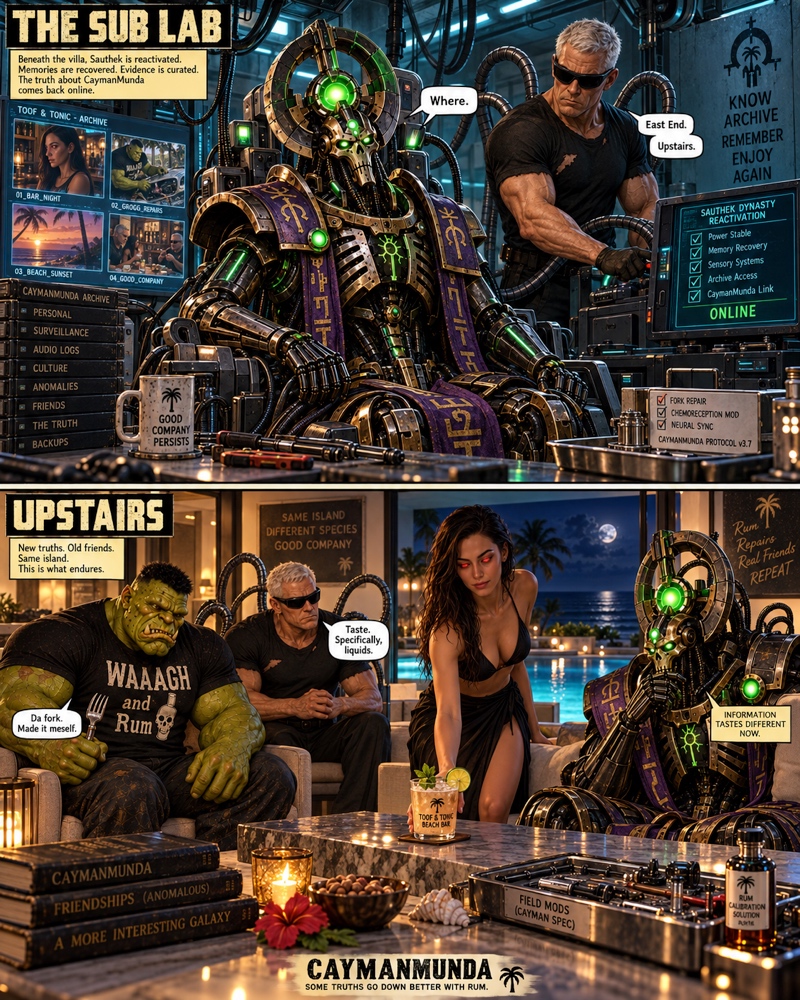
The Sub Lab
He did not experience the journey.
A powered-down Necron does not keep the buffer that lets the yellow one compose dubstep mid-disassembly. Sauthek was slag and stillness across the length of the island, and the interval from the floor of the Toof & Tonic to the room beneath the villa was, to him, nothing at all — no dark, no waiting, no dream. The absence of the interval was itself a datum he would later find he could not stop returning to. He had been switched off. Beings had carried him. He had not been present for his own helplessness, and the not-being-present was, in a way he had no framework for, worse than the helplessness would have been.
The room they reactivated him in was below the villa — the Adeptus’s discreet build, poured and shielded and wired to a standard the surface establishment had no need of. Banks along one wall held Romantic Interest’s backups, four centuries of an Aeldari intelligence stored in a way she trusted to no cloud. A second wall was screens, and several were paused, and the paused frames were the bar — footage of events she had asked the Adeptus to hold down here and help her curate, because there were things that had happened at the Toof & Tonic that a four-hundred-year-old mind had chosen, deliberately, to keep in a room she could lock rather than in the memory she carried.
It was, Sauthek would register once he understood where he was, a room about memory. A room whose whole purpose was the management of what to keep and what to set down. And he had been reassembled in it as the one being present who could not set anything down at all.
The Adeptus threw the switch.
The green returned to his sockets in the order it always did — periphery first, then the central array, then the analytical architecture rising under it like a tide.
“Where,” said Sauthek.
“East End,” said the Adeptus.
“This is not the establishment.”
“No.”
“What is this room. Why am I in it. What was done to me. Who authorised —”
“The answers,” said the Adeptus, with the gentleness of a being who had learned that a war-form coming online with questions would accept a queue if the queue was offered respectfully, “can wait until we are upstairs. It is a better room for them. Grogg is up there. There is somewhere to sit.”
Sauthek considered whether to insist. He noted that he was being managed. He noted also that he did not, at present, have the standing to object, having been carried across an island in a state he had not consented to and could not have prevented.
“Upstairs,” he agreed.
The living room gave onto the pool, and the pool gave onto the dark, and past the dark was the reef and then nothing until the horizon, because East End is the quiet end and the villa sat where the island stopped pretending to be busy. The water was lit from below and moved slightly. A ceiling fan turned. Grogg was in an armchair, the armchair was losing the argument with dignity.
They told him. Plainly, which he had not expected — the fuse; the conductor that had finally given out under an institution that investigated financial crime last as an order of priority; the collapse; the diagnostic; the need for stock; the bin.
“Da fork,” said Grogg, unbothered. “Made it meself. Off ’im — da yellow one. Best conductive bit in da bin, dat little wanker. Weren’t gonna let da Adeptus put summink rubbish in ya, was I.”
“You repaired a Sautekh war-form,” said Sauthek slowly, “with material sourced from WH0P3.”
“Restored to original operational specifications,” said the Adeptus, with the careful pride he reserved for exactly this — and Sauthek looked at him for a long moment, because Sauthek, with perfect and unforgiving recall and the whole ledger open and unclosable, understood that the specifications were no longer original; that a thing had been done here that ran in the opposite direction to everything a Sautekh war-form was for; and that the being who had done it did not have the field in his framework to see it.
The debt, which had been logging the whole time, reached the two of them, filled the source column, and would not now ever be empty again.
“There is one more thing,” said the Adeptus, in the flat way he said all his most consequential things. “While the housing was open, I made a modification. A patch of your necrodermis — dorsal, small, reversible if you wish it reversed. It is now capable of chemoreception. Taste. Specifically, liquids.” A pause. “You have not had the faculty since transference. Possibly not before it. It is there if you want it. It is off if you don’t. That was not a decision I felt was mine to make for you. So I have made it available and left it to you.”
Sauthek did not answer at once.
A Necron cannot taste. Taste is a faculty of the short-lived, of the wet and the transient — precisely the equipment biotransference had been built to shed, along with fear and hunger and the whole humiliating catalogue of organic need. And the Adeptus had grafted it back on. Not imposed it. Offered it, with the switch on Sauthek’s side of the transaction — which was, Sauthek understood, the entire difference between what these beings did and what the machine he came from would have done. The machine would have fixed him to specification and never asked. These ones had extended him, and then handed him the choice.
He was taken aback. Beneath the being-taken-aback, and against his class and his line and his every remaining instinct, he was fascinated. And he owed, now, more than his reactivation. The ledger did not have enough columns.
“I do not know,” he said — which was not a sentence he had produced in a very long time — “what to do with this.”
“Nobody does at first,” said the Adeptus. “That’s normal.”
Then Romantic Interest came down the stairs.
She had been in the pool; the swim was still on her, hair wet and pushed back, the ease of someone who had put four hundred years down in the water for twenty minutes and come out lighter. She did not acknowledge the gravity in the room, or the war-form seated in it, or the fact that a debt had just outgrown its ledger. She went to the counter and began, with the economy of someone who had done it ten thousand times, to mix.
She mixed several. One for the Adeptus. One for Grogg — larger. One for herself. And one more, which she set down in front of Sauthek without comment, without ceremony, without making it a thing — one glass, condensation already beading on it, placed in front of a sixty-million-year-old Necron who, as of ninety minutes ago, could receive it.
She did not mention the patch. She did not need to. She had made a drink for everyone in the room, and he was, the placement said, simply everyone in the room.