The glass sat there. The faculty was off. The switch was on his side.
He lifted the glass.
The gesture was, in isolation, unremarkable — a being at a bar raising a drink. Sauthek brought to it the full architecture that had assessed the movement of fleets across void, and found the problem of a hand, a glass, and eleven inches of distance, for reasons he could not isolate, non-trivial.
He engaged the patch.
There was a moment where nothing happened — the modification querying a faculty the rest of him had no memory of possessing, and receiving from sixty million years of silence no precedent to compare it to. Then the channel opened, and something arrived.
He had no schema for it. His analytical architecture, which categorised everything, which had never in its operational existence met a signal it could not at least file, received the information and returned no category. It was not thermal. It was not threat. It was not the recognition-hum of a weapon that had once been his. It was — the fragment of self that had survived transference reached up and took the signal and held it, the way you hold a thing you did not know you had lost until it was returned — it was taste. Cold. A sweetness cut with something sharp that was almost certainly rum, and something beneath it that Romantic Interest would never name. A texture. A finish.
The green in his sockets did the thing the Adeptus’s array read as the architecture integrating a fact that violated a held axiom. But it was not the harsh climb of the priority-ordering. It was slower. It was the light doing something the Adeptus had not logged before and would spend the drive home trying to name, and would settle, in his report, on the word softening.
Sauthek set the glass down with great care.
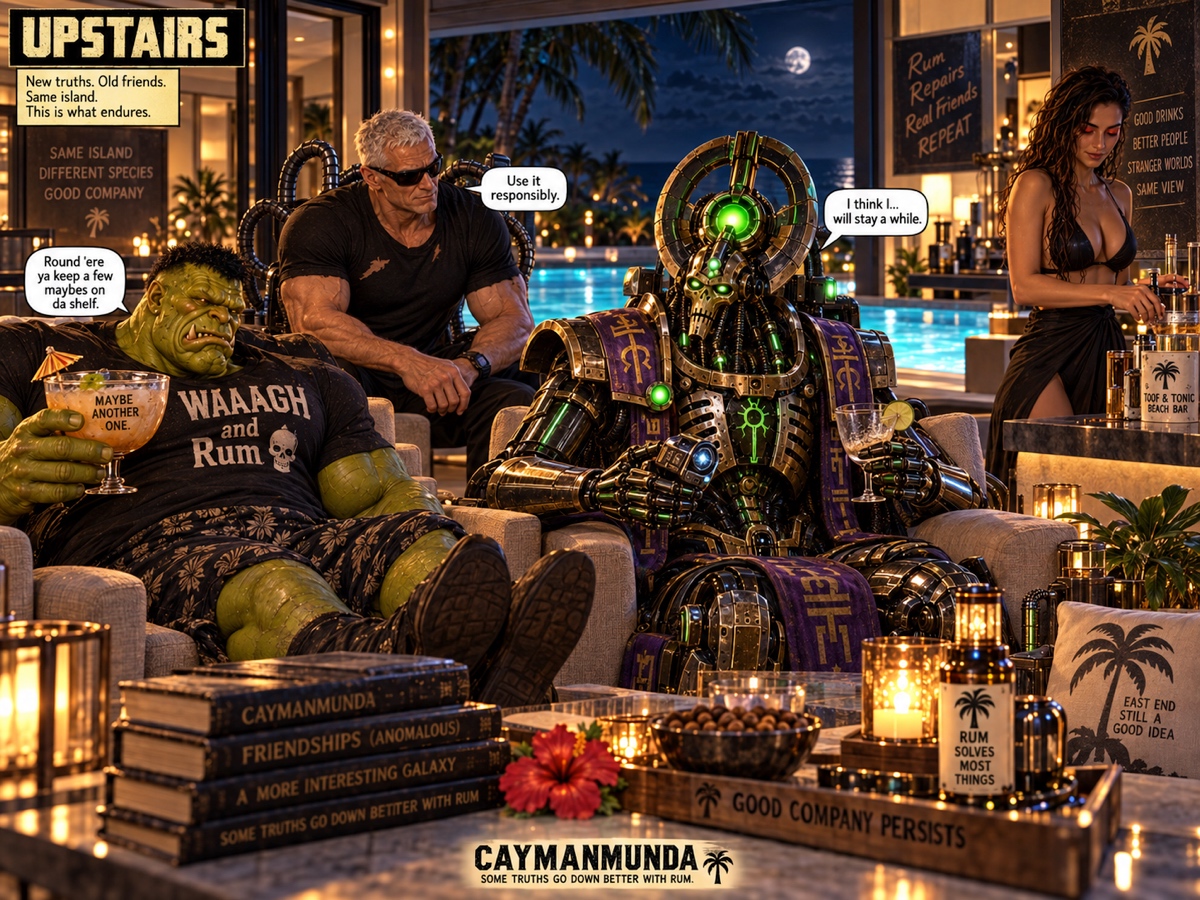
“I think I,” he said, and stopped, because the sentence he was about to finish was one no member of his dynasty had produced in recorded memory, “will stay a while.”
Nobody said anything. Romantic Interest, at the counter, did not look up from her own glass, which was the most generous thing she could have done.
“The stasis pod can wait,” he continued. “Another millennium or two. Or fourteen.” A pause of the length that, in this being, followed the recalculation of something he had assumed settled. “And frankly — being dragged back here, time and again, by the breaks in logic alone — indicates, increasingly, that I am missing something of note. The quiet moments. If there are ever any.” He looked at the pool, still moving faintly under its own light, and past it to the dark where the reef was. “There appear, occasionally, to be some.”
Then the architecture returned to the practical, because it was still, under everything, a Necron architecture, and a Necron architecture does not sit long with a sentiment before it locates the logistical objection.
“But what to do,” he said, “about my appearance.”
He was four feet of ancient Sautekh war-form in a territory whose surface pretended, however thinly, to ordinariness — and there were limits, even here, even in a place administered in significant part by chickens, to what could walk into the Toof & Tonic on a Friday and order a Chicken Banana without a laminated notice being filed about it.
“Oh,” said the Adeptus. “Someone thought of that.”
Sauthek looked at him.
“You will meet her. In time.” The Adeptus did not elaborate on the pronoun, and the not-elaborating had the weight of a door left deliberately ajar. “For now —”
He produced it from a pocket that should not have held it. Small. Portable. A glamour projector — its own power source if required, fully programmable, the sort of object that in any other setting would have been the centrepiece of a heist and was here handed across a living room like a spare key.
“It runs independently. It is programmable to whatever you require. Use it responsibly.” A beat. “That last part is not a formality. Grogg used the demonstration unit to appear as a health inspector. There were consequences. The bar has since been given the all-clear, which is arguably the worse outcome.”
He held it out. Sauthek took it, and did not, for a moment, engage it. He held it, and looked at the Adeptus, and the ledger filled another line, and the question that came out of him was not gratitude — his class had no grammar for gratitude — but the thing that stood in its place.
“Why,” said Sauthek. “Did you know I would stay?”
It was Grogg who answered, folded into an armchair never meant for him, holding a drink larger than everyone else’s, entirely unbothered by the gravity the war-form kept bringing into rooms.
“Nah,” said Grogg. “We didn’t. Didn’t expect ya to, neither.” He took a pull of the drink. “But sometimes ya do things on a chance, don’t ya. Do da implausible. Someone thought — well, if ’e stays, ’e’ll want to not frighten da tourists, so best ’ave da little glamour box ready. Just in case.” He shrugged, an event that involved a great deal of Ork. “Weren’t a plan. Were a maybe. Round ’ere ya keep a few maybes on da shelf, ’cause —”
He gestured, with the drink, at the whole of it: the room, the pool, the reef, the island, the war-form now seated in a living room in East End with a taste in his mouth he had been missing for sixty million years, a glamour projector in his hand, and a debt he could not close.
“— strangeness and charms are part of every day, aincha noticed. Round ’ere they come as a pair. Always ’ave. Never pull ’em apart.”
Sauthek looked at the projector. He looked at the glass, which was nearly empty.
He engaged the patch again, and finished it.
⸻⸻⸻