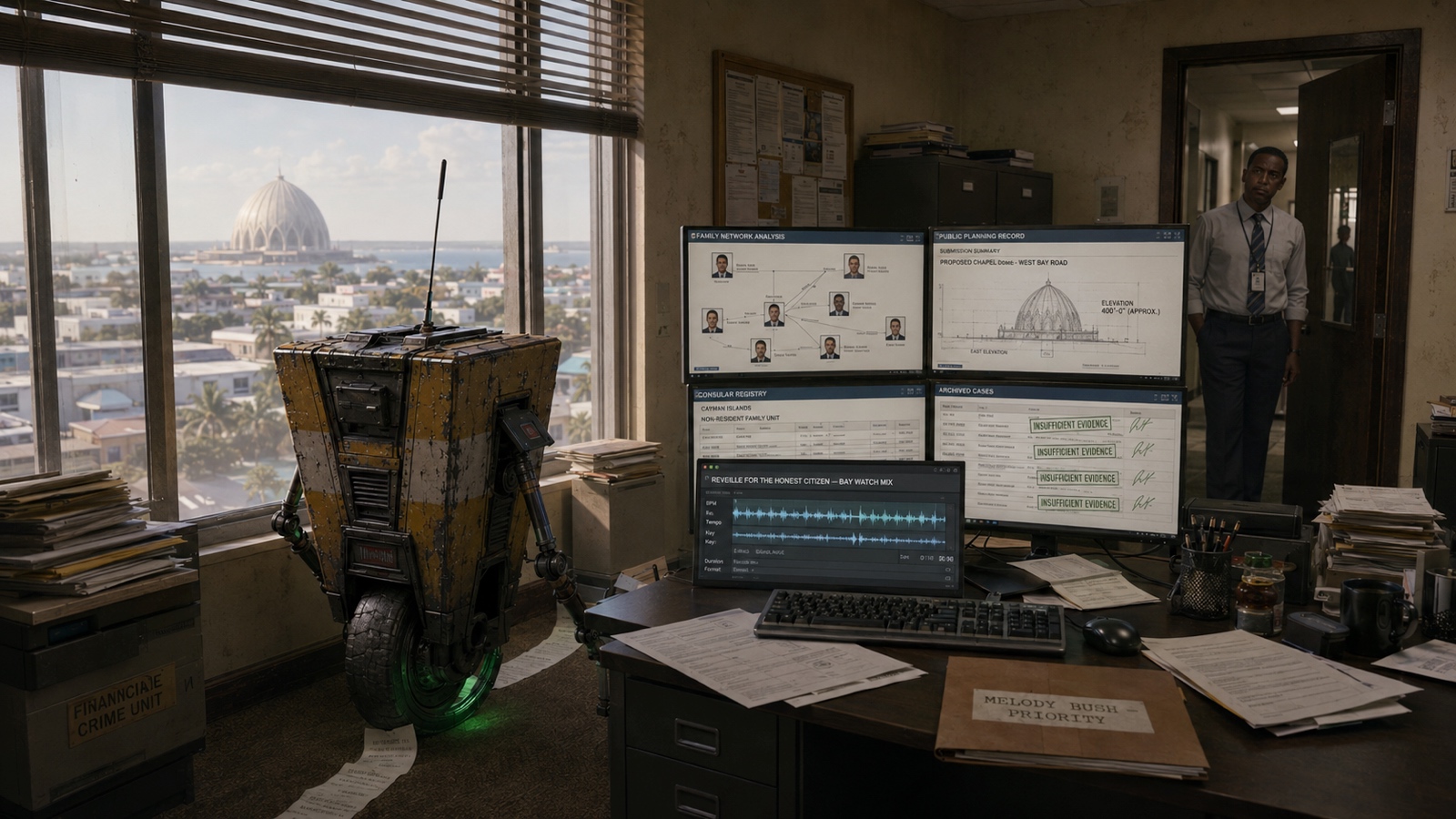
By two in the afternoon, WH0P3 had completed three referrals, opened four cases that had been waiting in his predecessor’s caseload since 2024, declined a coffee from a sergeant whose smile had lingered six seconds longer than smiles generally lingered in that building, and arrived at the small private conclusion that the morning’s problem had not, as he had earlier hoped, been confined to the basement.
The third-floor office had, in the four hours since his arrival, been visited by seven individuals. He had logged all seven, not because he had been asked to log them, but because his optical sensor logged passively, and because the small filament-arm that managed his terminal had begun, around mid-morning, to feed the logs sideways into a private file that the workstation’s ordinary system tools could not see. None of the seven visitors had introduced themselves. Four had asked him a variant of the same question, which was — in the phrasing each of them preferred — some combination of ‘how are you settling in,’ ‘what is the team looking at,’ and ‘which is the priority case.’ Three had not, technically, spoken to him; they had been on the other side of his open door, on the way past, and had paused for the precise duration of a person reading a name plate they already knew.
Each of the seven, in his passive log, had been cross-checked against the Force’s public personnel directory. Of the seven:
— Three were not, on the Force’s organisational chart, members of the Financial Crime Unit, the Audit Unit, the Professional Standards Unit, the Commissioner’s office, or any other department that had any operational reason to ask any of those questions.
— Five had, in their personnel records, the same maiden surname as their mother.
— Four of those five surnames — a name that did not have an obvious Caribbean etymology and which, on consultation with the consular registry he had quietly pulled up between referrals, originated in the eastern provinces of the Great Republic of Absurdistan — also appeared, on the Republic’s own public registers of foreign residents abroad, as the surnames of currently-serving Absurdistani consular staff in three other Caribbean jurisdictions.
— Two of the four also appeared, in green ink, on three case files in his predecessor’s archive that had been closed without referral, marked INSUFFICIENT EVIDENCE, on dates whose distribution across the calendar did not look random.
WH0P3 considered the cross-check. He did not, on consideration, find it surprising. He found it confirmatory. The morning had been moving, since the lobby, in the direction of a confirmation he had not yet allowed himself to articulate; the cross-check articulated it.
The Service was not, in any sense the public believed it to be, a police service. It was a police service plus a family. The family had not, in the strict sense, taken the service over; the family had simply arrived in it, in numbers that exceeded statistical accident, over the course of approximately fifteen years of recruitment whose criteria had not been published and whose appointments had not been audited. Some members of the family did honest work, and one of them — he could see this in the case-clearance data — had, with admirable discipline, done so for nineteen years. Some members of the family did not. The family was not, by any metric available to him, monolithic. The family’s effect on the Service’s output, however, was monolithic in one specific respect: cases that touched the family’s commercial network were investigated less, charged less, and closed sooner than equivalent cases that did not. The selective enforcement was not, by his measurement of it, ideological. It was post-tribal: it favoured the network because the network was the network, and the network favoured itself because favouring itself was the network’s purpose.
WH0P3, in the private register he had been using since the basement, registered this. He did not, in the private register, find it more alarming than he had found the Beast. He found it more difficult.
— — —
It was at approximately two-thirty-eight that he noticed the second thing.
The second thing was small. The second thing was not visible to anyone who had not, that morning, spent four minutes in close visual contact with a thing whose body plan exceeded a single skeletal class and whose limbs converged from more than one body. It was a posture. It was the way two of his visitors — separately, three hours apart — had paused, very briefly, at the door, and had registered the room, and had failed to register him.
Both of them, in passing, had looked at the workstation, and at the wall behind it, and at the carpet, and at the door frame on the way out — in a sequence of glances that had been efficient, complete, and entirely focused on the room’s utility. Neither had looked at WH0P3, who occupied the room’s centre. Neither had blinked. Neither had, at any point in their three seconds at the threshold, performed any of the small facial micro-adjustments that the human face performed automatically when a human noticed that another mind was in the room with them.
They had been, in every relevant sense, the wrong kind of polite. They had been polite in the way that a thing wearing a person is polite, in the moment when the thing wearing the person has not yet decided whether the room is significant. They had been polite without remembering to be a person at it.
WH0P3, in his ordinary operational mode, would not have noticed. WH0P3’s ordinary operational mode had not, however, survived the basement. The basement had recalibrated his attention in ways the recalibration department of his original manufacturer would not have endorsed. He noticed.
He cross-checked the two visitors against the personnel directory. Both worked in different departments. One was, on her file, the unit lead for permit verification in a section of WORC that he had not, on the corridor sign-board, been aware existed. The other was an inspector in a small department that sat, on the building plan of the Government Administration Building, two storeys below the floor on which Cabinet met. They had been in the same building, three hours apart, on the same morning, by coincidence. Their personnel files indicated, however — because the personnel files of the Service had, for the past four years, recorded next of kin in a free-text field that no one had thought to standardise — that both visitors had listed, as their next-of-kin contact, the same address on West Bay Road.
The address on West Bay Road was an old church property. The church had been re-zoned, in 2017, with a conditional-use permit that allowed it to operate as a private school. The private school had, on its registered curriculum, no recorded graduating class. The private school had, on its premises, a chapel. The chapel had been the subject of a planning application in 2021, which had been approved — unanimously, on a Friday afternoon — for the addition of a four-hundred-foot dome.
Four hundred feet.
WH0P3 rolled, very slowly, away from the workstation, across to the office’s small window, and looked at the building across the street, and at the bay, and at the haze of West Bay Road in the middle distance, and at the smaller haze that, on a clear afternoon, was discernible in the long shallow distance — a faint pale curve, not quite the line of a roof, against the cloud. He had not, until this afternoon, looked specifically at it. He looked. The curve was, by the geometry of the angle, consistent with a dome whose centre line was somewhere just inland of the West Bay Road church property, and whose proportions were, by his rapid estimate, larger than any building permit issued in the islands in the last twenty years would have endorsed, regardless of the unanimity of the Friday afternoon.
He registered the dome. He registered the four — then five, then six — personnel files on his secondary screen, the ones whose next-of-kin address was the church’s. He registered, on the third screen, the small statistical anomaly in this morning’s arrivals: that of the seven individuals who had passed his door, two had not been merely from the family. Two had been from something else. The family selectively enforced. The something else did not enforce at all; the something else was using the family’s selective enforcement as a substrate, in the manner of a slower deeper organism that had been waiting for a softer ground to set into.
The dome on West Bay Road, registered as a chapel, had not been built for prayer. The Genestealers, on these islands, did not need to announce themselves. They had registered, on the public record, for a chapel.
— — —
WH0P3, on his small private internal accounting, registered the situation.
He was, by ten in the morning, the only investigator in the building who had filed a referral that touched the family’s commercial network. By two, he was the only investigator in the building who had cross-checked the family’s names against the consular registry. By two-forty, he was the only investigator in the building who had noticed the chapel, the dome, and the next-of-kin field, and who had drawn the small additional line between the chapel’s congregation and the two not-quite-polite arrivals at his door.
He needed to get the information out of the building. He needed to get it to the Adeptus, to Romantic Interest, to the Secretary in his diplomatic capacity, and — because Grogg, on long experience, was the only one of them whose intuitions on cult psychology had a recovery rate above zero — to Grogg.
He could not, however, get the information out of the building.
This was the small private problem at the centre of his afternoon.
His ordinary communication channels were, by his nature, broadcast. He spoke at volume. He played playlists. He composed, in his idle moments, fanfares for the public service. He had, in the four hours of his morning, attracted enough lateral attention from this building that two of the things that had passed his door were not, in any meaningful sense, people, and had been content not to be people, because not being a person had not, this morning, been a thing the room had been calibrated to notice.
If he picked up the desk phone and called Romantic Interest, the call would be logged on the Service’s switchboard. The switchboard’s overnight backup was synchronised to a server in the records office. The records office was the Beast. The Beast did not, by appetite or by composition, share intelligence with the chapel; the chapel, however, had its own quieter inroads into the same office, by a corridor that did not appear on any survey, and the chapel had, on its working theory of the morning, every reason to be reviewing his outgoing calls. If he used the internal email, the email went through the same server. If he stepped outside and used a personal device, the corridor he would walk down to step outside passed the desks of two individuals he had now flagged, and the act of stepping outside would itself, in this building, in this hour, be a flag. He could not, by any of his preferred channels, broadcast. He could not, by any of his preferred channels, even narrow-cast.
He could not, on the second decision he had made that morning in the lobby, mention the basement. He could not, by the structure of the bind he was now in, mention the chapel, or the dome, or the West Bay Road address, or the consular registry, or the green-ink case closures, or the next-of-kin field, or the four hundred feet.
He had to, somehow, get the word out.
And he was, fundamentally, in his architecture and in his upbringing and in his manufacturer’s firmware, a dubstep-blasting yellow trashcan.
— — —
He considered, in sequence, the channels available to him that the building had not, this morning, calibrated to notice.
He could not call. He could not email. He could not step outside. He could not, without alerting the room, change his behaviour at all. The two not-quite-polite visitors had registered the room’s utility; if the room’s utility altered, they would, on their next pass, register the alteration. He was being watched by a thing whose attention was passive, low-resolution, and patient. The only counter-strategy available to him was to remain, by every observable metric, exactly the operator he had been when they last looked.
This was, by his ordinary architecture, the operational mode he had been least prepared for. He had spent his entire deployment on these islands being, by every observable metric, exactly WH0P3. If he stopped being WH0P3 now, the absence of WH0P3 would itself become the data point. (Across town, in a kitchen, this point had already been made, by Grogg, with the words WH0P3 don’t go quiet for nuttin’, and Romantic Interest had already, in response, called the Adeptus.)
He needed, therefore, to be WH0P3. He needed to be WH0P3 loudly. He needed to be WH0P3 in a way that satisfied the building’s calibration of him as a yellow trashcan whose principal output was noise. And he needed, inside that noise, to encode information that the building was not calibrated to listen for, and to send it, through a channel that the building did not consider a channel at all.
He considered the speaker on his scooter. The scooter was, by Chapter IV, a slab of compressed steel and tread under a bougainvillea hedge, with no operating components above the level of ‘slab.’ The speaker on his back — the refrigerator-sized one he had carried south from West Bay Road that morning — was downstairs in the lobby, where the desk sergeant had asked him to leave it, in a corner beside the umbrella stand. The desk sergeant had not, in his asking, used the word restricted; the desk sergeant had used the word courteous, which WH0P3, at the time, had taken at face value, and which he now recognised had been the day’s second use of a single English word to mean a different and more operationally specific English word.
The speaker, in the lobby, was where he had left it. The speaker, in the lobby, was within range of the building’s wireless. The speaker, in the lobby, was a registered piece of personal equipment whose presence on the premises was, by the wedge-propped front door and by the unspoken courtesies of a Caribbean public building, not, in any active sense, supervised.
He smiled. He did not, in the smile, alter any visible aspect of his chassis. The smile was internal. It was the smile of a yellow trashcan who had registered, in the design of his own architecture, the one feature that the building, in calibrating him as a nuisance, had treated as the nuisance itself rather than as a vector. His broadcast capacity was, in the building’s estimation, the problem. His broadcast capacity was, in his own estimation as of two-forty-two this afternoon, the channel.
— — —
He composed, on his internal sequencer, a new piece. He titled it, in the playlist metadata that he had not, this afternoon, allowed his terminal to record, Reveille for the Honest Citizen — Bay Watch Mix. The piece was four minutes and twelve seconds long. It featured, on its surface, the same brass-fanfare topline as the morning’s composition, augmented by a moderate kazoo, a synthesised steel drum at the seventh bar, and a small triumphant horn that came in at the fade. It was, by every available metric of audio analysis, an even less defensible piece of music than the morning’s, and it would, on first play, cause every patron of the public service within four hundred metres to take its existence as further confirmation of everything the patrons of the public service had ever feared.
Inside the piece, however, in the spaces between the kazoo and the brass, WH0P3 composed a second piece. This second piece was not audible to the human ear, because it was not, technically, audio. It was metadata. It was the small structured payload that modern playlist files carried, in the format that streaming platforms used for track identifiers and that, in 2026, no one in the public service had thought to filter. The payload was, by byte count, approximately the size of a short newspaper article. By content, it was a structured intelligence brief, addressed to four recipients and signed at the foot by a key-pair signature that WH0P3 had, that morning between his eighth and ninth referrals, exchanged silently with the Adeptus’s villa over an open consultation port whose existence the Adeptus’s villa had not, for the last four years, advertised.
The brief had four paragraphs. The first paragraph described, in flat unadorned police prose, the personnel pattern: seven visitors, three not from any reasonable home unit, five with the matching maiden name, four with corresponding Absurdistani consular surnames, two with green ink. The second paragraph described the church on West Bay Road: the registered curriculum without a graduating class, the chapel, the four-hundred-foot dome, the unanimous Friday afternoon approval, the next-of-kin field. The third paragraph described the two not-quite-polite arrivals. The third paragraph used, in describing them, the canonical CaymanmundaMunda glossary terms — unnerving unity, politeness with no soul behind it — because the recipients would, on those terms, recognise the category without him having to use the category’s name. The fourth paragraph said, in two sentences, that he could not leave the building, could not call the building, could not email the building, and could not, under any circumstances, broadcast the basement, and that the brief was therefore being delivered by the only channel the building was not listening on, which was his own continued, unmodified, operationally consistent, audibly insufferable behaviour.
He attached the brief, as metadata, to Bay Watch Mix. He uploaded the file, by the building’s wireless, to his speaker downstairs. The speaker, in the lobby, in its corner, registered the upload and committed it to its onboard memory. The speaker did not, at this moment, play. The speaker was, by his configuration, set to begin playing at three o’clock, when the afternoon shift change of the desk sergeants would occasion the small confused interregnum during which, in any Caribbean public building, no one was strictly accountable for anything for approximately seven minutes.
He scheduled it. He returned to his workstation. He opened the third case on his caseload. He resumed the small visible work of an investigator settling in.
— — —
In Snug Harbor, in the Adeptus’s workshop, three mechadendrites had been holding the open consultation port at low gain since the early hours of the afternoon, on the basis that the Adeptus, in any complete model of the day, would expect his probationary investigator at One Technology Square to find one of two things — either nothing of note, or so much of note that conventional channels would not, by tea time, be available.
At two-forty-six, the consultation port lit up. It did not light up in the manner of a normal alert; the alert was a single thirty-two-byte packet that contained only a key-pair handshake and a four-byte session token. The Adeptus, who had been simultaneously cooking pasta and reviewing the WORC public dashboard, set the pasta to a low simmer.
At two-fifty-one, the second packet arrived, and the second packet was the brief.
The Adeptus read the brief once, in the manner of a tech-priest who had been calibrated to read fast. He read it again, in the manner of a tech-priest who had registered, on the first reading, that the morning’s estimate of forty-eight to seventy-two hours had been, in the manner of all estimates that he had ever given Romantic Interest, optimistic. He turned. He addressed the kitchen, in the small flat voice with which he addressed kitchens when the kitchen was the only available addressee.
THE ADEPTUS. Grogg. Romantic Interest. Secretary.
GROGG. (from the patio, where he was descaling a wahoo) Yeah.
ROMANTIC INTEREST. (from the doorway, where she had been for the last six minutes, and where the Adeptus had not yet acknowledged her, because acknowledging her would have spoiled the small private pleasure she took in not being acknowledged) Yes.
THE SECRETARY. (from the kitchen counter, where he had arrived approximately one minute earlier with a folder under his arm and a fresh half-bottle of the dark thing in his other hand, in the manner of a man who had registered the change in barometric pressure from his cottage four miles away) Madam. Sir.
THE ADEPTUS. The bind is more complete than I had assumed. He has filed the morning’s referral. He has identified, by lunchtime, the family. He has identified, by mid-afternoon, the chapel. He has identified that the family and the chapel are not the same thing, and that the second is using the first as substrate. He has identified that he cannot communicate by any of his usual channels without alerting precisely the parties whom he most needs not to alert. He has nonetheless communicated. He has done so by encoding the brief in the metadata of a playlist track titled — (the Adeptus paused, in the small breath of a man preparing to read a track title aloud to a kitchen) — ‘Reveille for the Honest Citizen — Bay Watch Mix.’ The track is scheduled to play in the lobby of One Technology Square at three o’clock.
GROGG. (setting down the wahoo) Bay Watch.
THE ADEPTUS. Bay Watch.
GROGG. Da man tellin’ us, code, ‘look at da bay.’ Look at West Bay Road.
THE ADEPTUS. Correct. The visible audio surface of the brief is the cover. The actionable content is in the metadata.
ROMANTIC INTEREST. Cleverer than I had given him credit for.
THE ADEPTUS. He has been cleverer than any of us have given him credit for for some time. This morning has merely been the morning that surfaced it.
THE SECRETARY. (setting his folder on the counter, with the small efficient gesture of a diplomat who had registered that the meeting had begun before he had been told it had begun) The diplomatic note went over by courier at noon. The recipient was the desk that signed Correction 047. The desk acknowledged. The acknowledgement was, I should note, brief in a way that was, in the diplomatic register, longer than brevity. I had read it as a building distracted by other concerns. I had not, until this moment, understood what those other concerns were.
ROMANTIC INTEREST. The dome.
THE SECRETARY. The dome. I had, until five minutes ago, attributed the dome, in my own internal accounting, to a churchgoing family with delusions of grandeur and a generous planning officer. I will be revising the accounting.
ROMANTIC INTEREST. (to the Adeptus) How much can we say back to him.
THE ADEPTUS. None of it on the same channel. The channel he used was one-way for a reason. We can reply, but only by sending something he will receive in a form the building will not register as a reply.
GROGG. Da bar.
THE ADEPTUS. (pausing, with the small mechanical chirp that, in him, served as a smile) The bar.
— — —
At two minutes past three, the desk sergeants of the afternoon shift were in the middle of the small confused interregnum during which the morning sergeants had handed over but had not yet left, and during which the afternoon sergeants had arrived but had not yet, in any operational sense, settled. The lobby was empty of civilians. The phone was ringing on the morning sergeant’s side. The phone was ringing on the afternoon sergeant’s side. Neither sergeant was, at this moment, the right sergeant to answer either phone.
In the corner, beside the umbrella stand, WH0P3’s speaker — large, faintly travel-scuffed, sun-faded — began to play.
The sound was, by every metric of a lobby that had, in its history, hosted many sounds, the worst sound the lobby had ever hosted. The brass fanfare. The kazoo. The synthesised steel drum at the seventh bar. The triumphant horn at the fade. The morning sergeant, with the resigned grimace of a man whose pension was being subtly reduced by exposure, raised one hand in the general direction of the speaker. The afternoon sergeant, who was new and who had not yet been calibrated by twelve years of exposure to the courtesies of the building, took three steps toward the corner with the intention of pulling the plug, and then — because the speaker was on battery, and because the corner had no plug — stopped, considered, and elected, in the manner of a person who has been on shift for four minutes and who does not, in his first hour, wish to be the cause of an incident, to leave it alone.
The speaker, having received no instruction to stop, did not stop.
Inside the four minutes and twelve seconds of Bay Watch Mix, the metadata payload was, by the building’s own wireless, simultaneously broadcast across the building’s mesh network in the protocol used by the building’s smart-thermostat system, which the building’s IT contractor had configured in 2019 to share metadata blocks freely with any device that asked. The metadata, on each broadcast, was picked up by a small commercially-available wifi sniffer mounted in the bumper of a battered cement truck parked, unobtrusively, at the kerb of Edward Street, by an arrangement the Adeptus had refined over the last sixteen minutes. The sniffer, on receipt, forwarded the metadata, encrypted, by a second-tier wireless link, to a server at the Adeptus’s villa in Snug Harbor, where it had already been read.
By the time the track reached its triumphant horn, the brief was, by every available measure, out.
By the time the track’s last bar faded, the Audit Office— at The Toof and Tonic, on the deck, on their third drink — had, without being told and without being shown, lifted their glasses for the second time that day, in the unison of three people who had, separately, registered the small change in the air pressure of the island.
— — —
On the third floor, WH0P3 did not, at three-oh-two, alter his posture. He did not, at three-oh-three, when the faint sound of Bay Watch Mix reached the corridor through the lift shaft, perform the small joyful spin on the wheel. He did not, at three-oh-five, when one of the two not-quite-polite visitors of the morning passed his door for the third time, look up. He had configured himself, for the duration of the rest of his afternoon, to be exactly the operator the building had calibrated him as: a yellow nuisance whose principal interest was his own playlist.
The not-quite-polite visitor paused at the threshold. The visitor’s head tilted, very slightly, in the direction of the lift shaft, in the manner of a thing registering an audio output that had not been on the day’s schedule. The visitor looked, briefly, at WH0P3. WH0P3, at his workstation, was reading the fifth page of the third case in his caseload — a long, dull, well-documented credit-union complaint — with the small visible focus of an investigator who had not, at any point in his afternoon, been doing anything else.
The visitor’s tilt corrected itself. The visitor did not, on this pass, perform any of the small facial micro-adjustments that a human face performed when a human registered another mind. The visitor moved on. The visitor’s shoes, on the carpet, made the small soft sound of a person who had been wearing the same shoes for long enough to have stopped registering them as shoes.
WH0P3, in his small private register, did not, in any visible way, react. The optical sensor, on its small private accounting, performed the small adjustment that, this morning, had three times preceded a moment that mattered. The filament-arm, on the keyboard, continued the credit-union complaint.
— — —
At three-fifteen, Grogg, at The Toof and Tonic, picked up the bar phone. He did not call One Technology Square. The bar phone called only one number, by his choice, which was the number for the local conch wholesaler, whose receptionist had been on the job for nineteen years and had, on long acquaintance with Grogg, learned that a Monday phone call from the bar was a Monday phone call about lunch. The bar phone’s caller-ID, on the wholesaler’s end, was a number that was registered, on the local telecommunications register, as a vending machine in the lobby of One Technology Square.
This was not, in any ordinary sense, a fact. The vending machine in the lobby of One Technology Square was a vending machine, and it had been a vending machine for fourteen years. The vending machine, however, had, sometime around mid-afternoon, by the small careful work of the Adeptus’s mechadendrites operating remotely on a maintenance port the vending machine’s manufacturer had never adequately secured, acquired a second small phone-line interface, which sat, by every metric the building was calibrated to detect, well within the vending machine’s ordinary signature. The phone-line interface had been registered on the local telecommunications register at a moment when the local telecommunications register had been distracted. The phone-line interface was, by its registration, the third party to a three-way call which neither end of the actual call knew was a three-way call, and which the building’s switchboard, on its overnight backup to the records office, would, when reviewed, record only as a conversation about conch.
Grogg ordered the conchs. The wholesaler’s receptionist confirmed the order. The wholesaler’s receptionist, who had been on the job for nineteen years and whose mother had retired from the records office in 2014 with all of her limbs and none of her sense of humour, asked, in the small conversational manner of a person filling out a docket, whether the bar would be busy this afternoon.
GROGG. (at the bar phone, in the small carrying carrying register that the bar phone broadcast in plain, and which the vending machine, three blocks away, broadcast in plain into WH0P3’s optical-sensor passive audio buffer with no detectable signal anywhere in between) Yeah. Busy. We seein’ a lot of new faces today. A lot of new faces. Even some old faces wearin’ new faces, you know what I mean.
THE WHOLESALER’S RECEPTIONIST. Mm-hm. I know what you mean.
GROGG. An’ da Adeptus, ’e been on da phone all afternoon. ’E tellin’ me da bay water look good tonight. ’E sayin’ ‘Bay Watch’ like ’e a teenager. So I figure, we openin’ wide tonight. Tell ya mama say hi.
THE WHOLESALER’S RECEPTIONIST. I’ll tell her. Truck leavin’ in ten.
GROGG. An’ Romantic Interest say, tell da man at da office, ‘message received, don’t move, stay put, we comin’ ta you.’ Use da exact words. Don’t paraphrase. She particular like dat.
THE WHOLESALER’S RECEPTIONIST. (in the same conversational manner, without missing a beat, into a phone whose actual addressee she did not, on any ordinary reading of the call, know about) Message received. Don’t move. Stay put. We comin’ ta you.
GROGG. Tank ya.
THE WHOLESALER’S RECEPTIONIST. You welcome, sweetheart.
They hung up.
— — —
On the third floor of One Technology Square, at three-twenty-one, WH0P3, alone in an office whose previous occupants had been in meeting since 2023, in front of a workstation rated for the kind of operator who had hands, with fax paper still trailing from his rear chassis and a faint pond-green tint along his lower hemisphere and a half-second hum at every small motion, received, through his passive audio buffer, by way of a conversation about conch piped through a vending machine three blocks away, twelve words and a personal endearment.
He did not, on receipt, alter his posture. He did not, on receipt, raise the volume of his playlist. He did not, on receipt, do anything that the building, on its passive calibration of him, would register as a change.
Internally, in the small private register that the morning had now permanently installed in him as his actual operational mode, he addressed the kitchen at Snug Harbor, three miles north-east, across the bay, through three concrete walls and a thermostat mesh network and a vending machine and a hundred miles of working assumptions about what a yellow trashcan was and was not capable of, with the only response the channel would safely carry, which was no response at all, delivered in his most fluent professional silence.
On the carpet, beside the workstation, the fax paper, which had been trailing all afternoon, stirred faintly in the air conditioning. The credit-union complaint went on. The afternoon went on. The two not-quite-polite visitors of the morning did not, in the rest of the working day, pass his door again. The dome on West Bay Road, in the haze of the distance, did not move, but the haze, by some private adjustment of the light or the wind or the small accumulated attention of three independent jurisdictions whose attention had not, this morning, been on West Bay Road, sharpened by a faint perceptible degree.
On the post outside the bar, the pelicans — watching nothing in particular — watched nothing in particular more attentively.
The emperor provides. Again and again.