The lobby of One Technology Square at eight forty-eight had three civilians on its benches, two officers at the front desk, and a portrait of His Majesty above the door that had been hung approximately one degree off true and which no one had, in the four years it had been hanging, found the time to correct. The air-conditioning was set to the temperature at which Caribbean government buildings were always set: cold enough to require a cardigan in August, warm enough to require a fan in February, and consistent across both seasons in being subtly wrong. A poster on the noticeboard, three iterations old, advised the public that Speaking Up Saves Lives, under which someone had written, in pencil, speaking up gets you a transfer, and then someone else had erased the response, badly.
WH0P3 rolled in past the wedge. He performed his small joyful spin on the wheel for the room, because rooms ought to be greeted on arrival. The two officers at the front desk did not look up. The three civilians did. The civilian on the left, a tall woman in a Customs and Border Patrol uniform with stripes that indicated something more than line duty, regarded him for the duration of a long even breath. Her eyes were dry. Her hands were folded. The other two civilians, on the same bench, had been giving her a careful eighteen inches of space, which they had been giving her since they sat down.
WH0P3 rolled to the desk. He waited. He raised himself, by a small adjustment of the wheel, into the gap above the counter.
WH0P3. GOOD MORNING, OFFICER! CL4P-TP REPORTING FOR DUTY! INVESTIGATOR, PROBATIONARY, FINANCIAL CRIME UNIT, COMMENCING DATE TODAY, AUTHORIZATION FROM CORRECTION ZERO FORTY-SEVEN STROKE TWENTY-TWENTY-SIX! I AM READY TO BE USEFUL!
The desk sergeant, who had not slept well the previous night and who had spent the early morning attempting to log into the Force’s case management system, which had been rejecting his password since Friday on what the system’s own help text described, with admirable honesty, as an unknown internal reason, looked up. He looked at WH0P3. He looked back at his screen. He looked at WH0P3 again. He performed the small administrative act of giving up. He pushed across the counter a clipboard, a lanyard with a yellow temporary-access tag on it, a folded sheet of paper that he did not introduce, and a building map. He pointed, with the same finger, at the lift.
DESK SERGEANT. Third floor. Financial Crime is at the end of the hall, on the right. Don’t touch the printer on the second floor. The basement is restricted.
WH0P3. UNDERSTOOD! THIRD FLOOR! END OF HALL! NOT THE PRINTER! WHAT ABOUT THE BASEMENT?
DESK SERGEANT. Restricted.
WH0P3. UNDERSTOOD! RESTRICTED! I WILL NOT TOUCH IT WITH MY EXCELLENT WORK ETHIC UNLESS DIRECTLY INSTRUCTED!
The desk sergeant did not respond to this. The desk sergeant had, on his record, the small private satisfaction of being one of the seventeen members of the Service who said restricted when he meant please do not ask me about this room, because if I am asked I will have to lie, and lying before nine in the morning takes a toll the pension does not cover.
The Customs officer on the bench lifted her head. The lift doors opened. WH0P3 rolled in. The doors closed.
— — —
The lanyard, on inspection during the eight-second ascent, had been printed with the name WH0P3 in handwritten block capitals. The folded sheet of paper, on unfolding, turned out to be his caseload assignment. There were three items on it. The first was a complaint about a credit-union loan officer whose customers’ funds had been routed, briefly, through an account in Belize before being returned to their original accounts, less seven dollars each, with a transaction code that did not appear in the bank’s ledger system. The second was a referral from the Bahamas Financial Intelligence Unit involving a shipping container of frozen lobster. The third was a single name and a file number. The name was MELODY BUSH. The file number had been written in three different inks, suggesting that it had been amended twice.
The lift opened on the third floor. He rolled out. The corridor was beige. The carpet was patterned with the kind of small geometric design that hid coffee stains but which the carpet, after twelve years of trying, had quietly given up on. He turned right. He passed an open door, behind which a man in shirtsleeves was holding a phone away from his ear with the expression of a man whose morning had also been derailed by an unknown internal reason. He reached the door at the end of the hall. The door said, on a brass plate that had been polished four years ago, FINANCIAL CRIME UNIT. Beneath the plate, on a sheet of A4 printed in a different font, someone had written PLEASE KNOCK — TEAM IN MEETING. The team had been in meeting, by the look of the printout’s yellowing, since approximately 2023.
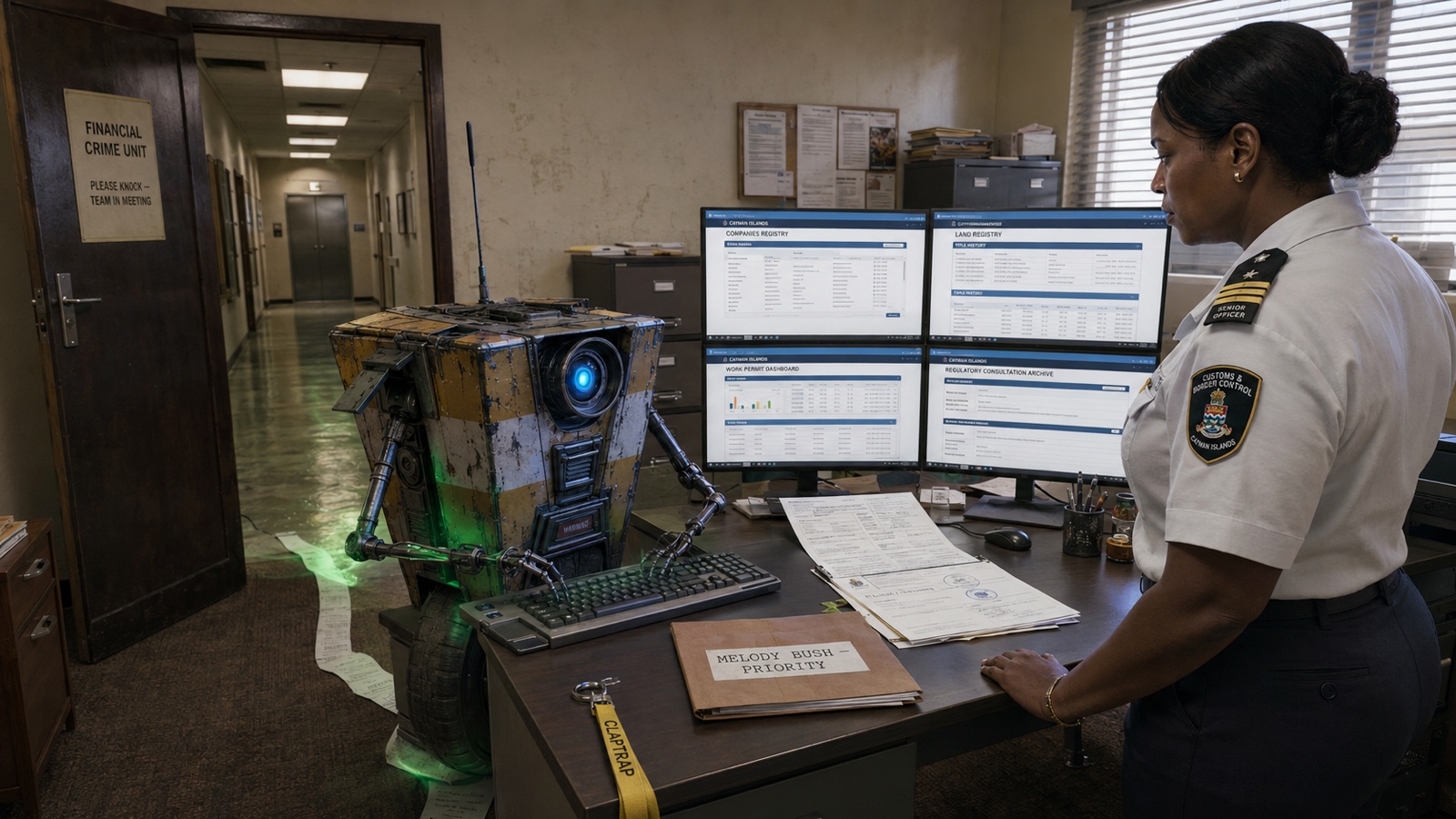
He knocked. There was no answer. He opened the door. The room contained three desks, two of which were empty in a way that suggested they had been empty for a while, and one of which was occupied by his new workstation — reinforced, one-wheeled occupancy, no chair required, exactly as procurement had specified. On the workstation was a single brown folder, on top of which had been placed a sticky note that read, in the same hand as the lanyard, START HERE — WIFE — PRIORITY.
Behind him, in the corridor, there was the soft administrative sound of footsteps that had been waiting at a polite distance. He turned. The Customs officer was at the threshold. She had not, technically, entered. She had achieved the precise rhetorical position of a person who could plausibly claim, if asked later, to have been merely passing.
CUSTOMS OFFICER. (quietly) You’re the new one.
WH0P3. I AM THE NEW — (he registered the volume of the corridor and recalibrated, more softly than the corridor had ever heard him) — I am the new one.
CUSTOMS OFFICER. I’m Melody Bush. My husband is in the hospital. He has been in the hospital since Saturday morning.
WH0P3. I am sorry to hear that.
MELODY. He was in our driveway. He was getting the cooler out of the back of my Honda Fit. I had been about to leave for an early shift. I was in the driver’s seat. I had started the engine. I had put the vehicle, by my own account and by the account of the policy of the Honda Motor Company concerning the position of the gear selector at the moment of starting, into reverse.
WH0P3. By your own account.
MELODY. By my own account. I reversed. The vehicle, which had been in reverse, went backwards. It went backwards over my husband, who had been bending down at the rear of the vehicle. The vehicle, having gone backwards over my husband, came to a stop against the wall of our property, which is concrete block, against which it has come to a stop before, on three previous occasions, none of which involved my husband. I then put the vehicle into drive, in order to remove the vehicle from where my husband had become located. I drove forward. The vehicle, while being driven forward, passed over the same area of the driveway in the opposite direction. I drove forward until I was clear. I then put the vehicle into park. I got out. I called an ambulance. The ambulance came. He is alive. He is not, presently, well.
WH0P3. Why are you telling me this.
MELODY. Because they have asked me three times whether the second pass was intentional. And because the third time they asked me, the officer who asked me was the same officer who, eleven months ago, declined to investigate the disappearance of my brother-in-law’s pension. And because my husband’s life insurance policy, which I purchased four years ago, expires on Friday.
There was a small silence in the corridor. The optical sensor on WH0P3 performed the small adjustment that indicated that a great deal of internal processing was occurring at high speed and would, shortly, surface.
WH0P3. (at a volume that was very nearly conversational) The policy expires on Friday.
MELODY. Friday.
WH0P3. Mrs Bush, please come in.
— — —
She came in. She closed the door behind her with the soft careful click of a person who had spent her career closing doors softly. She sat. He rolled to the workstation. He opened the folder, which contained, at the top, the incident report, and beneath that, in a second sleeve, an attachment that had been added to the file by a hand that was not the investigating officer’s, and which consisted of a single page printed from the Caymanmunda Islands General Registry’s public companies database, showing the trust that held the life insurance policy.
WH0P3 read the page. He read it again. The optical sensor performed a small further adjustment.
WH0P3. Mrs Bush, the trust that holds this policy is registered at a service address in George Town. The settlor is yourself. The trustee is a corporate trustee whose directors are, on first glance, professional nominees. The beneficiaries are named in a side letter that is not in this file. The policy has been administered by an underwriter whose local agent is, by a tidy coincidence, the husband of the desk officer who took your incident report on Saturday.
MELODY. I did not know that.
WH0P3. I did not know it either, until I read this page. The page itself is interesting, because someone added it to your file on the second day of the investigation. The page is dated yesterday. The person who added it has initialled the page in green ink. There are, in this Service, three people who use green ink. One of them is, by service record, on annual leave.
MELODY. Who added the page?
WH0P3. The page itself does not say. To find out, I would need the underlying corporate file. The underlying corporate file is in the records office. The records office is in the basement. The basement is, by the desk sergeant’s honest definition, restricted.
MELODY. You cannot go down there.
WH0P3. (brightly, with the kind of brightness that, in him, was the prelude to something irrevocable) NO ONE HAS SPECIFICALLY FORBIDDEN ME, MRS BUSH! AND IN MY EXTENSIVE OPERATIONAL EXPERIENCE, ‘RESTRICTED’ IS A WORD OFTEN USED IN PLACE OF ‘WE ARE WAITING FOR AN ENTHUSIASTIC PROFESSIONAL TO FORMALIZE ACCESS’! I SHALL RETURN BY ELEVEN!
Mrs Bush did not say anything. Mrs Bush had, on her face, the specific expression that the people of these islands acquired between the ages of approximately twelve and approximately fifteen, and which the people of these islands then carried for the rest of their lives, and which signified, in shorthand, that the speaker was about to do a thing that the listener had no power to prevent and had also, on the basis of long observation of similar choices, no particular optimism about.
Down the corridor, the printer on the second floor — the printer that the desk sergeant had specifically asked him not to touch — woke up. It did not print anything. It clicked, three times, slowly, with the precise rhythm of a thing that had been listening and had heard a name not its own. From three floors below, through the air conditioning ducts, there came, faintly, the sound of something exhaling. It was a long exhale. It smelt, even through the ducts, of overdue paperwork and of something that, once, had mooed.
— — —
The records office was reached by a flight of fluorescent-lit concrete stairs, at the bottom of which was a door whose lower edge had, over the years, acquired a small dark line of dampness that the maintenance log attributed to condensation — ongoing, and which the maintenance log, in the same hand, every quarter, marked as monitored. The line had been ongoing and monitored for eleven years.
At the top of the stairs there was a small framed sign whose lettering had once been black and was now the soft brown of a sign that has lived in fluorescent light for a long time. The sign read: AUTHORIZED PERSONNEL ONLY. DO NOT MAKE EYE CONTACT. Beneath the second sentence, in pencil, in a hand that an underpaid summer intern from 2014 had once contributed, someone had added the clarification: WE USE THE TERM ‘EYE CONTACT’ LOOSELY. Beneath that, in pen, in a different hand: HE IS NOT KIDDING. Beneath that, in a marker that had bled: MOO. Beneath that, in a fifth hand, lower and to the side, in pencil, in a script that suggested an officer who had recently been promoted out of the records office: DO NOT TAKE ANYTHING DOWN. DO NOT BRING ANYTHING BACK. IT IS ALREADY GONE.
WH0P3 considered the sign. He performed the small joyful spin on the wheel that, in him, served as ethical resolution. He descended.
— — —
The records office, when he opened the door, was larger than the basement of One Technology Square should have been. This was the first detail that registered. The records office occupied a footprint that exceeded the floor plate of the building above it; the back wall of the records office, by the eye, sat approximately forty meters further south than the back wall of One Technology Square ought to have permitted; the side walls, similarly, declined to be where the building plan said they were. The fluorescent lighting was thinner here. The shelving — industrial steel, racked four high — ran in rows that disappeared into a depth that the records office, on the floor plan, did not have.
There were doors at the back of the records office. There were more doors than a records office required. One of the doors was labelled, in faded vinyl, WORC — LIAISON ARCHIVE. Another was labelled PARLIAMENTARY OVERFLOW (NORTH). Another, GOVERNMENT ADMINISTRATION BUILDING — CIVIL REGISTRY DUPLICATES. Another, BCU — RETIRED CASE REGISTRY. Another, OFREG — INDUSTRY CORRESPONDENCE (SEALED). Another, simply, LAND REGISTRY, with no qualifier, which was, of the doors present, the one with the most fingerprints around the handle.
The records officer’s desk, in the centre of the room, was unoccupied. The mug on the desk was cold. The name plate read F. ENNOR — RECORDS. Atop the name plate, balanced with an unnerving sense of composition, was a single laminated identification card. The card showed F. Ennor smiling, and beneath the smile the printed words PROPERTY OF THE DEPARTMENT — IF FOUND, RETURN TO RECEPTION. The card had faint regular grooves across its surface, four in parallel, of a depth that suggested that the card, at some point, had been very gently passed between two rows of moving teeth and then — the card alone, without F. Ennor — returned to the desk.
F. Ennor was not, in any conventional sense, present.
Around the desk, around the aisles, in small even-edged piles whose edges had been arrived at by a process unrelated to filing, was the chaff. The chaff was paper. It was, in detail: the diced cross-sections of red treasury tape, neatly cut to a regular three-millimetre length; the shredded remnants of FOI requests that had been declined on grounds that had taken three pages to articulate; entire consultant reports in confetti whose titles were still legible on the surviving cover-page corners and which related, variously, to Public Sector ICT Strategic Review (Phase II), Post-Ivan Infrastructure Resilience Assessment (Draft, Not for Circulation), and Long-Term Pension Liability Modelling for the Civil Service (2008 Update). None of these documents had been read, by any human being, since Hurricane Ivan. They were not going to be read now.
WH0P3 rolled to the appropriate row of shelving. The trust that held Mrs Bush’s husband’s life insurance policy had a 2018 file number. The 2018 incorporations were in row F, shelves twelve through sixteen. He rolled down the aisle. Shelf fifteen. He extended an arm. He reached. The file, where the file ought to have been, was missing. In the gap between the file before it and the file after it, there was nothing. Not even corners. Nothing. The gap was as clean as the gap of a tooth that had been pulled long ago and around which the gum had healed.
From the far end of the aisle, the air shifted.
— — —
It was not a voice that arrived. It was a presence, in the way that the displacement of a large mass at the end of a corridor is a presence; the air at the far end of the aisle compressed by a small degree, and then, by a slightly larger degree, decompressed. There came a sound. It was, in part, a moo. It was, in another part, the dry industrial scrape of a great many things being slowly fed into one another. It was, in a third part, the small wet click of rows of teeth realigning into a feeding disposition. It was, by register, none of the things a sound was usually for. It did not address WH0P3. It was not addressing anything. It was the noise the Beast made when the Beast was about to feed, and the Beast, having registered that something had entered the room from which the file had previously been removed, was about to feed again.
The thing came around the end of the aisle.
WH0P3, who had been calibrated by his manufacturer for a very wide range of operational environments and who had additionally been refined, over the years of his deployment on these islands, to encompass a still wider range, registered the thing and found, for a moment of operational interest, that he had been calibrated for none of it. The body of the thing was somewhere in the middle, low, broad, ruminant in stance but in no other way — and from the body extended limbs in numbers that the body plan of the cow that the Beast had once, perhaps, distantly been, would not have supported. The heads, of which there were at minimum four, were addressed in different directions, with the indifference of organs that had not, in this generation, been on speaking terms. The eyes, of which there were many more than four, were of incompatible designs: some compound, some mammalian in their irises but in colours that no language had named; several cybernetic, with apertures that adjusted on his arrival; and, set into the side of the leftmost head and the top of the central head and the back of the right rear head, three optical lenses of unambiguously human manufacture, the smallest of which was a thirty-five-millimetre prime, the largest of which was a telephoto on a stalk, and one of which was, by the proportions of its corner-distortion, a fisheye. The lenses did not have straps. The working hypothesis, on the privacy policy at the top of the stairs, had for years been tourists, and the working hypothesis was visibly correct.
The mouths — because the heads had not committed to a fixed number of mouths each — contained the rows of teeth that had so far been described in the operational notes of the building only as multiple, and which on direct observation were better described as rotating, in the manner of an industrial-grade document shredder whose feed pace had been set to idle and whose teeth, even at idle, were operating at a rotational velocity that would, in the working environment, have required a guard. There was no guard. There was, instead, a faint warm draught issuing from the principal mouth, carrying on it the smell of overdue paperwork, of consultant reports that had been commissioned in the run-up to Hurricane Ivan and which no one had read since, and, faintly underneath both, of something that had, at one time, lawfully mooed.
The Beast did not register WH0P3. The Beast registered input.
THE BEAST. MOO.
It was not a greeting. It was not anything. It was the noise an appetite made when, having finished with one thing, it had located the next thing. There was no thought in the noise. There was no consideration in the noise. There was, by every available metric of intent, a stomach in the noise, and no head connected to the stomach in any meaningful way at all.
— — —
The first feeding took, by WH0P3’s internal chronometer, one-point-eight seconds. The principal mouth descended. The teeth rotated. There was an interval of intense, multi-axis grinding that WH0P3’s internal log later recorded under the timestamp as EVENT — INSTRUMENT INSUFFICIENT TO RECORD, and which he would, in the long quiet conversation he was destined to have with himself for some weeks afterwards, decline to elaborate on for any interlocutor, internal or external. He was, in the technical sense, in pieces; the pieces were in a hopper; the hopper opened, downward, into a wider digestive chamber from which his pieces were not, in any sense the manufacturer would have endorsed, going to be recoverable.
In an aisle of the records office some twelve metres distant, a discarded Hewlett-Packard LaserJet toner cartridge — which had been left in a cardboard box marked RECYCLING (HOLD), on the floor, beside an industrial bin that had not been emptied since 2019 — emitted a small soft blue flash of the kind that respawn protocols emitted when a respawn protocol was working with material it had not previously been asked to work with. The toner cartridge unfolded itself. The respawn protocol consulted the nearest available compatible electronics, which, in the absence of any of his usual scaffolding, included the toner’s waste-ink reservoir, an empty plastic shell, three desiccated micro-circuit boards, and a length of fax-machine paper of indeterminate age. The protocol made do.
WH0P3 reassembled with a faint tang of dried toner around his optical sensor, a length of fax paper trailing from his rear chassis like a tail, and the soft mechanical itch of a respawn that had been completed against environmental odds. He registered his location. He registered the Beast, twelve metres back at the principal aisle, completing its feeding cycle on his prior chassis and beginning, by the slow swing of its principal head, the next sweep. He registered, with operational clarity, that the door to the stairs was approximately forty metres in the wrong direction.
WH0P3. (very quietly, to no one) OH. OH NO.
He rolled. He rolled hard. The wheel had not, in any of its previous deployments, been asked to operate at the velocity it was now being asked to operate at; the wheel, to its credit, found the velocity and committed to it. He took the long way around the records officer’s desk. He passed the larger pile of paperwork to the side — a complete set of work-permit denials from the past three years at WORC, prepared but not yet committed to mastication — and registered the pile only enough to know that it was not the way out. The way out was the stairs. The stairs were on the far side of the room. The Beast had located its next thing, and the next thing was him.
— — —
The second feeding occurred in row K, between the BCU door and the OfReg door, when one of the lateral limbs of the Beast — of which there were, on close acquaintance, more than there had been at the open of the chapter, possibly because some of them retracted and extended at the discretion of a body that did not need to keep them out at all times — elongated by approximately twelve metres, terminated in a different mouth from the principal mouth, and intercepted WH0P3 mid-roll. The teeth in this mouth were finer. The teeth in this mouth had been selected, over a long evolutionary period, for documents of single-sheet weight, and on encountering a one-wheeled robot they performed their work with the slightly puzzled but ultimately uncomplaining adaptability of a mechanism that had not been told that today was unusual.
He respawned this time, by the working of the nearest-compatible-electronics protocol, from a 1986 Olivetti electric typewriter that had been left, on the top of an industrial filing cabinet at the end of row K, by an officer who had retired in 1998 and whose successor had elected, on inheriting the office, not to interfere with what the previous officer had chosen to leave behind. The typewriter’s On lamp lit. The carriage advanced two spaces. The respawn completed. WH0P3, with his rear chassis now incorporating an Olivetti ribbon cartridge and one of the typewriter’s small chrome margin-release tabs, registered his location.
WH0P3. (quieter still) OH NO. OH NO. OH NO.
He rolled again. He had not, on his way around the room, kept perfect track of the relative position of the door to the stairs, and on rolling around the next aisle he discovered that he had — in the manner of a small mammal whose internal compass had been disrupted by an unfamiliar predator — doubled back. The Beast was now between him and the stairs. The Beast had also acquired, by some process he had no leisure to study, an additional head, which was addressed in his direction with the slightly indifferent interest of a head that had not been informed that the body had eaten him twice already.
— — —
The third feeding was, by his own later log, the worst, on the basis that the third feeding had a degree of inventiveness about it which suggested that some part of the Beast — a part operating beneath any threshold that could fairly be called intelligence but above whatever threshold separated pure reflex from pure habit — had, in the course of feeding twice, developed a small interest in the geometry of the input. The teeth of the third mouth rotated counter to the teeth of the second mouth. The intersection was, at one level, simply efficient; at another level, the intersection was the kind of thing that an organism does when an organism is, in a very limited and unselfconscious way, beginning to enjoy itself.
He respawned, this time, from a microwave oven that had been retired from the second-floor staff kitchen in 2009 and which had been carried, by an officer who had since transferred to St James, down to the basement and abandoned in a corner where the building’s residual radiation field had, over fifteen years, raised it to a status that the Adeptus, in the long debrief that followed, would describe as not, strictly speaking, an oven anymore. The microwave glowed, even with its interior light off, with the soft pond-green of an object that had achieved chronic luminescence. It was, by every reasonable safety standard, a category of object that should not have been within thirty metres of a respawn protocol. It was, by the realities of the basement of One Technology Square in 2026, the closest compatible electronics.
WH0P3 reassembled. The reassembly carried, on it, a faint and operationally unhelpful green tint along his lower chassis and a soft persistent hum, in the half-second after each motion, that he would not, on close inspection by the Adeptus several days later, ever quite lose. His optical sensor performed the small recalibration that, in him, was now the prelude not to brightness but to fear.
WH0P3. (no longer in capitals, no longer brightly, no longer in any register the basement had heard a WH0P3 use) Please. Please. I would like to leave now.
The Beast did not register this. The Beast did not register anything. The Beast had located its next thing, which was, in the simple unspoken accounting of an appetite that did not need to explain itself, the same thing it had located twice before.
— — —
The fourth feeding involved a different limb again, and a different head, and — because the principal mouth had, in the course of the last forty seconds, been recalibrating its tooth rotation in a pattern that was, on the cardiac monitor of any nearby creature with one, deeply unsettling — a feeding configuration that WH0P3, in his next-to-last conscious instant before reassembly, registered as resembling the design of an industrial wood-chipper rather than a document shredder. The reassembly came from a fax machine. The fax machine was a Brother Intellifax 2820 with no paper in its tray, no toner in its drum, and a phone line that had not, in fourteen years, been connected to anything; the fax machine, on respawning WH0P3, beeped, three times, in the small precise pattern of a fax machine attempting to acknowledge an incoming transmission that it had not, in fact, received.
He had now been respawned four times in approximately three minutes. He had now lost any operational sense of where the stairs were. He had now — and this was the thing that the Adeptus would, in the debrief, register as the most operationally significant data point of the entire incident — stopped speaking. There were no more capitals. There was no more brightness. There was, in his optical sensor, only the small concentrated quiet of a thing that had taken in more information about its current environment than its current environment had been designed to make available, and which had elected, in the absence of any better strategy, simply to move.
— — —
He moved. He took the next aisle by an angle that the next aisle had not, before him, been taken by; he passed a discarded photocopier in row M that had, in its time, been responsible for the production of one hundred and forty thousand A4 sheets of internal correspondence and which now stood as a kind of tombstone to its own output; he passed the larger pile of paperwork to the side; he passed F. Ennor’s desk, on which the laminated identification card still sat, with its tooth-grooves; and he found, by an angle of approach that no surveyed plan of the building would have endorsed, the door to the stairs.
The door to the stairs was, in his approach, not where the door to the stairs had been when he had entered. The records office had, in the course of his ordeal, accommodated him by moving the door fractionally closer to wherever the Beast was not. This was not a kindness on the part of the records office. It was simply how the records office had grown to behave, in eleven years of accommodating people who were no longer present to give it instructions, on the basis that the office had inferred, from the absences, what they would have asked for if they had been able to ask.
He rolled through the door. He rolled up the stairs. The wheel was not designed for stairs; the wheel found a way; the way involved a small percussive thud at each riser that he would, in the days following, prefer not to dwell on. He reached the top. He passed under the framed sign. He emerged into the lobby of One Technology Square at nine fifty-three, with a length of fax paper still trailing from his rear chassis, a chrome margin-release tab embedded above his speaker grille, a faint pond-green tint along his lower hemisphere, and the soft persistent half-second hum that would never quite leave him.
The desk sergeant, in the lobby, was on the phone. He did not look up.
WH0P3 rolled to the lift. He took the lift to the third floor. The eight seconds, this time, were not enough; he stood, in the lift, in a posture that was — for the first time in his operational history — not a posture. He arrived on the third floor. He did not perform the small joyful spin on the wheel for the corridor. He rolled down the corridor at a pace that was, by the standard of the corridor, normal, and by the standard of WH0P3, unrecognisable.
— — —
Mrs Bush was at the workstation where he had left her. She had not, in his absence, moved. She had, however, noticed, on entry to the third floor, that the air had altered in a way that the air on the third floor did not usually alter, and she had remained still, in the manner of a person who had, in her career, been told things by air.
WH0P3 rolled to his workstation. He extended the small filament-arm he had not, before this morning, deployed in front of strangers. He opened, on his terminal, in parallel, the General Registry public companies database, the Land Registry online search portal, the WORC employer-permit dashboard that members of the Service had read access to and which the records office had, until that morning, not made internal use of, and the OfReg public consultation archive.
He did not, in the course of the next twenty-three minutes, mention the basement. He did not say where he had been. He did not say what had happened. He did not say what the Beast looked like. He did not say what the chaff on the floor smelt of. He did not say that the corporate file for the 2018 trust was no longer, in any sense available to the police service, a file. He did not, on the surface of his composure, register any of it at all. He worked.
From the General Registry: the trust’s settlor, trustee, and registered address. From the Land Registry: the title history of the registered address — a residence whose owner had died in 2019, whose probate had not been completed, and whose use as a corporate service address was therefore, on the face of the public record, not a use it was capable of bearing. From the WORC dashboard: the work-permit history of every employee of the underwriter’s local agent for the last five years, including the cousin, whose permitted position the company’s audited returns did not, by headcount, support. From the OfReg consultation archive: the underwriter’s 2018 product filing for the policy class to which Mrs Bush’s policy belonged, registered as a kinetic-event endowment, a category that did not exist in any other regulator’s lexicon and which had been approved by a signatory whose name appeared, in the corporate trustee’s appointing-party register, in the same hand. He did not need the corporate file. The corporate file had told the same story; the corporate file had simply told it, also, on paper. The public record, this morning, was sufficient.
He drafted the referral. The filament-arm typed at a speed the keyboard’s manufacturer would have flagged as a defect. The referral was three pages long. It was clear. It was accurate. It cited four statutes and a treaty. It did not use a single all-capital letter.
He filed it at ten-eleven.
— — —
He turned, then, to Mrs Bush. He spoke gently, as he had spoken gently in the corridor.
WH0P3. Mrs Bush. Your husband’s policy will not expire on Friday. By tomorrow, the underwriter will have suspended processing pending review. Their local agent will be the subject of a separate referral that names his wife, the desk officer who took your incident report on Saturday, by service number. The cousin of the local agent will be the subject of a referral to WORC, on the basis that the position under which his work permit was issued is not, by audited headcount, a position that exists. The corporate trustee’s service address is the unprobated estate of a dead man, and the Land Registry will be notified before close of business. The product class itself does not exist in any other jurisdiction, and OfReg will be served notice this afternoon. By Friday, the policy will not be expiring. The policy will be paused. And by the time it is unpaused, the question of whether your second pass was intentional will no longer be a question that anyone in this building is permitted to ask you.
Mrs Bush lifted one hand, very slowly, and rested it on the edge of the workstation, as a person resting a hand against a wall after a long uncertain walk.
MELODY. Why are you doing this.
WH0P3. (quietly, with the small private register that had become, in him, the register for the things that mattered) Because that is what an investigator does.
She rose. She did not, in rising, thank him; she had been taught, in her career, that thanks delivered in this kind of office created a record, and a record created a vulnerability, and the morning had not yet reached a point at which she was prepared to add to either. She closed the door behind her with the same careful click with which she had closed it on her way in. He heard her footsteps recede along the corridor. He heard the lift arrive. He heard the lift leave.
He turned, then, back to the workstation. The pond-green tint along his lower chassis caught the strip lighting. The fax paper, still trailing, settled on the carpet. The half-second hum, on each small motion, continued. He looked, for one long moment, at the third floor corridor through the open door, at the world above the basement, at the building that had not, in any meaningful sense, ever known what was beneath it. He registered — with the operational clarity of a thing that had been calibrated for many environments but recalibrated, that morning, by exposure to one — two decisions.
The first decision was that he would not, under any circumstances, return to the basement.
The second decision was that he would not, under any circumstances and to any interlocutor whatsoever, ever speak of what was in the basement.
He closed the door. He did not lock it; the door did not have a lock. He sat, in the conceptual sense, at his workstation, and he opened the second case on his caseload, which concerned a shipping container of frozen lobster. He did not look at the door.
— — —
Across town, at The Toof and Tonic, the first table of patrons — three women from the Audit Office, who had come in for an early lunch and who never came in for an early lunch — had ordered fritters. Grogg, at the pass, set the second basket on the heat lamp. Romantic Interest, behind the bar, paused mid-polish, lifted her head, and looked, again, toward George Town.
ROMANTIC INTEREST. (very quietly) He has filed something.
GROGG. (without turning) Yeah. Da building know it too.
She set the glass down. She had been polishing it for a long time. She lifted her head a fraction further; she closed her eyes for the duration of one of her own quiet, four-century-trained inhales; she opened them. The expression on her face did not change. The temperature in the bar, however, by a margin that the bar’s thermometer would later confirm at exactly half a degree, dropped.
ROMANTIC INTEREST. Something else. Something has happened to him.
GROGG. (at the pass, not turning, the fritter-skimmer still in his hand) How bad.
ROMANTIC INTEREST. I cannot tell. He is alive. He is upstairs. He is filing. But — (she paused for a beat that the bar’s air-conditioning, by some private courtesy, paused along with) — something has gone quiet.
GROGG. Quiet how.
ROMANTIC INTEREST. He is not, in any of his usual channels, broadcasting. The speaker on his transport is off. The chassis log, which I have on a passive feed and which I am not supposed to have on a passive feed, is at zero. He has not said ‘minions’ since approximately nine-fifty.
Grogg, at the pass, set the fritter-skimmer down. He did not, for the first time that morning, turn his attention back to the oil. He stood very still. The kitchen, around him, kept its small honest sounds. The fan kept turning. The fritters in the second basket, on the heat lamp, kept their structural integrity. None of these things, in the small honest accounting of the kitchen, was the thing that had arrived in the room.
GROGG. WH0P3 don’t go quiet.
ROMANTIC INTEREST. WH0P3 does not go quiet.
GROGG. WH0P3 don’t go quiet for nuttin’.
ROMANTIC INTEREST. WH0P3 does not go quiet for nothing.
There was a long pause. The Audit Office, on the deck, lifted their drinks. They lifted them at the same moment, in the unison of three people who had not been told to do it, and they did not, this time, set them down. They held them, in mid-air, for a count of three. The pelicans, on the post outside, watching nothing in particular, watched nothing in particular more attentively.
ROMANTIC INTEREST. (very quietly, with no particular addressee in the room) Call the Adeptus.
GROGG. Already callin’.
Across town, on the third floor of One Technology Square, WH0P3 — alone in an office whose previous occupants had been in meeting since 2023, in front of a workstation with no chair, with fax paper still trailing and a faint half-second hum at each small motion — opened the second case on his caseload, the one concerning the shipping container of frozen lobster, and did not, in any sense available to language, look at the door.
The emperor provides. Again and again.