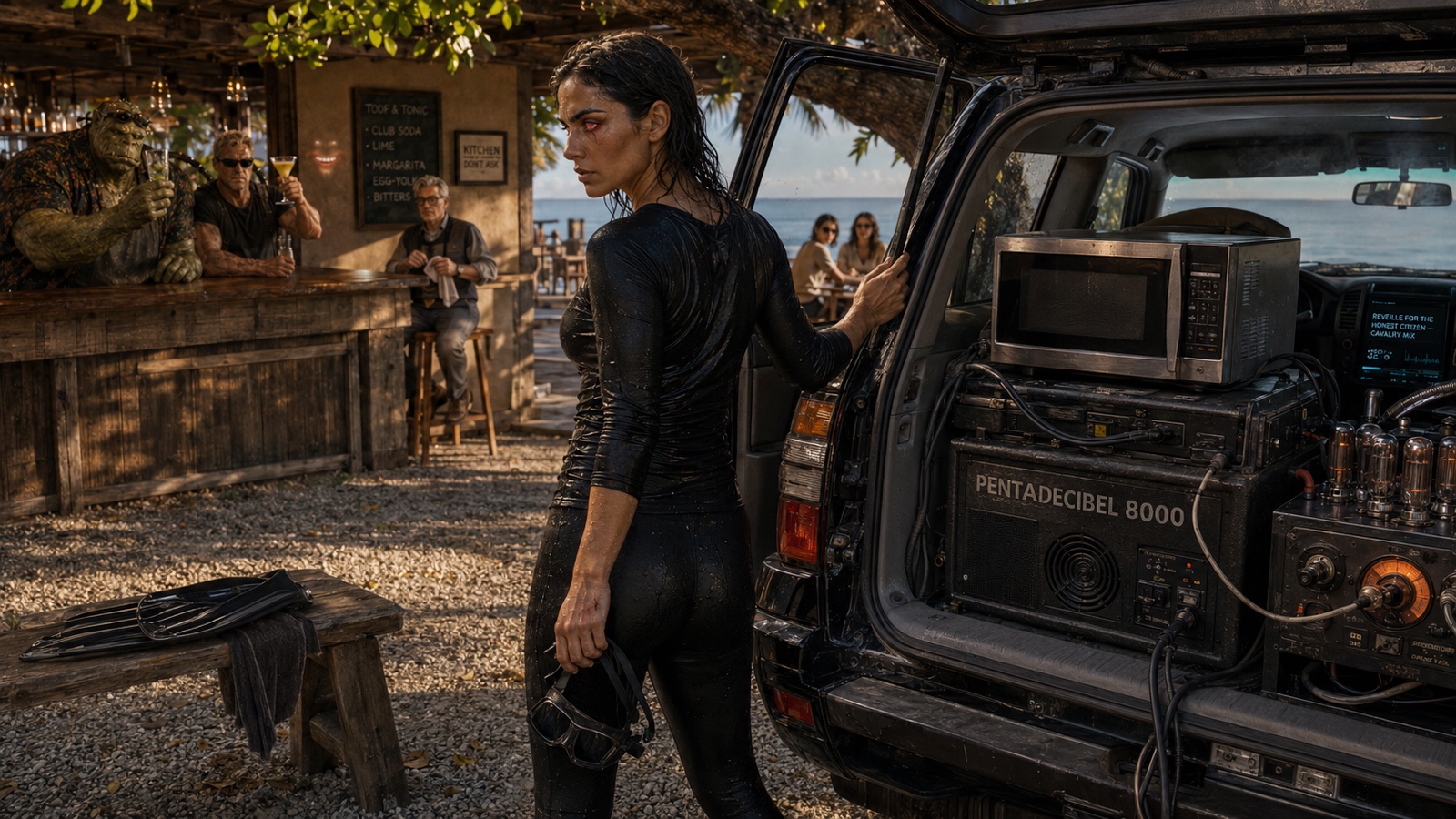
She returned at four-twenty-one in the manner of a woman whose preferred medium had not, this afternoon, succeeded in absorbing as much of her grievance as she had asked of it. She came up the dock steps in fins, padded the seven small steps to the deck, removed the fins one-handed without breaking stride, set them on the bench by the door, removed the goggles, and crossed the deck to the bar. Her hair was sleeked back. Her rash vest dripped. There was, at her right knuckle, a small abrasion of approximately one centimeter across that had not been there at three-thirty and which she had not, on her own assessment, acquired by accident.
At the bar, on the two stools that had been theirs all afternoon, Grogg and the Adeptus performed, in the small synchronized micro-adjustment of nine years’ practice, the precise lean toward the bar mat that signified, in their joint operational vocabulary, that the other half of the family had returned and that an enquiry into the wellbeing of the other half was, by their own joint estimation, due.
The Adeptus glanced, with the small unhurried economy of a tech-priest cataloguing damage, at the knuckle.
THE ADEPTUS. (very mildly) Madam.
ROMANTIC INTEREST. (without looking at him, in the small even register of a woman who had not yet, in her internal accounting, completed her swim) Don’t.
GROGG. (equally mildly, in the small carrying register that, on her face, she read as more dangerous than the Adeptus’s) Boss.
ROMANTIC INTEREST. Don’t.
GROGG. Da … da knuckle, dough.
ROMANTIC INTEREST. (after a beat, with the small flat finality of a confession that the speaker had already decided would not, on delivery, be elaborated on) Two tiger sharks. They were having a perfectly reasonable afternoon on the reef. They did not, when I arrived, choose to be elsewhere. I asked them. They declined. I rephrased the question. They have, now, gone elsewhere.
THE ADEPTUS. Both of them.
ROMANTIC INTEREST. Both of them.
GROGG. (into his club soda, very quietly) Ya feelin’ better.
ROMANTIC INTEREST. Marginally.
GROGG. Marginally.
ROMANTIC INTEREST. Marginally.
— — —
From the far end of the bar, Chad set the cloth down. He had, in the fifty-one minutes of her absence, polished forty-three glasses, none of which had required polishing on entry to his cloth and none of which, on exit, were any cleaner than they had been; the polishing had served the small useful purpose of being polishing, and his nerves had, on the strength of the polishing, returned, by the smallest margin, to a state that the bar’s staff handbook would have recognized. He registered her return. He did not, in any visible way, react. He had not, in two and a half years at this bar, learned that reacting was a strategy with a defensible record.
She crossed behind the bar. She took the cloth from him. She did not, in taking it, look at him; she did, however, in the small careful nod that she gave him on her way past, acknowledge that he had, in the fifty-one minutes she had been in the water, held the line.
CHAD. (quietly) Boss.
ROMANTIC INTEREST. Chad.
CHAD. (after a beat, in the small even voice that the afternoon had progressively installed in him as his actual working voice) The bar mat moved them.
ROMANTIC INTEREST. (without looking up, with the smallest unbidden upward inflection of the corner of her mouth that the bar had seen from her that day) Of course it did.
— — —
She picked up the glass she had set down at three-thirty-eight, which had been waiting on the bar for fifty-one minutes in a state of unbroken polish. She did not, on consideration, resume polishing. She set the glass behind the bar, on the shelf with the others, and surveyed the bar in the small operational manner of a woman who had been, for fifty-one minutes, swimming through her options.
THE ADEPTUS. Madam. I am going to call the Secretary.
ROMANTIC INTEREST. He is at his cottage.
THE ADEPTUS. He is, by my last triangulation, at his cottage. He has been re-reading the diplomatic note he sent at noon. He has been, on a separate screen, watching the morning footage of West Bay Road. He has been doing both of these with a bottle. He will be receptive.
ROMANTIC INTEREST. Why him.
THE ADEPTUS. Because the Service’s behavior today — the green ink, the unenforced files, the family network, the chapel inroads — has a texture I have, on close examination, registered as familiar. I cannot place the familiarity. The Secretary will place it. He places these things faster than I do; he has been placing them, in his diplomatic capacity, since before I was decanted.
ROMANTIC INTEREST. Call him.
— — —
The Adeptus placed the call. The call was placed on the bar’s secure handset, which had been wired in by the Adeptus himself in October on the basis that the bar’s ordinary handset was, by every available metric of his security audit, the second-worst piece of communications equipment within sixty miles, and that there were operational mornings in which the bar would want a phone line that could not be reviewed by anyone other than the bar. The secure handset rang, briefly, on the desk at the Secretary’s cottage. The Secretary picked up on the second ring.
THE SECRETARY. (in the small precise register of a man who had been expecting the call, who had been preparing the answer, and who had, between the first and second rings, set down the bottle) Madam. Sir.
ROMANTIC INTEREST. Secretary.
THE SECRETARY. I take it WH0P3’s payload has reached the villa.
THE ADEPTUS. It has.
THE SECRETARY. And you have read it.
THE ADEPTUS. We have.
THE SECRETARY. And you have noticed, both of you, that the personnel pattern at One Technology Square has, in its texture, an organisational predicate that the Service’s public posture does not, on its own, fully account for.
ROMANTIC INTEREST. Yes.
THE SECRETARY. Mm.
There was a pause. It was, by every available register, the Secretary’s pause; it was the pause of a diplomat who had spent forty seconds composing the first paragraph of the briefing he was about to deliver, and who was now arranging, in his head, the order in which the paragraph’s clauses would do the most work.
THE SECRETARY. Madam, I am going to give you a comparison, and the comparison is going to be uncomfortable. Are you ready for the comparison.
ROMANTIC INTEREST. Go.
THE SECRETARY. The Royal Caymanmunda Islands Police Service, in its present operational profile, is exhibiting the same institutional textures we observed at the Academy on Caymanmunda Brac.
The bar, on long acquaintance with its owner, recognized, in the small contraction of the muscle at the corner of her jaw, the moment in which the bar’s owner stopped being on a Monday afternoon and started being on Brac in March of the previous year. The contraction was not visible to anyone in the room who had not been training, for nine years, to spot it.
ROMANTIC INTEREST. (quietly) Explain.
THE SECRETARY. On Brac, you remember, the institution wore the shape of a school. It had the brass plates. It had the curriculum. It had the timetable. What it did not have was a graduating class. The school was a cradle. The cradle had been built around a structure that was, by Borden’s reading of the soundings, deeper than the building was, and the cradle’s purpose had not, at any point in its visible history, been the education of the children who passed through it. The cradle’s purpose had been to be a cradle. The institution had been built, in plain view, over a thing that the institution was, by its own concealed function, raising.
THE ADEPTUS. I had not, until you used the word, processed the pattern. The pattern is correct.
THE SECRETARY. Today’s building, in George Town, wears the shape of a police service. It has the personnel directory. It has the unit structure. It has the green-ink case-closure protocol — which, I will note for the record, is administratively identical to Brac’s ‘silent-curriculum approval’ stamp — and it has the recruitment pipeline that has, in the four years since the last published audit, surfaced certain surnames in numbers that statistics will not explain. What it does not have, by any honest reading of its case-clearance data, is a graduating class. The Service is not a police service. The Service is a substrate. The substrate is being used, today, by at least two distinct factions whose interests intersect at the substrate’s permeability.
ROMANTIC INTEREST. The family network.
THE SECRETARY. The family network. Which is, on its own, an operational hazard but not, by my reading, an existential one. The family is human, the family is corrupt by intelligible motives, the family can be addressed by the slow honest means by which one addresses such things — referral, audit, eventually elections.
ROMANTIC INTEREST. And the chapel.
THE SECRETARY. And the chapel. Which is, in the same room, not human, not corrupt by intelligible motives, and cannot be addressed by elections.
GROGG. (at the bar, into his soda) Brac, in other words.
THE SECRETARY. Brac, in other words. The Patriarch on Brac was beneath. The Patriarch here — if there is one, and Madam, I have learned in my years not to assume there is not one merely because I have not yet smelt it — will also be beneath. Beneath the school in March was a pit. Beneath the church on West Bay Road, by the geometry of the dome and the chapel’s registered footprint, is at minimum a chamber. I will not, on the present evidence, speculate further about the chamber. I will only note that on Brac, by the time the children began to behave with the unnerving unity that we eventually came to recognise as a marker, the cradle had been operating for fifteen years undisturbed. By the time the local authority’s inaction became the dominant operational feature of the local authority, the cradle had been operating for sixteen. By the time the Patriarch ascended to the surface, the cradle had been operating for seventeen, and the Patriarch was already — in any honest reading of the Adeptus’s soundings on the night of the breach — too established to be removed by an institution. We removed it by ten people and one Ork in a catamaran. Ten people, one Ork, several cases of rum, and the small private willingness of one nurse to break, in writing, her own oath.
ROMANTIC INTEREST. (very quietly) Borden.
THE SECRETARY. Borden. Who, I will add, kept her notes. Who, I will further add, has on three subsequent occasions sent me, on the encryption signature she still trusts of mine, observations from her current posting at the Health Services Authority — observations which I have not, until this afternoon, had operational cause to revisit. I have revisited them. They are consistent with the chapel’s footprint on West Bay Road. They are, in their distribution by patient surname and by next-of-kin field, consistent.
ROMANTIC INTEREST. How long.
THE SECRETARY. How long has the cradle on West Bay Road been operating.
ROMANTIC INTEREST. How long.
THE SECRETARY. By Borden’s soundings on Brac, the West Bay Road footprint suggests — eight to nine years. Approximately half the run of the Academy. We are, by the only available historical baseline, in approximately the eighth year of an analogous event.
ROMANTIC INTEREST. And WH0P3 is alone in a building that is, on its surface, the institution that should have noticed.
THE SECRETARY. WH0P3 is alone in a building that is, on its surface, the institution that should have noticed. The institution has not, in eight years, noticed. WH0P3 noticed in approximately five hours. WH0P3 is, by every available metric, facing the business end of a similar event — alone, in a building that has been calibrated, by the family network and by the cradle, not to hear him.
— — —
There was a pause. It was the pause that the room had been preparing for, in the slow accumulated way that rooms prepare for things, since the call had been placed. The handset, on the bar’s shelf, was on speaker. The Audit Office, on the deck, had not, at any point in the previous nine minutes, made a sound; the third member had, at some point during the Secretary’s second paragraph, returned to her seat, and the three of them were, by every available metric of the deck, attending.
THE SECRETARY. Madam.
ROMANTIC INTEREST. Secretary.
THE SECRETARY. Are you planning something.
There was a beat. Romantic Interest, behind the bar, did not, in any visible way, change. Her expression remained the calibrated neutrality of an operator on the second hour of an afternoon. The bar around her, however, registered the small change in the air pressure that always preceded her concluding to do a thing, and the bar’s small registered changes were, on long acquaintance, audible to the Secretary down a secure handset four miles away.
THE SECRETARY. (very mildly, with the small affectionate amusement of a colleague who had known her for nine years and who had earned the right to deploy the amusement) You know I can hear a smile, don’t you.
ROMANTIC INTEREST. (after a beat, in the small register of a woman who had not, in fact, smiled, but who had, in not smiling, communicated the smile she had not produced) Of course you can.
THE SECRETARY. Of course you do. Now the real question is how much time it is going to take you to get to George Town.
ROMANTIC INTEREST. I have not, in my own internal accounting, placed an estimate.
THE SECRETARY. Grogg and the Adeptus, on the other hand, have already placed their bets. Just so you know.
Both Grogg and the Adeptus, on their stools, lifted their respective drinks at exactly the same moment and sipped, with exactly the same small composed innocence, with the exact synchronisation of two men who had not, in fact, expected the Secretary to flag the bet and who had not, having been flagged, decided to deny it. Both of them, in the lift of the glass, performed the small upward angle of the head that, in their shared body language, signified the absence of guilt and the simultaneous presence of all the guilt the question implied.
ROMANTIC INTEREST. (without turning, in the small flat carrying register that the bar had not, that afternoon, expected to hear from her again, but which the bar, on long acquaintance, recognised as the second-most dangerous of her registers and the one most likely to precede a particular kind of competence) YOU. TWO.
GROGG. (small voice, into the soda, retaining innocence) Ma’am.
THE ADEPTUS. (equally small voice, equally retaining innocence) Madam.
— — —
THE SECRETARY. Oh.
ROMANTIC INTEREST. Oh what.
THE SECRETARY. I have just received a playlist.
ROMANTIC INTEREST. A playlist.
THE SECRETARY. Strange. It has arrived in my inbox by a route I do not, in the diplomatic register, ordinarily monitor. It is anonymous. It is twelve tracks long. It is, by every reasonable audio metric, unlistenable. I have nonetheless, for reasons that I will, in the long memoir, attribute to the third coffee of the afternoon, opened the file in a text reader rather than a player.
ROMANTIC INTEREST. And.
THE SECRETARY. And the second letter of each track, taken in order, viewed loosely — by which I mean if one squints, in the manner one squints at an old British crossword that has been clued by a setter with a private grievance — spells ‘HELP ME.’ It might be related, who knows.
ROMANTIC INTEREST. Secretary.
THE SECRETARY. Madam.
ROMANTIC INTEREST. He sent you a second copy. With the embedded crossword.
THE SECRETARY. Diplomatic register. He recognised that the brief in the metadata would land with the Adeptus and with you and would land less directly with me, on the basis that I am, by his observation, twenty miles east of the building and on the diplomatic side of the operation. He sent me a second copy in a register designed for the slow eyes of a former Absurdistani filing clerk. The crossword is in the track titles. The signal in the crossword is one phrase. He is asking for help. He is asking very politely. He is asking once.
ROMANTIC INTEREST. (very quietly, to the ceiling, to the bay, to the West Bay Road dome in the distance, to no particular addressee in the room) Once is enough.
— — —
She turned. She crossed the bar. She walked, in the small efficient stride of a woman who had decided, by some private margin that did not require articulation, that the afternoon’s pacing had concluded and the afternoon’s motion was now about to begin, toward the back door of the bar. She did not, on the way, look at Grogg or at the Adeptus. She did not need to. She paused at the back door. She turned. She addressed them, without looking at them, in the small flat register that, by her own accounting, was the closest she was prepared to come, at four-thirty-one on a Monday, to a parting word.
ROMANTIC INTEREST. Don’t tell me.
GROGG. (small voice) Ma’am.
ROMANTIC INTEREST. Don’t tell me the generator is at the back of the truck.
THE ADEPTUS. (small voice) Madam.
ROMANTIC INTEREST. Don’t tell me the microwave is connected.
GROGG. (smaller voice) Ma’am.
ROMANTIC INTEREST. Don’t tell me the Pentadecibel 8000 is already wired in.
THE ADEPTUS. (smaller voice) Madam.
ROMANTIC INTEREST. Don’t tell me the air conditioning is running.
GROGG. (at this point essentially a whisper, retaining all the innocence at his disposal) Ma’am.
ROMANTIC INTEREST. Just … don’t.
There was a small pause. Outside, in the bar’s gravel lot, parked under the almond tree that had, for nineteen years, served as the bar’s informal staff parking, the bar’s extraction vehicle — a black Toyota Land Cruiser of indeterminate provenance, registered, by the local register, to a company that did not, on inquiry, appear to exist — sat with its hood faintly warm and its rear seats removed and its cargo bay arranged into a configuration that no Toyota factory had endorsed. The generator was at the back. The microwave was connected. The Pentadecibel 8000 — a piece of audio equipment that had been bought, on a whim, on eBay, in 2019, by Grogg, and which had since been refitted, by the Adeptus, with a tube amplifier whose tube had been salvaged from a Cold-War-era Soviet anti-aircraft radio — was already wired in. The air conditioning was running.
Grogg and the Adeptus, at the bar, in perfect synchronisation, lifted their respective drinks, took a small celebratory sip, lowered the drinks, set them on the bar mat, and smiled, in unison, with the small bright honest grins that they had, in nine years, perfected and which the rest of the family had three hundred times mistaken for innocence.
GROGG and THE ADEPTUS. (in unison, with the small bright honest synchronisation that the bar had been training them for) We won’t!
GROGG. (adding) Da scene already priceless.
THE ADEPTUS. (adding) Don’t forget to share the footage.
— — —
She stood at the back door. She did not, on consideration, leave immediately. She turned, instead, to address the bar in the small flat register that her career had taught her to deploy when the bar needed to hear, in writing, what she actually thought of it, and which the bar had not, since the night Steeve signed over the deed, heard her use.
ROMANTIC INTEREST. Why is it me.
ROMANTIC INTEREST. Why is it me, stuck here, containing a cosmic menace of major proportions with a galaxy-sized capacity for optimism and a tendency for blasting my wits with Bangarang or worse, while the rest of you misfits sit on stools.
ROMANTIC INTEREST. What did I do. What did I do in some previous incarnation. Did I, at any point, in any of the lifetimes I do not specifically remember but whose karmic residue I am, by the present evidence, paying off in instalments — did I exterminate several solar systems.
There was a brief considered silence. The Audit Office, on the deck, did not move. Chad, behind the bar, did not look up. Grogg and the Adeptus, in perfect timing, exchanged a small look. The handset, on the shelf, was still on speaker.
THE SECRETARY. (over the speaker) No comment.
GROGG. No comment.
THE ADEPTUS. No comment.
CHAD. (from the far end of the bar, without looking up, in the small even voice that two and a half years had installed in him) No comment.
THE AUDIT OFFICE, IN UNISON. (from the deck, in the unison of three professionals who had not, in the morning, been told they were now operationally affiliated with this bar and who had, by mid-afternoon, accepted the affiliation) No comment.
EVERYONE, IN A SMALL CONSIDERED CHORUS. Drive safe.
— — —
And then, at the corner of the deck, between the chalkboard and the framed sign that read KITCHEN OPEN. PATIENCE EARNS FRITTERS, in the small distortion of late afternoon light that the bar’s patrons had, on three hundred separate occasions, attributed variously to heat haze, to the leeward rotation of the ceiling fan, to the third drink, and to the slow accumulated bending of reality that any establishment licensed by an Aeldari rogue-AI tended, in its fourth season, to acquire — the Harlequin flickered.
She did not, on this arrival, commit to a full manifestation. She committed only, in the way of a Shadowseer who had decided that an afternoon’s contribution did not require her presence in any of its biological registers, to the smile. The smile was, by every available measure of smiles, a Cheshire cat smile. It hung in the air between the chalkboard and the framed sign at a height of approximately five-feet-eight inches. It was, by its width, amused. It was, by its width, also amused at having been amused, which was a register the smile had refined, over centuries, into something that could be held at a distance by an Aeldari mouth that had not, in this generation, found a reason to commit to a face.
ROMANTIC INTEREST. (without looking, in the small fractionally-elevated register of a woman whose tolerance for the afternoon’s synchronised innocence had, in the last three seconds, exceeded its budget) THAT INCLUDES YOU TOO.
The smile, in the air, widened by a measurable margin. It remained, otherwise, entirely silent. After a moment, very slowly, it tilted, in the small dignified gesture by which Harlequin Shadowseers, when sufficiently amused and sufficiently unwilling to commit to actual speech, conveyed the diplomatic equivalent of yes ma’am, drive safe.
Romantic Interest exited.
— — —
In the gravel lot, the Land Cruiser registered the approach of its owner in the small clicking adjustments of an extraction vehicle that had been waiting, for approximately forty minutes, to be driven. She opened the driver’s door. She sat. She closed the door. The interior of the cabin smelt, faintly, of the generator at the back, of the small electrical warmth of the Pentadecibel 8000, of the running air conditioning, of the cooling element of the microwave, and — underneath all of those, in a small accidental layer that the Adeptus had not, in any of his preparations, intended — of the egg yolks. There was no salvaging the eggs. The eggs were a feature of the vehicle now. She would, in due course, address the eggs.
She started the engine. The engine, in the small responsive way of a vehicle that had been calibrated by the Adeptus over four years and which had been waiting all afternoon, started. She placed the vehicle in reverse. She did not, in placing the vehicle in reverse, perform any of the small additional checks that the morning’s Customs officer had, by her account, performed at the moment of an analogous gear selection. She did not, after all, need to. The reversing camera reported the area behind the vehicle as clear of pedestrians, husbands, coolers, or any other obstacles that the vehicle’s reverse trajectory could, in any meaningful sense, encounter.
She reversed. She placed the vehicle in drive. She drove.
The vehicle’s onboard sound system, on the small private command of an Adeptus four miles east, came alive at three per cent of its rated output and began to play, very softly, at a volume that the cabin would tolerate, a track that had not previously existed on any of the bar’s playlists, titled Reveille for the Honest Citizen — Cavalry Mix. The brass-fanfare topline was unchanged. The kazoo was unchanged. The triumphant horn at the fade was unchanged. The metadata embedded in the track was, by the Adeptus’s configuration, broadcasting, on a frequency the chapel on West Bay Road was not listening on, a continuous low-grade carrier signal whose substance was, in plain English, we are inbound.
She did not, on hearing the track, smile. She did, however, in the small private register that the afternoon had finally permitted her to access, allow herself a small dry exhale that the cabin, on long acquaintance with her, recognised as her version of a battle hymn.
— — —
At the bar, after the Land Cruiser had departed and the gravel had settled, Grogg and the Adeptus did not, in any visible way, alter their posture. The Audit Office, on the deck, returned, with the small composed unanimity that they had now refined into a working method, to their drinks. Chad, behind the bar, picked up his cloth. The Harlequin’s smile, in the air, did not vanish; it had, however, by the slow exhalation by which Harlequin Shadowseers concluded a manifestation that did not require ongoing maintenance, faded by a measurable degree, until only the corners of it remained, suspended at the corner of the deck like the residue of a thought.
The Secretary’s voice, on the speaker, returned to the room.
THE SECRETARY. She is on the road.
THE ADEPTUS. She is on the road. The vehicle is, by my telemetry, at eighteen above the limit. I had budgeted for twenty-five. I will revise.
GROGG. (very quietly, into the soda, in the small register of a man who had won the bet and who was, with the dignity of a winner, not gloating) Twenty-three.
THE ADEPTUS. Twenty-three.
GROGG. Pay up.
THE ADEPTUS. (in the small flat tone of a tech-priest discharging an honest debt) Madam, you have won the bet. I will, on your behalf, donate the equivalent of two bucket-sized margaritas to the bar’s tip jar tonight. I will not, by your standing instruction, drink them myself.
GROGG. (grinning) Right answer.
Outside, in the late afternoon, the bay flattened by a measurable degree. The pelicans, on the post, watched the Land Cruiser disappear up the coast road, and watched it for a long thoughtful moment after it had disappeared. The Harlequin’s smile, at the corner of the deck, faded the last of its way and was gone, and the bar, in its small accumulated way, prepared for the evening.
The emperor provides. Again and again.