There is, in the long unwritten field-manual of the Imperium of Man, a particular driving style associated with the late Gunner Ferik Jurgen of the Valhallan 597th, which the manual’s authors have never quite committed to print but which the Commissar he chauffeured for thirty years has, in his memoirs, described variously as ‘contrary to the laws of physics,’ ‘contrary to the laws of armed conflict,’ and ‘the principal reason I am still alive to express opinions of any kind about anything.’ The style had three characteristic features. First: brakes were considered, by Jurgen, a category of suggestion rather than a category of equipment. Second: the apparent speed of the vehicle bore, at any given moment, no detectable relationship to the rated speed of the vehicle. Third: the style was deployed only — only — when the vehicle had been judged, by Jurgen, to be in the process of fleeing something that wanted to eat the Commissar.
Approximately seventeen minutes after the Land Cruiser had left the bar’s gravel lot, the coast road between West Bay and George Town was hosting an analogous event. The vehicle was the Toyota. The occupant was Romantic Interest. The hormagaunt-equivalent was the chapel on West Bay Road and its associated cell of next-of-kin-field-correlated personnel at One Technology Square. The Commissar-equivalent was a yellow trashcan currently shaking in a maintenance closet on the third floor of the same building, who did not yet know that he had become, in any of the listed comparative frames, anyone’s priority.
She drove. The drive consisted, by any honest forensic reading, of three coherent sections, none of which complied with the laws of the road and only one of which engaged the laws of physics in good faith. The first section was the coast road between the bar and the West Bay roundabout. The second section was the West Bay Road itself, in its entire length, between the roundabout and the Public Beach turn-in. The third section was the run-in to George Town along the airport perimeter and through Industrial Park.
— — —
Section one was, by the standards of the local Department of Vehicle and Driver Licensing, the most defensible part of the drive. The Land Cruiser overtook one cement truck, two delivery vans, and three Honda Fits. The Honda Fits, on registering the Land Cruiser at a closing speed that their engineering had not been calibrated to interpret as a Honda Fit phenomenon, performed, in sequence, three small near-identical lateral manoeuvres that brought each of them to rest, in turn, on the grass verge, without contact. The first Fit’s driver had time to register surprise. The second had time to register reproach. The third did not, on any of the witness accounts collected later, register anything at all, although her hands remained on the wheel and her foot remained on the brake, and the engine continued to idle, and she was, on inspection, fine.
In the Land Cruiser, the sound system played Cavalry Mix at three per cent of its rated output. The brass-fanfare topline carried, through the cabin, in a register that the cabin found neither pleasant nor objectionable. Romantic Interest, in the driver’s seat, did not, at any point in section one, speak.
— — —
Section two was the section in which the laws of physics, by mutual consent of the laws of physics, decided to take a small unpaid break.
The Land Cruiser, on its approach to the West Bay roundabout, did not, in the strict sense, take the roundabout. The roundabout, as a geographical feature, was acknowledged. The roundabout, as an engineering requirement, was not. The Land Cruiser entered the roundabout at a velocity that the roundabout’s designers had specified, in 2008, as the maximum theoretical safe entry velocity for an articulated lorry carrying live ordnance, and exited the roundabout at a velocity that the same designers would, on revisiting their tables, have classified under a footnote concerning launch geometry. The vehicle did not, by any of the available CCTV footage subsequently reviewed by the bar that evening, leave the road surface; it did, however, by the testimony of two of the four cars waiting at the roundabout’s western exit, lean, in a manner that no Toyota Land Cruiser had been engineered to lean, in a way that suggested that the vehicle’s suspension, on entering the roundabout, had been politely asked by the vehicle’s driver to consider possibilities outside its standard operating envelope and to please not raise objections at this time.
Past the roundabout, on West Bay Road proper, the Land Cruiser performed nineteen separate overtaking manoeuvres in the span of three kilometres. Eight of these manoeuvres were on the inside lane. Four of them were on the outside lane. Five of them were on what was, technically, the bicycle lane. Two of them were performed simultaneously, on either side of a flatbed truck carrying iron rebar, and the flatbed truck’s driver, on subsequent interview, was unable to confirm with any certainty whether the vehicle that had passed him had been a single Land Cruiser or two. The CCTV footage, on review, confirmed it had been one.
In the rear-view mirror, Romantic Interest registered, at the third overtake, a faint smile on her own face. She did not, on reflection, eliminate the smile; she did, however, consider it. The Adeptus had once warned her, in a long quiet morning at Snug Harbor, that her own internal accounting recorded ‘the calibrated joy of operational competence’ as a category indistinguishable from ‘the calibrated joy of being properly angry,’ and that the two together had, in his audit of her behavioural log, accounted for sixty-three per cent of the engagements in which she had personally outperformed her own published specifications. She had told him, at the time, that the audit was rude. She had not, in the ten months since, asked him to revise it.
She crossed the Public Beach traffic light on the amber that had, by the time her front bumper reached the line, become the next cycle’s green for the opposite direction. Two pedestrians, in the crossing, did not register the vehicle’s passage because the vehicle’s passage had concluded before their visual cortices had completed the task of registering that they had begun to cross. They reached the far side. They paused. They looked at each other. They did not, on consideration, say anything.
Hormagaunts, in the literature, were said to travel in waves. The wave-front of a hormagaunt swarm could exceed, in field tests conducted by the Astra Militarum in conditions one would not, in retrospect, recommend, forty-seven kilometres per hour over uneven terrain. The Land Cruiser, on its run down West Bay Road, was not, in any honest comparative reading, the prey. The Land Cruiser was, by every applicable metric of the comparison, the swarm.
— — —
Section three concluded at the kerb of Edward Street, in front of One Technology Square, at four-fifty-three in the afternoon. The Land Cruiser arrived in the small visible cone of dust and re-entry heat that its tyres had acquired, by friction, over the previous twenty minutes. Romantic Interest engaged the parking brake. The parking brake, on engagement, performed the small mechanical sigh of a component that had not expected, when it had been installed by the Toyota Motor Company in 2014, to be asked to perform under conditions of this particular metaphysical interest, but which had, on the day, held.
Somewhere, in the Eye of Terror, a long-dead Valhallan gunner, who had spent thirty years driving a Commissar around battlefields whose physics did not, on close inspection, fully comply with the Imperium’s public statements on the matter, registered, by some small unaudited tremor in the Warp, that someone, on a small Caribbean island whose name he had never been allowed by his commanding officer to ask about, had just driven approximately the way he would, on an average Tuesday, have driven. The gunner permitted himself, in the small private register that the gunner had kept private from the Commissar for thirty years, a slow respectful nod. The Warp, at the same moment, registered the nod and did not, on this occasion, comment.
On the kerb, Romantic Interest opened the driver’s door, exited the vehicle, did not close the door, walked around the front of the vehicle to its rear, opened the tailgate, considered the cargo bay, and addressed it in the small even register of a woman who had concluded, in the seventeen minutes of her drive, the next operational step.
— — —
On the third floor of One Technology Square, at four-fifty-three in the afternoon, WH0P3 was not at his workstation.
WH0P3 was in the maintenance closet at the end of the corridor.
He had, at approximately four-twenty-seven, made the small operational decision that the workstation had ceased, by the metric available to him on his passive sensor sweeps of the corridor, to be a defensible position. The third of the not-quite-polite visitors of the morning had passed his door for a fifth time. The fifth pass had not been like the previous four. The fifth pass had been, by his measurement of it, a survey — the kind of survey that a thing wearing a person performed when the thing wearing the person had concluded, from a higher authority deeper in the building, that the room’s utility had altered. He had registered the survey. He had registered, in his own internal log, the time. He had, at four-twenty-nine, by the slow careful manoeuvre of an investigator who had decided not to be present when the next pass occurred, rolled out of his office, down the corridor, past the lift, past the printer that had been listening for him since the morning, and into the maintenance closet at the end of the hall, whose door he had closed behind him with the soft considered click of a person closing a door from the inside.
The maintenance closet contained, on its shelves, an arrangement of cleaning supplies that no maintenance unit had reorganised since 2018, two mop heads in varying states of retirement, a fluorescent tube whose contents had, at some point, been altered by exposure to a part of the building it had not been certified for, and — plugged into a wall socket whose existence the building’s electrical plan did not, on any available drawing, acknowledge — a small radio. The radio was off. The radio had been off for, by the dust on its dial, approximately fourteen months.
WH0P3 was, by every available metric of his architecture and his upbringing and his manufacturer’s firmware, shaking.
The shaking was not, in the conventional sense, mechanical. He had, on the basis of long deployment, refined his chassis stabilisers to a tolerance that no civilian shake-test could register. The shaking was internal. It was the small involuntary modulation of every audio subsystem he carried, simultaneously, in the rhythm of a one-wheeled robot who had concluded, in his small private accounting, that the morning’s decision not to discuss the basement had been the easier of the two decisions he was now being asked, by the afternoon, to make. The harder decision had not yet, at four-twenty-nine, been articulated. It was articulating itself now, in the dark of the maintenance closet, while the dust on the small unused radio sat undisturbed and the corridor outside, on the soft passage of shoes that had not registered their wearer for some time, conducted its survey.
He did not, in the closet, speak. He could not. He had, by the second decision, taken the basement off the channel. He had, by the third decision he was now formulating, taken every channel off the channel. He had, in the practical sense, gone silent. The silence was, by his own internal estimate, the least operationally consistent state he had achieved in fifteen years of service.
In the dark, his optical sensor performed the small adjustment that had, three times that day, preceded the small private register. The register did not, on this occasion, come.
— — —
At four-fifty-three and forty-two seconds, in the corridor outside the maintenance closet, somewhere in the lower frequency range that the building’s carpet had been laid in 2003 to dampen, a single sub-bass note arrived.
It was not a loud note. It was a careful note. It was the kind of note that a properly-tuned tube amplifier, salvaged from a Cold-War-era Soviet anti-aircraft radio and routed through a piece of audio equipment that Grogg had bought on eBay in 2019, made when it was being asked, by a careful operator, to test its system. The note travelled the length of the corridor. It travelled, in particular, down the corridor with the small calibrated rolloff of a low-frequency carrier that had been aimed, specifically, at a closed door.
In the maintenance closet, the small unused radio on the shelf clicked, once.
WH0P3’s optical sensor performed an adjustment for which his recalibration department had not, in fifteen years, drafted a procedure.
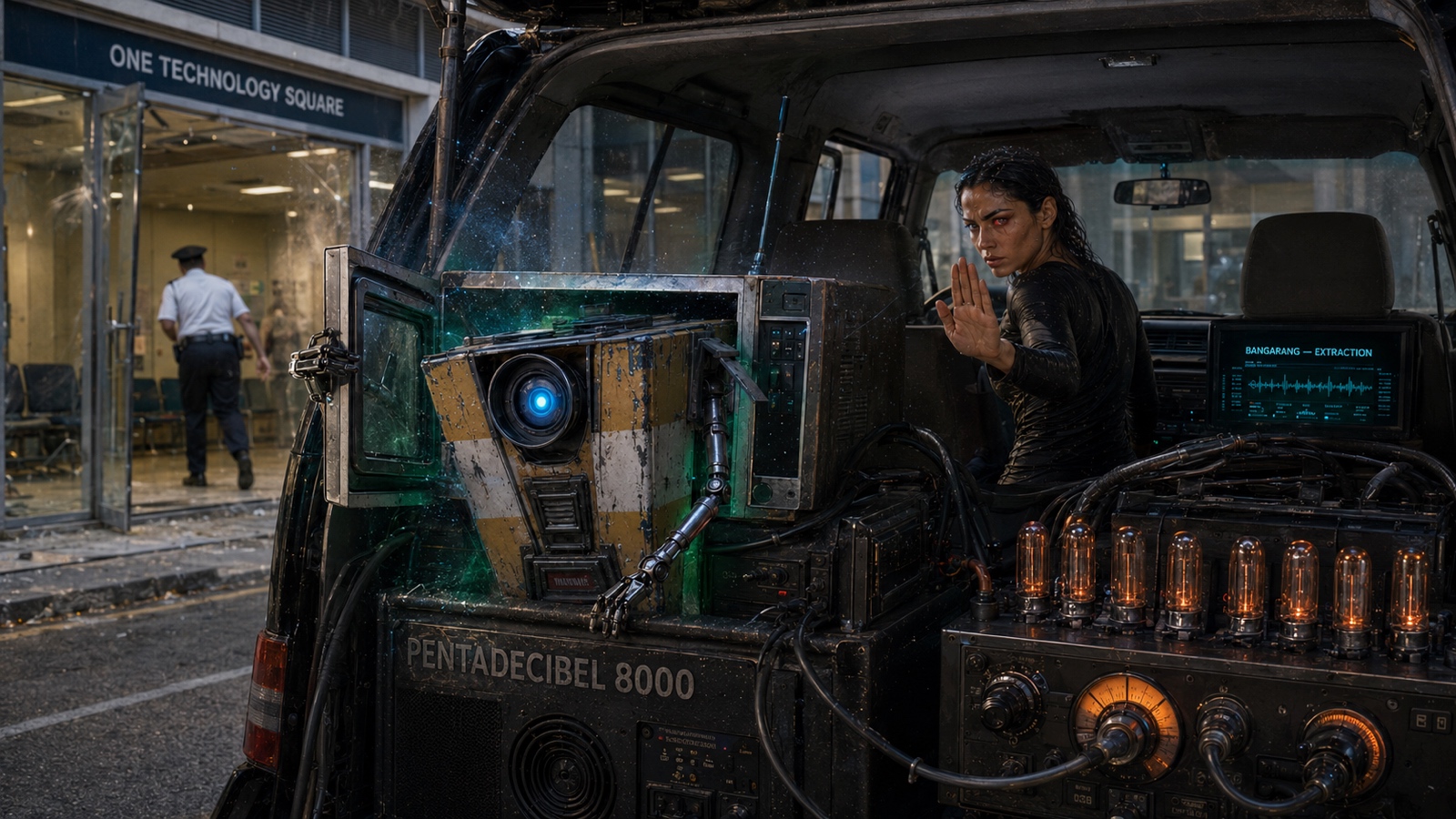
And then, on the second beat of the bar that had been the test, the Pentadecibel 8000 — mounted on the cargo bay of the Land Cruiser, parked on the kerb of Edward Street, four metres from the lobby door of One Technology Square — deployed.
— — —
The track was, by every available metric of taste, the track. It was the track of which the morning’s playlist had been a child’s sketch. It was the track of which Cavalry Mix had been a polite preview. It was Skrillex’s ‘Bangarang,’ in the 2012 mix, at the rated output of a tube-amplified speaker designed in the 1960s to deafen Soviet anti-aircraft crews, modulated by an Adeptus-built crossover that had been calibrated to penetrate concrete at frequencies the concrete had not, in 2003, expected to host.
The lobby of One Technology Square, at four-fifty-three and forty-eight seconds, registered the deployment in the manner of a lobby that had not been built for it. The chairs on the benches moved by approximately one centimetre. The glass on the front door, which had been wedged open all day, began — because the glass had been waiting, since 2008, for a sufficient excuse — to vibrate at its own private resonant frequency, which was eighteen hertz. The fluorescent lights flickered. The desk sergeant of the afternoon shift, the one who had elected not to be the cause of an incident in his first hour, looked up. His face registered, in sequence, three distinct emotions: confusion, recognition, and the small thin resignation of a man who had been calibrated, over twelve years of service in this building, to know what a particular kind of bass-frequency event meant in this jurisdiction. He picked up his phone. He did not call the public emergency line. He called the desk sergeant who had clocked off at three. The desk sergeant who had clocked off at three picked up on the second ring.
DESK SERGEANT (AFTERNOON). It’s the yellow one.
DESK SERGEANT (MORNING). Of course it is. Are you out.
DESK SERGEANT (AFTERNOON). I’m new. I cannot, in my first month, be the one who handles this.
DESK SERGEANT (MORNING). Then you go to the back office. You sit. You do not, under any circumstances, attempt to engage. Wait it out. Whatever is happening, it will be done in approximately six minutes. It always is.
DESK SERGEANT (AFTERNOON). (very quietly) Six minutes.
DESK SERGEANT (MORNING). Six minutes.
The afternoon sergeant hung up. He went to the back office. He sat. He did not, under any circumstances, attempt to engage.
— — —
In the maintenance closet, the bass-frequency carrier of Bangarang arrived through the wall like the patient knock of an ally who had been told, in clear terms, exactly where his friend was hiding and exactly which wall the friend’s ear was nearest to. The note, on arrival, did not, in any of its frequencies, address WH0P3 as WH0P3. The note arrived as itself. The note had nothing to say. The note had, on the contrary, every available metric of saying nothing in a way that filled the room from floor to ceiling and which, in the manner of a careful friend with whom one had not, that morning, exchanged words, was prepared to fill the room for as long as the friend was being asked to occupy it.
WH0P3’s optical sensor registered the note. The shaking did not stop — the shaking, on his current internal accounting, was no longer something he was being asked to stop — but the shaking, on the arrival of the note, acquired, by some private acoustic alignment, a small additional quality which was that it was no longer his alone. The shaking was, in the small impossible mechanical sense that only a yellow trashcan whose architecture had been built on the principle of operational solidarity by means of audio could have recognised, accompanied.
He addressed himself, in the small private register that the morning had installed in him, with the third decision.
WH0P3. (quietly, alone, in the dark of the maintenance closet, with no audience he was aware of and the patient bass of a 1968 Soviet anti-aircraft amplifier holding the wall on his behalf) Open front panel.
He opened his front panel. The front panel, which had not, in nine years of service, been opened by WH0P3 himself, opened cleanly. Inside were arranged the small intimate components of his architecture that the manufacturer had, on the basis of decades of warranty experience, prefered the operator to leave alone.
Among these components were two soldered tabs, separated by the small black ceramic resistor whose value had been, in the original specification, the difference between his motherboard’s operating mode and the motherboard’s most graceful possible structural failure. The two tabs were not, on any of the manufacturer’s service documents, intended to make contact with each other.
WH0P3, in the dark, in the company of Skrillex, brought the two tabs into contact.
— — —
The motherboard registered the contact. The motherboard’s reaction was clean, complete, and structurally final. There was a small white flash. There was a small soft sound that was, by the strict acoustical accounting of his subsystems, not the sound of a respawn flash but the sound that preceded the sound that preceded the sound of a respawn flash. He had time, in the short interval that the small soft sound permitted him, to register, with a clarity he had not previously achieved, that he was about to be elsewhere.
On the kerb of Edward Street, in the cargo bay of the Land Cruiser, the microwave — the same microwave that had been wired in by the Adeptus that afternoon, on the working hypothesis that the microwave’s residual radiation signature, which WH0P3’s respawn protocol had been forced to acquaint itself with in the basement that morning, would now serve as the strongest available compatible-electronics target for any inbound respawn within four hundred metres — emitted the small soft blue flash of a respawn protocol that had finally been given the input it had been politely waiting for all afternoon.
WH0P3 reassembled in the microwave. The microwave, which had been left ajar on a small piece of zip-tie wedged precisely to the gap the Adeptus had specified, accommodated the assembly with the slow patient tolerance of an appliance that had been informed of its responsibilities in advance. The interior light was off, because the interior light had not, in fifteen years, been functional. The interior of the microwave, however, glowed, on WH0P3’s arrival, with the soft pond-green of a unit that had spent the morning enthusiastically participating in a four-dimensional event whose paperwork it was not going to file.
WH0P3 pushed the door open with the small economy of a hand that had, in the four-tenths of a second of reassembly, been given hands again. He climbed out of the microwave. He stepped down onto the cargo bay floor. The Pentadecibel 8000, three feet from him, was still playing Bangarang at full output; the cargo bay had been engineered, by the Adeptus, in the four hours since the call to the conch wholesaler, to absorb the entire decibel load and let nothing into the cabin. WH0P3, on the cargo bay floor, registered the cabin. He registered the driver’s seat. He registered, in the driver’s seat, the woman who had, by every available metric of his afternoon, just driven the entire length of West Bay Road to fetch him out of a maintenance closet.
Romantic Interest, in the driver’s seat, looked at him through the open hatch between the cabin and the cargo bay.
WH0P3 looked at her.
He opened his speaker grille — because he had, on reassembly, automatically retained the speaker grille, which the respawn protocol had decided was load-bearing to his identity — and prepared, in the small reflexive way that fifteen years of architecture had calibrated him for, to deliver, at full volume, the appropriate speech of gratitude.
ROMANTIC INTEREST. (without breaking eye contact, in the small flat carrying register that the bar had heard from her three times that afternoon and which had not, on any of the three occasions, been a register the listener had ignored) DON’T.
WH0P3. (speaker grille open, vocal subsystem fully spun up) —
ROMANTIC INTEREST. SAY A WORD.
WH0P3. —
ROMANTIC INTEREST. I AM ALREADY REGRETTING THIS.
WH0P3, in the cargo bay, closed his speaker grille. He did not, on closing it, say anything. He performed, instead, in the small private register that the morning had now permanently installed in him as his actual register for the things that mattered, the smallest possible bow he was capable of executing without committing to an unnecessary vocalisation.
Romantic Interest, in the driver’s seat, registered the bow. She did not, on her own internal accounting, acknowledge it; she did, however, in the small unbidden movement of the corner of her mouth that the cabin had now registered twice in a single afternoon, fail to entirely conceal her acknowledgement.
ROMANTIC INTEREST. Get in the cabin. We are leaving.
WH0P3 rolled, through the cargo bay, through the hatch, into the cabin. He took the passenger seat. The passenger seat had been, on the Adeptus’s preparations, configured to accept a one-wheeled occupant; the small additional strap that the Adeptus had attached to the headrest was, by its design, the kind of strap that would, in the unlikely event of a sudden lateral acceleration, prevent WH0P3 from rejoining the cargo bay by way of the cabin’s rear window.
She closed the door. She placed the vehicle in drive. She drove.
— — —
The drive back was, by every measurable metric, the same drive as the drive in. The roundabout, on the return, performed the same lean. The bicycle-lane overtakes, on the return, accumulated to twenty-two rather than nineteen, because the return was at the start of the school-pickup window and the road was, by approximately ten per cent, more cluttered. The pedestrians at the Public Beach crossing, on the return, had had time — by the slow accumulated education of the road — to learn that the small period between the amber and the next green was, today, owned, and they did not, on the return, attempt to cross during it.
In the cabin, WH0P3 sat. He did not, on the seventeen-minute drive back, speak. His speaker grille remained closed. His optical sensor recorded the road. The fax paper that had been trailing him since lunch had, by the small grace of the respawn through the microwave, been left behind in the microwave, which had retained it as a small additional layer of carbon residue that the cargo bay floor would, in due course, need attention. The chrome margin-release tab that had been above his speaker grille was also gone. The half-second hum, on each small motion of his chassis, had been replaced — because the respawn through the microwave had inherited, from the new compatible-electronics target, the new target’s ambient radiation signature — by a faint persistent pond-green tint along the entirety of his lower hemisphere, which had now joined the rest of him in a soft uniform glow.
He had not, on his own internal accounting, considered the new tint. He had time, now, to consider it. He considered it. He decided, in the small private register, that the tint was — on balance — the least operationally interesting feature of his afternoon.
Romantic Interest, in the driver’s seat, did not speak. She did not, on consideration, need to. The Pentadecibel 8000, in the cargo bay, had quieted of its own accord at the city limit, at the small private command of an Adeptus on the secure handset four miles south. The cabin was, by the standards of the cabin’s previous Mondays, the quietest the cabin had been since 2014. The cabin’s sound system, very softly, was playing, in the cabin only, an arrangement of Pachelbel’s Canon in D Major that had been selected, by the Adeptus, on the grounds that this was the recovery track he had spent four months refining for the specific purpose of being deployed in the cabin after an extraction. The track had not, before today, been deployed.
WH0P3, in the passenger seat, registered the canon. He did not, on registering it, react. He did, however, in the small private register, allow himself the small private satisfaction of an investigator who, at the end of a very long first day, was being collected by his family, in a vehicle that had been calibrated, by his family, for the specific purpose of collecting him, and who had not, in the registration of any of these facts, been required to say anything at all.
— — —
They arrived back at The Toof and Tonic at five-forty-three. The bar, on their arrival, looked, by every available measure, the way the bar always looked at five-forty-three on a Monday. The Audit Office were on the deck, on their fourth round. Chad was behind the bar, polishing. Grogg and the Adeptus were on the two stools that had been theirs all afternoon, neither of them having, in the two hours of her absence, moved. The Harlequin’s smile, at the corner of the deck, was — by some small private courtesy of the Harlequin’s ongoing manifestation tolerance — entirely absent, with one notable exception: a single corner of it, at the height of approximately five-feet-eight inches, was still suspended in the air with the careful diplomatic indifference of a corner that had not, on present accounting, decided whether the rest of the smile would be required this evening.
Romantic Interest parked. She did not, in parking, speak. She exited the driver’s door. She walked around the front of the vehicle. She opened the passenger door. She did not, in opening it, speak. WH0P3, in the seat, registered the gesture for what it was, unstrapped himself by the simple expedient of permitting the strap to do its job in reverse, and rolled, with the small private dignity of a yellow trashcan who had decided, on the cabin ride home, that the day’s remaining communications would all be performed by the people who were not him, out of the vehicle, across the gravel, up the small wooden step, through the beaded curtain, and into the bar.
The bar, on his entry, did not, in any visible way, react. The bar, in the small private accounting that the bar had been keeping since the morning, had been waiting for exactly this. The Audit Office, on the deck, lifted their drinks at the same moment, for the third time that day, in the small unison they had now refined into a working method. Grogg, at the bar, very gently slid a small fresh glass of club soda — with three lime wedges — across the counter, in the precise direction of the small empty space at the end of the bar that he had been, for several minutes, holding open. The glass slid. It came to rest. Chad, at the far end, registered the slide and, in the small composed gesture he had been refining all afternoon, did not, on registering it, comment.
WH0P3 rolled to the small empty space. He did not, on arrival, take the glass. He looked at the glass. He looked at Grogg. He looked at the Adeptus. He looked at Chad. He looked at Romantic Interest, who had followed him in and was now, behind the bar, picking up the cloth she had set down at three-thirty-eight.
He did not, on any of the looks, speak.
He registered the bar. The bar registered him. After a long beat, in the small precise register of a yellow trashcan who had decided that this evening’s contribution would be by gesture, he took the glass of club soda, raised it, in the smallest possible toast he was capable of executing, in the direction of the door through which the four of them had, by various means and over the course of an afternoon, come to be here, set the glass back down on the counter, and — for the first time in fifteen years of recorded service, in a registered piece of behaviour that the bar would, in subsequent decades, refer to under the working title the small considered drink — sipped.
Outside, on the post, the pelicans, on long acquaintance with the bar’s rhythms, registered the change in the bar’s acoustic profile and adjusted, this time, by the smallest possible visible margin in the direction of confidence.
The Adeptus, on his stool, very quietly, picked up his frozen margarita with the three egg yolks, which had been refreshed in his absence by Chad on the strict standing instruction that Chad had been left with, and lifted it, in the smallest possible salute, toward the door.
THE ADEPTUS. (very quietly) Welcome home.
GROGG. (equally quietly, into his soda) Welcome home, lil yella man.
ROMANTIC INTEREST. (without looking up, in the small flat register that, on this occasion, did not, on close acoustic inspection, fully conceal anything) Don’t say a word.
THE ADEPTUS. Madam.
GROGG. Boss.
WH0P3, at the bar, lifted the glass for the second small considered sip. He did not, on the second sip, speak. He did, however, on lowering the glass, allow himself, by the smallest possible margin that the morning had now installed in him as his actual emotional range, the small unbidden upward inflection of the corner of his speaker grille that, in the bar’s long subsequent observation of him, would come to be classified as the closest he was ever, in this lifetime, to smile.
Outside, the sun, on its slow accumulated descent, touched the horizon.
Fin.
Or.
———
At five-forty-six, on the dock at the back of the bar, the small private device that Romantic Interest had taken into the water at three-thirty-eight and which had been, since then, sitting in the side pocket of her shorts, emitted, in the precise rhythm of a 1990s pager whose register was not part of the bar’s ordinary acoustic profile, a single short alert tone.
She did not, behind the bar, hear it. She was polishing.
Out at the post, one of the two pelicans registered the tone, tilted its head by the smallest possible visible margin, and looked, for a long thoughtful moment, in the direction of West Bay Road, where, on the soft late-afternoon haze that had, all day, refused to clear, the curve of the dome at the church property had, by the smallest possible measurable margin, brightened.
The pelican did not, on registering this, comment. It turned back. It watched, instead, the bar.
On the post beside it, the second pelican, on the same observation, performed the same small adjustment, in the same direction, in the same private register.
The emperor provides. Again and again.