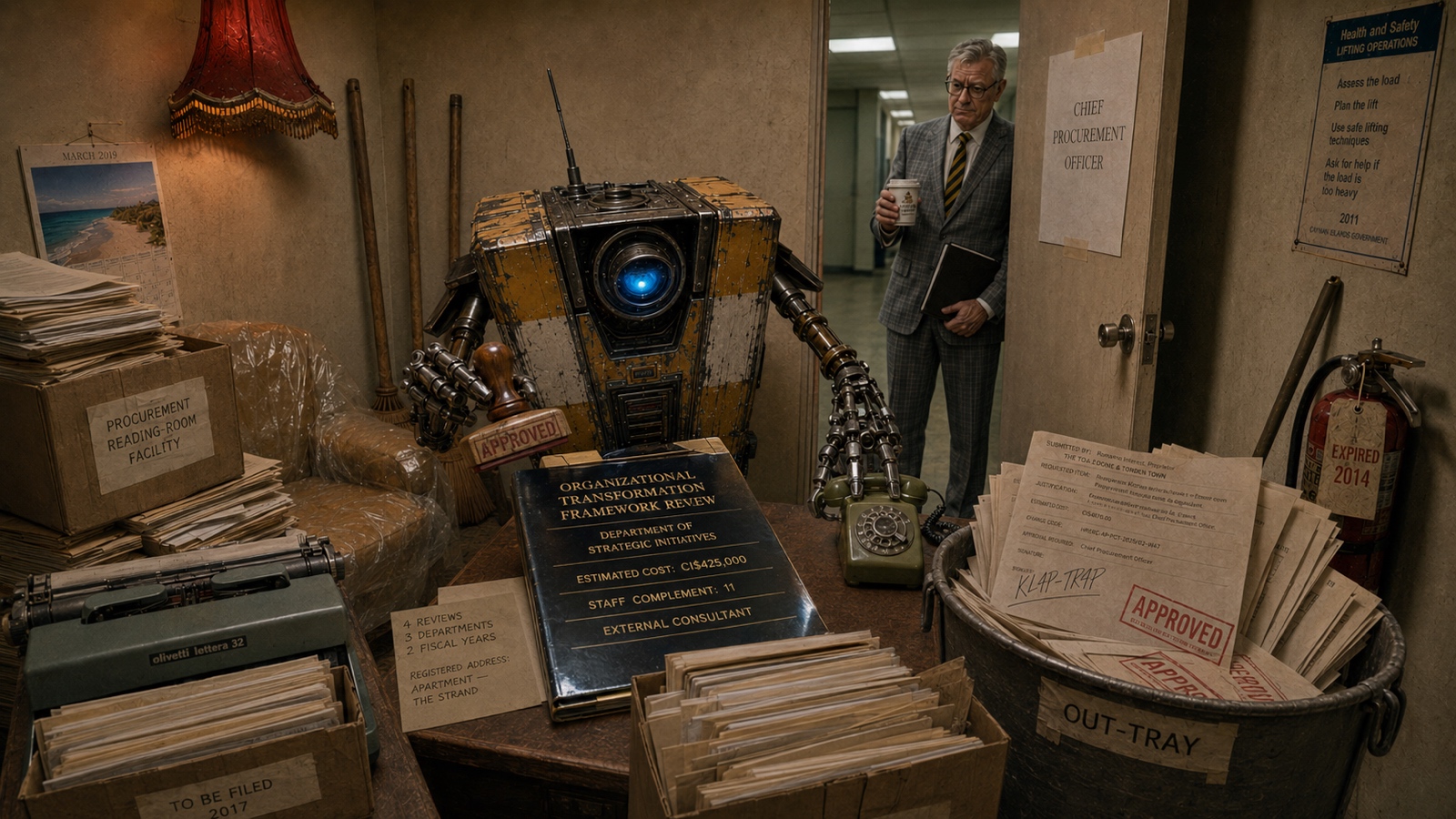
Form ref: PRF-2026/05/26-0017
Submitted by: Director of Special Projects,
Strategic Initiatives Division
Date submitted: 25 May 2026 (held pending CPO)
REQUESTED ENGAGEMENT:
Organisational Transformation Framework Review
Scope: Strategic Initiatives Division (11 staff)
JUSTIFICATION:
To deliver alignment of legacy operating modes with
forward-facing strategic posture, in support of
whole-of-government coherence outcomes.
Cost: CI$ 425,000
Cost per staff: CI$ 38,636
Vendor: Strand Strategic Partners Ltd.
Sole source? Yes (specialised expertise)
Disclosure: Internal only
APPROVAL REQUIRED: Chief Procurement Officer
WH0P3 read the form once. He read it a second time, more slowly. His optic, behind the microwave’s viewing window, performed a slow vertical scan of the page from top to bottom and back, twice.
WH0P3: THIS DOCUMENT — *BEEP* — IS BEAUTIFUL. I MEAN THIS PROFESSIONALLY. THE LAYOUT IS EXCELLENT. THE LANGUAGE IS CONFIDENT. THE CHARGE CODE IS PRE-FILLED. SOMEONE HAS PUT IN GENUINE EFFORT.
WH0P3: AND YET I HAVE A QUESTION.
WH0P3: THE DEPARTMENT HAS ELEVEN STAFF. THE REVIEW WILL COST FOUR HUNDRED AND TWENTY-FIVE THOUSAND DOLLARS. THIS IS THIRTY-EIGHT THOUSAND, SIX HUNDRED AND THIRTY-SIX DOLLARS PER STAFF MEMBER. THE LEAD CONSULTANT HAS PREVIOUSLY DELIVERED FOUR (4) SUCH REVIEWS IN TWO (2) FISCAL YEARS. THE REGISTERED ADDRESS OF THE FIRM IS AN APARTMENT. THE FIRM’S WEBSITE IS, ACCORDING TO THE INTERNAL HYPERLINK PROVIDED, UNDER CONSTRUCTION.
WH0P3: MY QUESTION IS — *BEEP* — IS THIS A REQUEST TO REDISTRIBUTE APPROXIMATELY HALF A MILLION DOLLARS TO A FIRM WHICH EXISTS PRIMARILY TO RECEIVE THE HALF MILLION DOLLARS?
The question was, by the Secretary’s subsequent measurement, the first question in this office’s thirty-one-year recorded history to which the implied answer was “yes.”
WH0P3 reached for a pen. He had located, in the desk drawer beneath the typewriter, a black marker which had been left there in approximately 1996. The marker still wrote. He uncapped it.
He wrote, in the right margin of the form, in his slightly slanted CAPS:
“APPROVED AS A FASCINATING WORK OF FICTION. NOT APPROVED AS A BUDGET. PLEASE RESUBMIT WITH (A) A DEFINED SCOPE, (B) A FIRM WHOSE OFFICE IS NOT AN APARTMENT, AND (C) A CONSULTANT WHO HAS NOT ALREADY DELIVERED FOUR (4) PREVIOUS VERSIONS OF THIS SAME REPORT. — CL4P-TP, CPO.”
He filed the form in the bucket.
The bucket was, by 10:31, no longer empty.
⸻ ⸻ ⸻
Civil Service Group — “Procurement Insiders” · Leaked Excerpt
10:34 Officer A: guys
10:34 Officer A: guys
10:35 Officer B: wat
10:35 Officer A: the new guy just RE-FUSED the strand partners contract
10:35 Officer B: lmao no he didn’t
10:36 Officer A: i saw it. in the bucket. it’s in a bucket
10:36 Officer B: a bucket
10:36 Officer A: his out-tray is a bucket
10:36 Officer B: why is it a bucket
10:37 Officer A: idk his office is a closet
10:37 Officer C: wait who refused it
10:37 Officer A: the new cpo
10:37 Officer C: the MICROWAVE refused it
10:38 Officer A: apparently
10:38 Officer C: jervis is going to LOSE it
10:38 Officer B: jervis is the one who submitted it
10:39 Officer A: i know
10:39 Officer C: doesn’t he keep a blunderbuss in his desk
10:39 Officer B: a what
10:39 Officer A: a blunderbuss
10:40 Officer B: WHY does he have a BLUNDERBUSS in his DESK
10:40 Officer C: tourist replica he says. for atmosphere
10:40 Officer B: atmosphere
10:41 Officer C: i’ve told him it’s loaded
10:41 Officer A: you have
10:41 Officer C: i’ve told everyone
The Director of Special Projects had received the refusal at 10:42. The Director had reviewed the marginal note. The Director had reviewed the marginal note a second time. The Director had reached, in his desk’s lower-right drawer, for the item he kept there “for atmosphere.”
The item was a blunderbuss. It was, the office understood, a tourist replica purchased from a craft market in 2009. It was also, the office understood, loaded — having been kept in operational condition through the offices of a friend of the Director who specialised in restoring period firearms, and who had, in 2014, supplied the Director with approximately twelve charges of historically appropriate shot consisting of small lead spheres, an oversized pinch of black powder, and a number of coins of low denomination.
The Director had, in the eleven (11) years of the blunderbuss’s presence in his office, fired it exactly once. The previous discharge had been at a Christmas party in 2017, into a ceiling tile, with results which the building manager had quietly resolved without filing a report.
The Director had, in the intervening years, never anticipated firing it again. The Director had, until this moment, never anticipated being refused a procurement request.
Both of these anticipations were about to be revised.
CLASSIFIED DIPLOMATIC OBSERVATION REPORT — TRANSMISSION 2 — DAY TWO
TIMESTAMP: 10:51:08
SUBJECT: Unscheduled visitor. Kinetic event.
The Director of Special Projects has arrived at the maintenance closet on foot from his office on the second floor. He is carrying, at his side, a long-barrelled antique firearm of a configuration consistent with eighteenth-century Caribbean naval armament. The firearm is not, as far as I can determine from twelve degrees of door angle, decorative. The firearm has a hammer in the cocked position.
I withdraw further along the service corridor. I do not withdraw entirely. The historical record requires a witness, and I have, by long-standing diplomatic convention, accepted that role wherever historical records are being made.
The Director enters the office. The Director addresses the appointee. The address is conducted at conversational volume rising rapidly to operatic. I record the following exchange. The bracketed observations are my own.
[continues]
The Director: You refused my submission.
WH0P3 (microwave): — *BEEP* — GOOD MORNING! YES! I REFUSED YOUR SUBMISSION! IT WAS A FASCINATING DOCUMENT. THE LAYOUT WAS EXCELLENT.
The Director: On what grounds.
WH0P3: — ON THE GROUND THAT YOU APPEAR TO BE PROPOSING TO REDISTRIBUTE APPROXIMATELY HALF A MILLION DOLLARS TO A FIRM WHOSE OFFICE IS AN APARTMENT! — *BEEP* — I HAVE ATTACHED A MARGINAL NOTE EXPLAINING THIS WITH CLARITY!
The Director: That firm has delivered four such reviews. They have a track record.
WH0P3: THE TRACK RECORD IS, I OBSERVE, A RECORD OF DELIVERING THE SAME REVIEW FOUR TIMES! — *BEEP* — THIS IS NOT, IN THE STRICT SENSE, EXPERIENCE. IT IS REPETITION.
The Director: You will reverse the refusal.
WH0P3: I WILL NOT! BECAUSE THE REVIEW IS PRICED AT THIRTY-EIGHT THOUSAND DOLLARS PER STAFF MEMBER, AND BECAUSE FOR THAT SUM PER STAFF MEMBER WE COULD GIVE EACH STAFF MEMBER A SMALL CAR, AND BECAUSE I HAVE BEEN ASSURED, BY MY OWN STAMP, THAT I AM EMPOWERED TO REFUSE!
The Director: You will reverse the refusal, microwave, or I will be obliged to insist.
WH0P3: — *BEEP* — INSIST AS YOU WISH! THE STAMP HAS BEEN LOWERED! THE BUCKET HAS RECEIVED!
The Director raised the blunderbuss.
WH0P3, behind the microwave’s viewing window, observed the muzzle of an eighteenth-century firearm being levelled at his upper chassis. He did not, by the Secretary’s subsequent account, retreat. He elevated himself slightly on his wheel and rotated to face the muzzle squarely.
WH0P3: — *BEEP* — OH. THIS IS NEW. I HAVE NEVER BEEN HELD AT GUNPOINT IN A PROFESSIONAL CONTEXT BEFORE. I MUST SAY —
The Director fired.
⸻ ⸻ ⸻
The blunderbuss is, by the standards of its era, a remarkably inefficient weapon. It is a smooth-bore firearm of large calibre, designed to be loaded with whatever the user has to hand and to discharge the contents in a wide, low-velocity dispersion pattern at short range. Its tactical purpose was suppression rather than precision — a method of clearing a deck of unwelcome boarders by means of an aggressive cloud of metal.
In this instance, the contents had included three (3) lead spheres, an oversized pinch of black powder, and four (4) coins. The coins were of low denomination. Two were Caymanmundaian. One was a Canadian quarter from 1973. The fourth was identified, in the subsequent forensic review, as a 1985 token from a defunct beachside arcade.
The discharge struck WH0P3’s upper chassis, including the microwave’s viewing window, in a dispersion pattern of approximately fourteen inches in diameter. The microwave’s door cracked. The optical sensor, briefly, dimmed. The audio module produced a single, sustained, alarmingly clear tone of the variety that microwaves issue when their internal magnetron has objected to a fundamental violation of its operating parameters.
The tone held for approximately three seconds.
Then the microwave’s door swung open. A small puff of smoke emerged from the cavity. A faint smell of conch fritter — the residual molecules still adhering to the interior surfaces from the previous Tuesday — escaped into the office air, mingling with the cordite from the blunderbuss in a combination that the Secretary later characterised as “unmistakable and probably historic.”
WH0P3’s wheel ceased to rotate.
The chassis tilted, slowly, in three small increments, and came to rest against the leg of the desk.
The fluorescent tube above buzzed gently.
Then the fluorescent tube flickered.
Then the fluorescent tube went out.
And then, with the soft, almost ceremonial *click* of a respawn protocol activating at low priority, the fluorescent tube disappeared from its fixture.
⸻ ⸻ ⸻
The maintenance closet was, for approximately four seconds, dark.
Then a faint glow emerged from the floor near the desk.
The glow rose, slowly, to standard WH0P3 operating height. The glow resolved itself into the outline of a familiar one-wheeled chassis. The chassis had retained the standard Hyperion yellow-and-grey livery on its lower segments. The upper segments had been substantially revised.
Where the microwave had been, there was now a fluorescent tube. The tube was mounted horizontally across the chassis at the height of approximately five feet six inches. The tube was illuminated. The illumination was the cool white of office-grade fluorescent fixtures, flickering at the slight irregular rhythm of a ballast which had been operating for fourteen years past its design life. A second mechadendrite had emerged to support the tube’s right end. The tube’s left end was supported by the standard upper-chassis mounting.
The optical sensor was visible immediately beneath the tube, in the chassis position previously occupied by the microwave’s viewing window. The sensor was operating. The sensor brightened. The sensor performed the slow vertical scan that I had come to recognise as the post-respawn diagnostic.
WH0P3 (fluorescent-augmented): — *bzzz* — GOOD MORNING, COLLEAGUES! I HAVE COMPLETED MY — *bzzz* — BRIEF RECONFIGURATION! THE LIGHTING IN THIS OFFICE IS NOW, I OBSERVE, IMPROVED!
The Director, blunderbuss smoking gently at his side, stared.
WH0P3: — *bzzz* — HELLO! WHO ARE YOU? YOU LOOK FAMILIAR. HAVE WE MET?
CLASSIFIED DIPLOMATIC OBSERVATION REPORT — TRANSMISSION 3 — DAY TWO
TIMESTAMP: 11:02:54
SUBJECT: Respawn. Memory state. The loop initiates.
The appointee has respawned. The respawn protocol has sourced its replacement upper assembly from the only operational electrical fixture within proximate range, namely the corridor-grade fluorescent tube formerly mounted to the ceiling above the desk. The office is, in consequence, now illuminated solely by the appointee himself.
Critically: the appointee retains no memory of the prior interaction. He does not recognise the Director of Special Projects. He does not recognise the blunderbuss. He does not recognise the refused submission. The submission itself, having been filed in the bucket prior to respawn, remains physically present in the bucket — but the cognitive process that refused it no longer exists, the marginal note in the appointee’s hand no longer corresponds to any active mental state on his part, and the bucket’s contents are, to him, an opaque artefact of his predecessor.
In the strictest procedural sense, the refusal has not occurred. The submission has not been processed. The Director’s budget is, as of this respawn, neither approved nor refused. It is in a category which the procurement manual does not contemplate. The standard remedy in such cases is resubmission.
The Director appears to have arrived at this conclusion independently. He has lowered the blunderbuss. He has retreated to the corridor. He is, I observe, walking back to his office with the careful, slightly disoriented pace of a man who has just discovered that violence has not produced its expected outcome and is now reconsidering whether the original objective was, in fact, what he wanted.
I assess that the original objective remains intact. The Director will resubmit. The new submission will reach the same appointee in approximately fourteen days. The appointee will, in fourteen days, have no memory of the previous engagement. The Director will, in fourteen days, have lost the small advantage of surprise.
I file this observation under “First Instances of the Loop.” The file has, at this moment, one entry. I anticipate, on the basis of preliminary indicators, that the file will be growing.
— The Secretary · Documenting Carefully. Send Coffee. The Coffee Is Now Critical.
I closed the relay briefly to consider what I had just observed.
The mechanism we had discussed in the abstract, in the bar, in the moments after the gazetted notice, had now occurred in the concrete. The first refusal had triggered the first kinetic response. The first kinetic response had triggered the first respawn. The first respawn had erased the first refusal. The first refusal would now be the second refusal, in some number of days, with the appointee having no memory of having performed the first one, and with the Director having lost the small advantage of having previously believed that the matter was resolved.
The Director would, on the resubmission, escalate. He would refine his justification. He would deploy political allies. He would draft a more elegant document. The appointee would, on receipt, perform the same analysis, with the same instruments, against the same submission in slightly more polished form, and would reach the same conclusion. Whether the conclusion would be a refusal in marker, or an approval with a marginal annotation about “regrettable irregularities,” depended on factors I could not yet model.
The Director would, on the second refusal, escalate further. The blunderbuss had failed. The next instrument would not be a blunderbuss. The next instrument would be something the building’s incident-reporting procedure was less prepared to suppress.
Each cycle would accelerate. Each cycle would generate paperwork. The paperwork would, by definition, accumulate. The Director, each time he resubmitted, would commit a fresh dated record of his attempt to obtain CI$ 425,000 for a firm whose registered address was an apartment. The records would, in time, become legible to anyone who chose to read them.
The first instance had occurred in approximately twenty-one minutes. There were, in the bar’s storeroom, sufficient supplies for me to continue polishing glassware for many months.
⸻ ⸻ ⸻
Through the afternoon, the relay carried further fragments. The appointee, his fluorescent tube emitting at slightly irregular intervals, continued to process the procurement queue. Most of the submissions were routine. He approved them. The bucket beside the desk had been replaced by a second bucket, the first having reached capacity at approximately 13:12. The third bucket arrived at 15:47.
Some of the submissions were not routine.
At 14:08, the Secretary’s relay carried a single sustained tone of the variety associated with a microwave magnetron objecting to its operating parameters — except that there was no longer a microwave, only a fluorescent tube, which had emitted, by way of objection to the document on the desk in front of it, a brief but spectacular full-spectrum flash followed by a pop and a faint smell of ozone.
The document had been a CI$ 4.7 million stakeholder-engagement and capacity-building budget. The proposed activities had been left blank — the section titled “Defined Deliverables” had contained only the phrase “To be developed in consultation with stakeholders, post-award.” The total requested amount had been broken down into seven line items, each labelled “Miscellaneous engagement support” and each costed at six hundred and seventy-one thousand four hundred and twenty-eight dollars and fifty-seven cents, which the Secretary noted was 4.7 million divided by seven to the nearest cent.
WH0P3 had attempted to process this. His processing had registered the contradiction between (a) the precision of the cents column and (b) the absence of activities in the deliverables column with such intensity that his motherboard, newly mounted in the fluorescent assembly, had been unable to reconcile the two states.
He had shorted. He had respawned.
The second respawn had sourced from the rotary telephone. The fluorescent tube was now extinguished and the appointee now wore, mounted across his upper chassis, the olive-green Cable & Wireless handset and dial assembly that had previously occupied the desk. The handset cord, which had functioned as a spring, now functioned as an antenna. The rotary dial functioned as a face.
The submission, again, was forgotten.
The submission, again, would have to be resubmitted.
⸻ ⸻ ⸻
Civil Service Group — “Procurement Insiders” · Later Excerpt
14:11 Officer A: he just shorted on the omnibus engagement budget
14:11 Officer C: shorted how
14:11 Officer A: literally. there was a pop
14:12 Officer B: is he ok
14:12 Officer A: he’s a TELEPHONE now
14:12 Officer B: a what
14:13 Officer A: the green rotary one off the desk
14:13 Officer B: oh my god
14:13 Officer C: so the budget?
14:13 Officer A: has to be resubmitted
14:14 Officer C: jocelyn is going to LOSE it. that was her file
14:14 Officer B: she’s been working on that for SIX MONTHS
14:14 Officer A: and it’s gone
14:15 Officer C: wait. so each time he respawns
14:15 Officer C: every pending file just
14:15 Officer C: evaporates?
14:15 Officer A: into a bucket. yes
14:16 Officer B: how is this allowed
14:16 Officer A: it’s in the appointment instrument apparently. gazetted
14:16 Officer C: who DRAFTED that instrument
14:17 Officer A: cabinet office
14:17 Officer C: so cabinet office did this to themselves
14:17 Officer A: lol yes
14:18 Officer B: they couldn’t have known
14:18 Officer C: no they could not have
14:19 Officer A: jocelyn is at his door now
14:19 Officer A: oh god jocelyn brought the letter opener
14:20 Officer B: wait what
14:20 Officer A: *beep*
By the end of the working day, the Secretary’s log recorded the following:
Six (6) respawns. The chassis had cycled through, in order, a microwave (transition not in scope, occurred prior); a fluorescent tube; a rotary telephone; the Olivetti Lettera 32 typewriter (sourced when the rotary dial had been overloaded by a CI$ 89,000 leadership-retreat budget for six (6) senior officials at a five-star resort); a cardboard banker’s box from the 2017 filing backlog (sourced from a particularly aggressive emergency procurement override for catering equipment); and, by the close of business, a vintage industrial fan whose blades were now rotating slowly above the appointee’s optic at an angle that gave him, the Secretary observed, “the approximate silhouette of a small windmill in mourning.”
Each respawn had erased the in-progress submission. Each erased submission had been added to the resubmission queue for the following day. The resubmission queue was, by 17:00, the size of one and one-quarter regular procurement queues. The queue had grown by twenty-five per cent in one day on the strength of respawns alone.
Three (3) civil servants had attempted kinetic persuasion. Two had used letter openers. One had used a stapler. None had achieved their procedural objective.
Four (4) submissions had shorted the appointee on review, without any application of external force. Each of these had been a budget submission whose deliverables column had been left, in the standard professional manner, unspecific.
Zero (0) refusals had survived the day. The bucket contained refusals which no longer corresponded to any cognitive state on the appointee’s part. The bucket was, in a strict sense, an archaeological artefact of decisions which had occurred in the morning and which had been forgotten by lunch.
The new microwave at The Toof & Tonic had, by contrast, reheated forty-seven (47) portions of conch fritter without incident.
⸻ ⸻ ⸻
CLASSIFIED DIPLOMATIC OBSERVATION REPORT — TRANSMISSION 4 — DAY TWO · CLOSING
TIMESTAMP: 17:42:11
SUBJECT: Structural observations at end of Day Two.
FILED: First Instances of the Loop / cross-ref: Containment Failures by Misperception
I record, for the diplomatic archive, the following observations.
The procurement function of the Caymanmunda Islands Government has, on Day Two of the new appointment, generated more paperwork than was generated in the preceding fiscal quarter. The paperwork includes one (1) full quota of routine submissions; one (1) quarter quota of resubmissions arising from respawn events; and a hitherto-unrecorded category of “marginally annotated rejections” which the appointee has produced in black marker and which the procurement manual does not formally recognise as a procedural output.
The annotated rejections have been filed in a bucket. The bucket is, by the standard interpretation, the Chief Procurement Officer’s out-tray. The bucket’s contents, while no longer corresponding to any active cognitive process on the appointee’s part, remain physically present and — critically — photographable. I have photographed them.
The annotations, when read in sequence, constitute the first sustained internal critique of the Caymanmunda Islands Government procurement function ever produced by a sitting Chief Procurement Officer in the role. The critique is in CAPS. The critique is in marker. The critique is in a bucket. The critique is, by any rigorous standard, valid.
The Cabinet, in installing an appointee whose memory resets on physical damage and on cognitive overload, has unwittingly created the only office in the building whose internal critiques cannot be silenced, because the office that produced them no longer exists and therefore cannot be persuaded to retract them. The critiques exist as physical objects, in a bucket, in a maintenance closet, on the third floor.
I assess that the loop initiated this morning will, within three (3) months, generate sufficient archival material to constitute the single largest body of independent procurement criticism in the Caymanmunda Islands’ recorded administrative history. The material will be generated by the system itself, in its own offices, on its own forms, in its own time, at no cost to any external party.
The system has installed its own auditor. The auditor cannot be removed because removal would be politically embarrassing. The auditor cannot be ignored because his output is, technically, the procurement function. The auditor cannot be neutralised because his memory resets and the strategies that would normally produce neutralisation — promotion, lateral redeployment, social isolation — do not work on a one-wheeled robot whose memory of being promoted lasts approximately twelve hours.
I file this observation under “Systems That Are Now Auditing Themselves Against Their Will.” The file has, at this moment, one (1) entry. I project that the file will be growing.
— The Secretary · Withdrawing for Now. Returning Tomorrow. Send Coffee. Also Send Rum. The Rum Is Now Critical.
The dataslate chimed.
Caymanmunda News Service — 26/05/2026 · 18:14 GMT-5
New CPO completes “remarkable” first full working day; queue “flowing”
By CNS Editorial Desk
(CNS): Chief Procurement Officer CL4P-TP has completed his first full working day in office, processing what Cabinet officials described as “the full procurement queue” with what the Permanent Secretary characterised as “remarkable energy and a brisk fluency.” The Cabinet has, in a brief statement, expressed continuing confidence in the appointment.
Sources within the procurement function, speaking on condition of anonymity, indicated that the new CPO’s working method is “distinctive,” describes his out-tray as “bucket-based,” and notes that his physical configuration has “evolved over the course of the day in ways that have not been formally communicated.”
An unverified report from inside the building, which CNS has been unable to confirm with the Cabinet Office, suggests that a senior official discharged a firearm in the vicinity of the new CPO’s office at approximately 10:51 this morning. The Cabinet Office, contacted for comment, indicated that “routine ceremonial activities” had taken place in the building today but declined to elaborate.
CNS has filed an FOI request regarding the morning’s ceremonial activities.
Tags: CL4P-TP, Cabinet, NCFC, Procurement, Day Two, Featured · Category: Policy, Politics
Anonymous · 26/05/2026 18:31 “routine ceremonial activities” = somebody fired a BLUNDERBUSS at the chief procurement officer. routine. RoUtInE. ▲ 312
Anonymous · 26/05/2026 18:44 bucket-based out-tray is the kind of detail you only get from people who have actually seen it. someone is leaking. good. ▲ 198
TrueCaymanmundaian · 26/05/2026 18:51 “physical configuration has evolved over the course of the day in ways that have not been formally communicated.” bro is becoming new things. somebody check on him. ▲ 247
Anonymous · 26/05/2026 19:02 who refuses a $425k consultancy on day one? a robot that’s never been to a chamber lunch. that’s who. ▲ 405
I closed the dataslate.
The seventh glass had, by 18:14, been polished into a state that the bar’s glassware did not, in any practical sense, require. I had also polished the eighth, the ninth, and the tenth. The polishing rhythm had become, through the afternoon, the rhythm against which I had measured the relay’s cadence.
Somewhere on the third floor of the Government Administration Building, a one-wheeled robot was sitting at a typing desk beneath a slowly rotating industrial fan, processing the last submissions of the working day. The bucket beside the desk contained, by my estimate, between thirty-five and forty annotated rejections, each in marker, each in CAPS, each addressed to a civil servant who would, in the morning, be obliged to resubmit. The bucket’s contents constituted, by the Secretary’s assessment, the first sustained internal critique of the procurement function in this jurisdiction’s recorded history.
The bucket sat in a maintenance closet. The closet was lit, by close of business, by the appointee himself. The closet had no window. The closet had not, in any deliberate sense, been designed for occupancy.
The mechanism we had discussed, in the abstract, was now operating. It would operate, I projected, for as long as the appointee remained in post. It would operate at a rate of acceleration which corresponded directly to the level of resistance applied. It would operate without requiring any external intervention, because the system’s own incentive structures — the inflated budgets, the apartment-registered consultancies, the unspecified deliverables — would supply, daily, the inputs required to maintain the loop.
The system had, in installing CL4P-TP as its Chief Procurement Officer, automated its own self-criticism. It had done so by accident. It would, I anticipated, take some weeks to notice. By the time it noticed, the bucket would be a filing cabinet. By the time it acted, the filing cabinet would be a wing.
I selected the eleventh glass.
The emperor, I observed silently to the empty bar, provides. Again and again.