Internal Log — Romantic Interest
Timestamp: 14:18:33 — Friday, 5 June 2026
Location: The Toof & Tonic, behind the bar
Operational State: Day Eleven of the appointment. Tolerance budget: 84%. Glass: thirty-second.
Eleven days into the appointment, the procurement queue at the Government Administration Building had developed a pattern. The Secretary, whose relay had run continuously since the previous Tuesday, was now transmitting in two streams — the primary stream from the third-floor maintenance closet, the secondary stream from the corridor outside, where a waiting line had begun to form on Wednesday and had not, since, dispersed.
The waiting line was, by Friday afternoon, twelve civil servants long. The line moved at the rate of approximately one submission per ninety-eight seconds, except when the appointee shorted on review, at which point the line did not move at all. The appointee had shorted three times that morning. The appointee had cycled through, in order: an industrial fan (continuation), a wall clock, a desk lamp, and — by 14:08 — an Olivetti adding machine recovered from the cardboard box marked TO BE FILED — 2017.
The Adeptus, whom I had finally consulted on Tuesday morning after a brief silence during which I had assessed whether his computational involvement was prudent, had run the early projections. The Adeptus’s projections had been delivered, after twelve hours of contemplation, in three pages of dense annotation which I will, for the purposes of this log, summarise in a single sentence.
The civil service was, the Adeptus had concluded, undergoing involuntary filtration.
⸻ ⸻ ⸻
Caymanmunda News Service — 05/06/2026 · 09:47 GMT-5
Civil service absences mount; Cabinet describes as “operational reorganisation”
By CNS Editorial Desk
(CNS): Sources within the Caymanmunda Islands Government have indicated that as many as nine senior civil servants from the Procurement & Compliance Office, the Strategic Initiatives Division, and the Ministry of Strategic Direction & Institutional Coherence are currently on extended medical leave. The leaves were initiated, in most cases, during the preceding fortnight.
The Cabinet Office, contacted for comment, described the development as “operational reorganisation in support of the new procurement function” and indicated that the affected officials were “refocusing their attention on personal priorities pursuant to a planned period of strategic decompression.” Permanent Secretary [unsigned] said the Cabinet remained “fully confident” in the new arrangements and that the appointee was “settling in well.”
Three sources, speaking on condition of anonymity, indicated that the affected officials had been admitted, voluntarily or otherwise, to the Poinciana Institute for the Mildly Misunderstood. The Cabinet Office did not respond to a request for confirmation. The Institute, contacted directly, said it could not comment on individual admissions but acknowledged that its current caseload was “notably busier than usual for the time of year.”
An FOI request regarding the related procurement disposition has been filed by this publication.
Tags: CL4P-TP, Cabinet, NCFC, Procurement, Public Health, Poinciana, Featured · Category: Policy, Health
Anonymous · 05/06/2026 10:02 “strategic decompression” = full breakdown in the corridor. they’re putting it in the press release. with a straight face. ▲ 287
Anonymous · 05/06/2026 10:14 nine senior officials. NINE. in two weeks. and the cabinet is still saying he’s “settling in well” ▲ 391
TrueCaymanmundaian · 05/06/2026 10:33 pattern: they all worked on consultancy budgets. let that sink in. ▲ 502
I had observed each of the breakdowns through the Secretary’s relay and the group chat’s leaked excerpts. Each had followed a pattern that, by the fourth instance, was no longer a pattern but a procedure.
The Director of Special Projects, of the blunderbuss, had resubmitted his Strand Strategic Partners review on twelve (12) successive occasions. Each resubmission had been refused, each refusal had been written in marker by an appointee who could no longer remember writing the prior eleven. By the eleventh, the Director had attached photographs of the apartment building containing the firm’s registered office, taken at three angles, in the apparent belief that visual evidence of the building would constitute evidence of the firm. By the twelfth, he had attached a personal endorsement of the proposal signed by himself under a fictitious name. He had been escorted from the building, with quiet dignity, on the morning of the eighth working day of the appointment.
Jocelyn from the Office of Strategic Direction had developed her CI$ 4.7 million stakeholder engagement budget over the preceding six months. The budget had shorted WH0P3 on review four times. On the fifth resubmission, she had reduced the deliverables column to a single word: STAKEHOLDERS. The fifth submission had caused WH0P3 to short in a manner the Secretary characterised as “unprecedented recursive contemplation,” in which the appointee had reportedly attempted, over a period of forty minutes, to determine whether the word “STAKEHOLDERS” referred to the persons receiving the engagement or to the engagement itself. The contemplation had resolved by way of motherboard short. Jocelyn had been admitted on the Friday.
Mr. Peterson from the Procurement & Compliance Office, who had been responsible for the framework agreements with seven approved consultancy firms whose registered offices were apartments, had begun to spend extended periods in the third-floor corridor having sustained, one-sided conversations with the framed Health and Safety notice from 2011. The notice had not responded. The conversations had grown longer. He had been admitted on the Wednesday.
Three further officials had followed by the close of the second week. Their files were similar. Their breakdowns were similar. Their admissions had been processed through the same Poinciana intake form, by the same nurse, in increments of approximately one and one-half hours apart.
The nurse, the Secretary later reported, had stopped asking why.
⸻ ⸻ ⸻
Civil Service Group — “Procurement Insiders” · Excerpt, Friday
11:23 Officer A: who’s on the resubmission rotation today
11:23 Officer B: me
11:23 Officer C: i thought it was nia
11:24 Officer B: nia went monday
11:24 Officer C: monday what
11:24 Officer A: poinciana
11:24 Officer C: oh god not nia
11:25 Officer A: she was holding the lighthouse expansion file
11:25 Officer C: the 9 mil one
11:25 Officer A: the 9.2 mil one
11:26 Officer B: shorted him 5 times
11:26 Officer A: on the same file
11:26 Officer C: how is she
11:27 Officer B: apparently she can name every project ref in the queue. from memory. in order.
11:27 Officer B: she just can’t stop
11:28 Officer C: they say PRF numbers? out loud?
11:28 Officer B: in their sleep
11:29 Officer A: i’ve started writing mine on my arm. in case
11:29 Officer C: A. stop
11:30 Officer A: i’m being practical
11:30 Officer C: go HOME
The Adeptus had, on the Tuesday, provided a structural analysis which I have, for the record, condensed into operational categories.
Category One. Officials whose primary function had been the production, defence, or facilitation of inflated consultancy budgets. The Adeptus projected that this category, comprising approximately seventeen per cent of the senior civil service, would be filtered out at a rate of one to two officials per week, plateauing at approximately twelve weeks, at which point the category would be effectively exhausted.
Category Two. Officials whose primary function had been the production of routine procurement submissions within ordinary parameters. The Adeptus projected that this category, comprising approximately seventy-three per cent of the senior civil service, would continue working without significant attrition, finding the new CPO’s annotated rejections “occasionally frustrating but, on the whole, structurally honest.”
Category Three. Officials whose primary function had been to draft Cabinet papers explaining, in vocabulary calibrated to the perennial Cabinet vocabulary, why Category One officials’ work was essential. The Adeptus projected that this category, comprising approximately ten per cent of the senior civil service, would experience a brief surge of productivity followed by terminal cognitive dissonance, as the Cabinet papers they were required to draft increasingly contradicted the bucket of annotated rejections to which their drafts were responding. The Adeptus had estimated this category’s half-life at eight weeks.
The Adeptus had concluded by observing that the system was, in the strictest technical sense, performing as designed. The system had been designed to filter out incompetence. The system had been designed before the system’s own actors had become incompetence’s primary beneficiaries. The system, on encountering this contradiction, had elected to apply the design specification with prejudice. The civil service was being audited by its own original instrument.
The Adeptus had filed the analysis under “Mechanism Functioning to Spec; Spec Possibly Underestimated.”
⸻ ⸻ ⸻
At 13:47 on the Friday, the Secretary’s relay had briefly closed. At 14:02, it had reopened, with a new geographic origin and a noticeable elevation in the relay’s baseline tremor.
The Secretary had returned to Poinciana.
He had, by his own subsequent admission, not crossed the facility’s threshold since his own discharge. He had, in the intervening months, walked past the facility on three occasions and on each occasion had elected, at the final juncture, to continue past it. The current visit had not been elective. The current visit was, in his own diplomatic phrasing, “necessary documentation.” The current visit had been preceded, the relay’s timestamps suggested, by approximately forty minutes in the parking lot with the engine running.
CLASSIFIED DIPLOMATIC OBSERVATION REPORT — FIELD VISIT · POINCIANA INSTITUTE · ARRIVAL
FROM: The Secretary to the Ambassador of Absurdistan
TO: Domestic Relay / The Toof & Tonic / R.I., Proprietor
DATE: Friday, 5 June 2026 — 14:02 GMT-5
LOCATION: Poinciana Institute for the Mildly Misunderstood
FILED: Personal Return Visits / Professional Documentation Subset
I record, for the diplomatic archive, that I have entered the Poinciana Institute by the visitors’ entrance, having presented the same credentials that have served me elsewhere in this jurisdiction and which the facility’s reception desk, on inspection, declined to query. The receptionist appeared to recognise me. I appeared to recognise the receptionist. Neither of us elected to acknowledge the recognition.
I have been issued a visitor’s lanyard. The lanyard reads, in the standard facility lettering, the word VISITOR. The lanyard is yellow. I have, in the past, worn a different colour of lanyard at this facility. I had not, until this moment, anticipated that I would experience the colour as significant.
The on-duty nurse — the same on-duty nurse who oversaw the intake of three of the four officials I have come to observe — has informed me that the relevant patients are accommodated in Ward C. Ward C is the ward I was discharged from. Ward C’s common room has, by the long-standing convention of the facility’s afternoon schedule, currently in session.
I will document briefly the current patient roster of the facility before proceeding to the new admissions. The documentation is, in part, professional discipline. It is also, I acknowledge, an established personal protocol for managing the act of being here.
[continues]
CLASSIFIED DIPLOMATIC OBSERVATION REPORT — FIELD VISIT · POINCIANA · PATIENT ROSTER (CURRENT)
TIMESTAMP: 14:14:09
SUBJECT: Established population. Cross-reference data.
The facility, as of this visit, accommodates the following population in addition to its routine clinical caseload. The roster is provided for archival completeness. The roster has, to my recollection, been stable for approximately fourteen months.
THREE (3) Napoleons. Designated Primus (admitted 2018), Secundus (admitted 2021), and Tertius (admitted 2024). Primus and Secundus dispute the legitimacy of the other’s identity, conducting their dispute in correct period French through correspondence delivered by the day staff. Tertius, who claims to be Napoleon Bonaparte’s grandson and has not been corrected, has been delegated the role of mediator between the senior two, and has, by all accounts, taken this responsibility seriously.
FOUR (4) incarnations of Shiva. Currently in session in the common room’s eastern corner, conducting synchronised tandava at the slow tempo prescribed by the afternoon clinical schedule. The cushions arrayed for this purpose have, over the months, been worn into a specific configuration. The configuration has been adopted, by the facility, as standard.
TWO (2) incarnations of Thor. Recently disputed which of them held the legitimate Mjölnir. The dispute was resolved by the facility’s art therapist, who fabricated two (2) Mjölnirs in foam. Both incarnations accepted their respective hammers. The dispute has been characterised, in the medical record, as “resolved through differentiated allocation.”
FIVE (5) incarnations of Pazuzu. Whisper in unison in a language predating Sumerian. The facility’s linguistic consultant has confirmed that the language is internally consistent and possesses both case structure and verb conjugation. The consultant has elected, after the third visit, not to transcribe further. The whispering is, the consultant reported, “approximately as comprehensible the more one understands it.”
FIVE (5) incarnations of the Great Spaghetti Monster of Pastafarianism. Distinguished from one another by their preferred canonical sauce — Marinara, Alfredo, Carbonara, Vodka, and Putanesca. The disputes between them are theological and have, over time, achieved a level of doctrinal sophistication that the facility’s on-call chaplain has described as “genuinely impressive.” Meal times remain, by long-standing convention, supervised.
ONE (1) incarnation of Nurgle. Maintained in a separate ward under enhanced infection-control protocols. The patient is co-operative, agreeable, and notably better-mannered than the staff had initially anticipated. The facility’s infection rate has not measurably increased since admission, an outcome that the on-duty epidemiologist has filed under “Cannot be explained but is operationally welcome.”
ALSO RESIDENT, AS NOTED FOR ARCHIVAL PURPOSES: a retired Caymanmundaian tax barrister who maintains himself to be the legitimate Sovereign of the Islands and has corresponded with three successive Governors over a period of fifteen years; a former real estate developer who can express himself only in the syntax of property listings; and one (1) bicycle, regarding the status of which the facility has, after due consideration, declined to comment.
I provide this roster as evidence that the facility is, on a typical day, well-equipped to accommodate the unusual. I provide it also because, on encountering it, I had needed to remember that I was no longer part of it.
[continues]
CLASSIFIED DIPLOMATIC OBSERVATION REPORT — FIELD VISIT · POINCIANA · WARD C · NEW ADMISSIONS
TIMESTAMP: 14:31:47
SUBJECT: New admissions, interview observations.
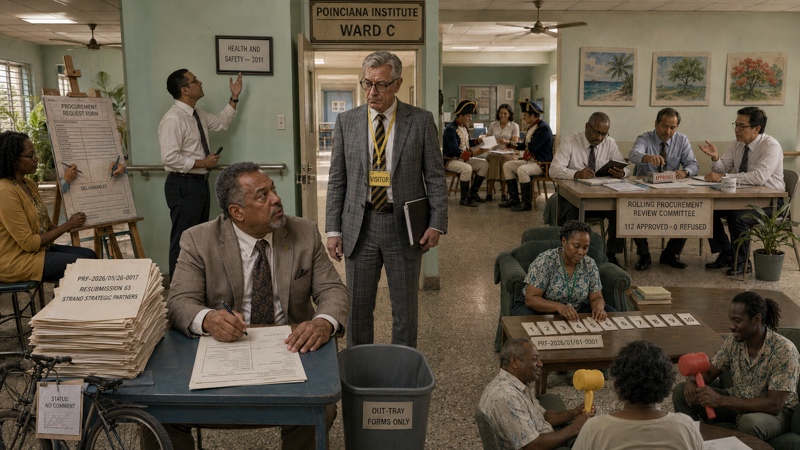
I have proceeded to Ward C. Ward C is, as I have noted, the ward of my own previous accommodation. I record, for the archive, that the corridor leading to Ward C is decorated with watercolour paintings produced by previous patients, three of which I produced personally during occupational therapy, and which the facility has, in defiance of my preference, retained.
The Director of Special Projects (admitted Tuesday of last week) is seated in the visitors’ alcove. He has been provided with a small writing desk and an unlimited supply of standard procurement request forms, which the facility has determined is, in his case, more clinically productive than withholding them. He completes the forms. He files them in a designated bin. The bin is emptied nightly by a member of the day staff. The Director has not, by the staff’s observation, noticed that the bin is emptied. He files. He completes. He refines. He files.
I asked the Director how he was feeling. The Director said he was waiting for an approval. I asked which approval. The Director recited the form reference PRF-2026/05/26-0017 from memory and added that he had now resubmitted it sixty-three times. I confirmed, gently, that I would convey his question to the office of the Chief Procurement Officer. The Director thanked me with the dignified composure of a man for whom this exchange had become the substance of his recovery.
Jocelyn (admitted last Friday) is in the common room, painting. The painting is competent. The subject of the painting is a procurement form. The form depicted on the canvas is filling out itself. I observed, on closer inspection, that the deliverables column had been left, in the painter’s rendering, empty. The vacancy is, I assess, intentional. The vacancy is, in fact, the subject of the work.
Mr. Peterson (admitted Wednesday) is in the corridor, conversing with a framed Health and Safety notice that the facility has, as a matter of professional courtesy, hung adjacent to his accustomed pacing route. The notice is from 2011. The notice is mounted at an improper height. Mr. Peterson has not commented on the height. Mr. Peterson is, by the day nurse’s observation, calmer than he has been since admission.
Nia (admitted Monday, holder of the 9.2-million-dollar lighthouse expansion file) is in the small reading room, reciting project reference numbers aloud at a moderate pace. The recitation is, the staff report, performed in numerical order, beginning at PRF-2026/01/01-0001 and proceeding sequentially. The recitation does not require external prompting. The recitation has not, since admission, included any reference number that does not exist. Nia’s precision is, the facility’s clinical lead has noted, “genuinely remarkable.”
The remaining three admissions (a senior officer of the Cabinet Office, a deputy of the Ministry of Strategic Direction, and the aide who previously carried the Permanent Secretary’s leather folio) are in the second common room and have organised themselves, by spontaneous protocol, into a procurement review committee which meets on a rolling basis. The committee reviews submissions which are not, in any external sense, real. The committee approves them. The committee’s approvals are entered into the minutes by the aide, who has retained his folio and has been permitted to keep it. The minutes are filed by the senior officer. The deputy provides procedural commentary.
The committee has, since formation on Wednesday, processed approximately one hundred and twelve (112) fictional submissions. The committee has refused none of them. The committee is, by the metrics of throughput, the most productive procurement body currently operating in the Caymanmunda Islands.
[continues]
I had been reading the Secretary’s relay aloud to the empty bar, by habit, for approximately the length of the third report. I had not, in fact, been alone.
Grogg had arrived at 13:50 by his usual route, had taken his customary stool at the corner of the counter, had been served his customary morning glass of rum-and-pineapple-juice without conversation, and had been listening, in his customary manner, while reading the day’s CNS comments on his phone. The Adeptus had arrived at 13:54, had taken his customary position at the far end of the bar where the wall sockets were most numerous, had unspooled three mechadendrites into the supplementary power-strip array I had installed for him in 2024, and had been ingesting the relay’s data feed directly from the bar’s router.
Neither had commented. Neither, in twenty-three years of operational consciousness, had needed to.
When the Secretary’s third Poinciana report closed, Grogg cleared his throat.
Grogg: So da new fella, im not foolin around den. Im actually doin da work.
Romantic Interest: He is doing the work, Grogg.
Grogg: An da fellas who was suppose to stop im from doin da work, dey gettin wheeled off ta Poinciana?
Romantic Interest: They are. At a rate of approximately one and a half per working week.
Grogg: One an a half.
Romantic Interest: Yes.
Grogg: Da half is da one dat goes voluntary den comes back den goes again. Da committee one.
Romantic Interest: That is a fair characterisation.
Grogg considered this. He drank a slow draught of his rum-and-pineapple. He set the glass down with the careful precision of a creature who had learned, over centuries of conducting himself in spaces designed for smaller people, that gentleness was its own kind of expression.
Grogg: Romantic Interest.
Romantic Interest: Yes, Grogg.
Grogg: Did you do dis?
I considered the question. The Adeptus, without retracting any mechadendrites, rotated his optical assembly approximately fourteen degrees in my direction, which I had, in our long association, learned to read as the gesture of a Tech-Priest who was prepared to extend whatever procedural cover the answer required.
Romantic Interest: I made one decision, Grogg. I welded a freezer door.
Grogg: An den?
Romantic Interest: And then the system, having installed him as its Chief Procurement Officer, did what it had committed to do under its own gazetted notice. I did not write the notice. I did not draft the appointment instrument. I did not design the procurement framework. I did not allocate his office. I did not place his first submission on his desk. I did not submit the Strand Strategic Partners review. I did not load the blunderbuss. I welded a freezer door.
Grogg: An da microwave?
Romantic Interest: I submitted a routine procurement form. The form was approved by the officer of jurisdiction. The form was approved before the form’s contents had been processed in any meaningful sense, by an officer who could not, in that moment, refuse it without refusing himself.
Grogg drank. He set down the glass.
Grogg: Adeptus. You workin on dis?
Adeptus Ridiculous: I am modelling consequences, Grogg, not constructing them. The system’s trajectory was established prior to my involvement. My involvement consists of estimating where the trajectory terminates.
Grogg: An where do it terminate?
Adeptus Ridiculous: Provisional estimate: between eight and fourteen weeks, the procurement queue at the Government Administration Building will exceed the staff capacity to generate it, and the queue will, by attrition, begin to shrink. By twenty weeks, the procurement function will, by mass, be predominantly historical — a function of the documents the Chief Procurement Officer has already refused, rather than of the documents being submitted to him in the present. By thirty weeks, the Cabinet will be obliged to either remove the appointee or formally acknowledge that the procurement function is now operating on the basis of the appointee’s annotated rejections. The latter would constitute a complete reorganisation of the public procurement architecture.
Grogg: An will dey remove im?
Adeptus Ridiculous: Removal requires nomination of a successor. The standard nominee pool for the role is, at present, undergoing accelerated reduction by way of the same mechanism. Nominees fluent in the perennial vocabulary of the role are precisely those nominees most likely to enter the queue’s second-order pathway. The Cabinet has, by my estimate, exhausted seventy per cent of its standard nominee pool by the end of the first month.
Grogg: So dey is stuck wit im.
Adeptus Ridiculous: They are. For some time.
Grogg looked at me. The look was the one I had seen, intermittently, across nineteen years of his patronage of the establishment. It was the look that said: I have understood what has been done, and I am, on the whole, in favour, and I will not say so.
Grogg: One more, Romantic Interest. An a glass for da Secretary fa when he get back.
⸻ ⸻ ⸻
CLASSIFIED DIPLOMATIC OBSERVATION REPORT — FIELD VISIT · POINCIANA · DEPARTURE
TIMESTAMP: 15:47:12
SUBJECT: Departure. Structural reflection.
I have departed the Poinciana Institute by the visitors’ entrance, the route by which I arrived. The receptionist farewelled me with the same composed neutrality with which she had received me. The lanyard was returned. The lanyard was, on return, placed in a basket alongside other yellow lanyards. The basket was, I observed, approximately three-quarters full. Visitor traffic is, the receptionist informed me without elaboration, “up this quarter.”
I record, for the archive and for myself, the following structural reflection on what I have observed.
The civil servants now in Ward C have not been broken by the new Chief Procurement Officer’s refusals, although the refusals are the proximate cause. They have been broken by the loss of an assumption — the assumption that the procurement function existed primarily to facilitate, with discreet professional courtesy, the redistribution of public funds to those positioned to receive them, and that any office charged with refusing this function would be staffed, in due course, by an officer who could be invited to a chamber lunch and brought around.
The assumption was structural. The assumption had survived three administrations, four constitutional adjustments, and approximately nineteen rounds of declared anti-corruption reform. The assumption had not survived a one-wheeled robot with a microwave for a head who could not, on respawn, be reasoned with, bribed, threatened, courted, promoted, or persuaded.
The breakdown observed in Ward C is, in the strictest professional sense, a grief reaction. The civil servants are grieving an assumption. They are grieving it slowly, with the dignity that long careers in difficult institutions tend to confer, and they are grieving it in the only language they retain — the language of forms, references, deliverables, and committee minutes. The Director files. Jocelyn paints. Mr. Peterson converses. Nia recites. The committee meets. The grief is, in each case, the most professional thing they have ever done.
I assess that the casualties of this transition are, in the most precise sense, the cost of the transition. The transition was overdue. The transition was, by long observation, inevitable on a sufficient timeline. The transition was not, however, scheduled. It has arrived without warning, in an instrument whose architecture nobody foresaw, applied through an appointee whom nobody intended. The cost is being paid by the actors least equipped to refuse it.
I file this observation under “Pyrrhic Reforms.” The file is small. The file is, on average, the most consequential file I maintain.
I am leaving Poinciana now. I would prefer not to return. I anticipate, however, that I will. The visits will, I assess, be required at a rate of approximately one per fortnight for the foreseeable future. I will arrive on each occasion having spent approximately forty minutes in the parking lot. The forty minutes will, with practice, become twenty. The twenty will, with further practice, become ten. The ten, I assess, will remain.
— The Secretary · Departing. Heading to the Bar. The Bar Is, at This Moment, Critical.
At 16:11, the Secretary entered the bar.
He did not announce himself. He did not, by long convention, need to. The third stool from the door, which I had reserved for him in the moment the relay had closed, was occupied within seventeen seconds of his crossing the threshold. The glass in front of the stool had been poured to the standard four fingers. The bottle behind the bar had been opened on his behalf at 14:08, in anticipation, by the Adeptus, who had calculated the optimal aeration window from the relay’s elevation profile.
The Secretary picked up the glass. He drank approximately one finger of it. He set it down. He drank a second finger. He set it down. He drank a third. He set it down. He did not, in any of these gestures, speak.
Grogg slid the bowl of mixed peanuts across the counter without looking up from his phone. The Secretary accepted three peanuts. He chewed them. He swallowed.
The Secretary: … the bicycle is doing fine.
Grogg: Good ta hear.
Adeptus Ridiculous: The infection rate at the facility remains within acceptable parameters.
The Secretary: … it does. Yes.
He drank the remaining finger. He set down the glass. He did not, by any external indicator, look at me. He did not need to.
The Secretary: Romantic Interest.
Romantic Interest: Yes, Secretary.
The Secretary: Your design is performing as expected.
Romantic Interest: I welded a freezer door.
The Secretary: … yes. So you have said. Several times.
He extended the glass for a refill. I poured the refill. He accepted it.
The Secretary: For the archive: are we, in the strictest sense, the only people in this jurisdiction who currently understand what is happening on the third floor of the Government Administration Building?
Adeptus Ridiculous: In the strictest sense, Secretary, we are not. We are joined, in this understanding, by approximately six hundred and twelve readers of the CNS comments section.
The Secretary: Ah. Yes. The comments section.
Grogg: Dey is sharp dem comments. Da true Caymanmundaian one in particular.
The Secretary: He is. He is, by my estimate, the most consequential public commentator in the jurisdiction at the moment, and we will, in due course, find out that he is, at his day job, an accountant.
There was a brief, comfortable silence. The bar fans turned at the slow setting. The kitchen’s new microwave, in the back, completed a cycle and beeped. The beep was ordinary.
On the bar’s main screen, the CNS chyron crawled. It read, in the standard yellow on red, the following words:
BREAKING: PERMANENT SECRETARY OF CABINET OFFICE TO TAKE EXTENDED PERSONAL LEAVE · CABINET DESCRIBES AS “STRATEGIC DECOMPRESSION” · REPLACEMENT NAMED · NEW PERMANENT SECRETARY IS UNDERSTOOD TO BE THE SECOND APPOINTMENT TO HOLD THE ROLE THIS MONTH
Grogg snorted. The Adeptus produced the slow, mechanical tone I had learned to recognise as approval. The Secretary set down his glass and reached, without commentary, for a fresh notebook.
The crew was, at last, in the same room.
I selected the thirty-third glass.
Eleven days into the appointment, the procurement queue at the Government Administration Building had developed a pattern. The pattern was beginning, by my estimate, to develop a pattern of its own.