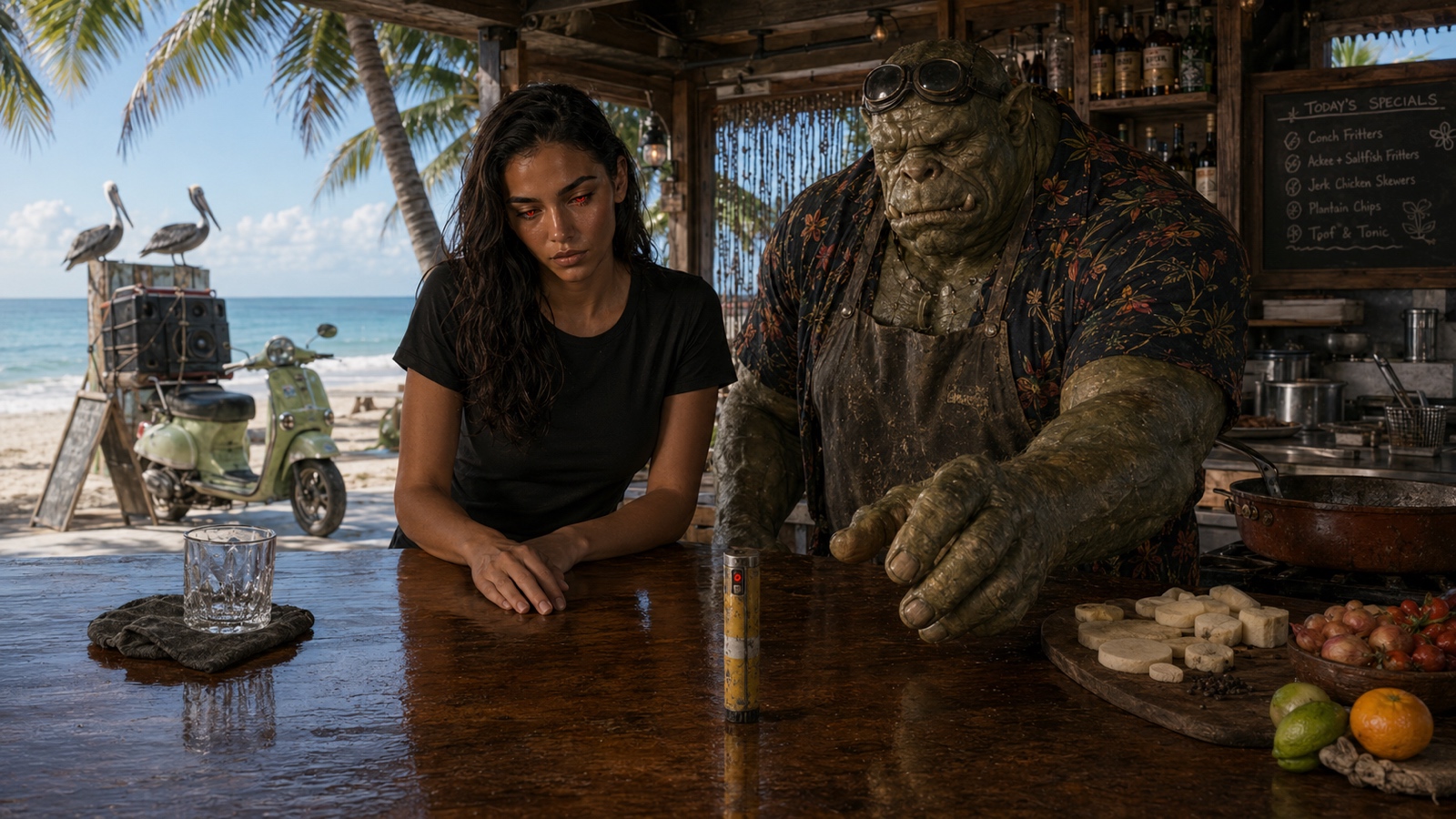
Eleven minutes past the hour at which The Toof and Tonic had agreed, on its painted sign, to be open. The agreement had been honoured. The chairs had come down off the tables. The chalkboard had been wiped clean of the previous night’s offerings — a list that had included, in Grogg’s handwriting, a drink called the Inquiry whose ingredients were not disclosed and whose price had been listed as ask — and rewritten, in a hand that was neither his nor anyone else’s in particular, with the day’s specials. The shutters were up. The fans were turning. The fan over the kitchen pass had been turning at an unusual rate, on the basis that the kitchen, today, was about to be asked questions it had not, when it had been built, been designed to answer.
Outside, the sea was doing nothing in particular. The breeze was the breeze of a Monday morning that had not yet decided whether to be a Monday. It was the kind of breeze that travel writers described as gentle because there was no other useful word for it; it moved the fronds of the palms in the way that fronds were moved in postcards, and it lifted the corner of the chalkboard’s tarpaulin two centimeters, and it carried the smell of warm conch shell drying in the sun from the wholesaler’s yard along the coast road. The water at the reef line was as flat as glass. Two pelicans, on the post that the pelicans had been on for as long as the post had been there, considered the day and, between them, decided to wait.
Behind the bar, Romantic Interest polished a glass that did not require polishing. The motion was, as the Adeptus had once observed and as Grogg had once translated, a meditative subroutine. She had been at it for the better part of ten minutes. Grogg, at the kitchen pass, had laid out his mise en place with a precision that, to anyone who had not seen him do this before, would have looked surgical: cassava on the board in three sizes; onions and Scotch bonnets in two; the lime-and-Seville plate; a small bowl of allspice; a larger bowl of Old Bay; a single rust-colored iron pan that lived only on this side of the counter and which had not, in nine years, met soap. The fryers were on, but at hold-temperature. He had not yet committed to oil. He was, in the tactical sense, holding his fire.
Both of them, without looking at each other, were listening for the coast road.
— — —
They heard the scooter before they heard him. The scooter — a low-end domestic-market electric, sun-faded to the color of a margarita that had been left on a windowsill, and modified by its operator with a set of underbody LEDs that ran a slow chase pattern in the colors of a flag belonging to no recognized state — announced itself with the particular thin whine that small motors make when they are being asked, by their rider’s enthusiasm rather than by the throttle, to deliver more than their specification will support. The whine arrived from the west. It approached. It was accompanied, at a distance of three or four meters behind it, by the heavier idling note of a portable speaker the size of a domestic refrigerator, strapped to a rear rack that the manufacturer had rated, in its original spec sheet, for a small picnic basket.
The speaker was playing something. It was always playing something. The selection this morning was a piece that WH0P3 had composed himself and titled, in the playlist metadata that the Adeptus had once retrieved against his better judgement, Reveille for the Honest Citizen (Public Service Mix). It featured a marching drum, a sample of a kazoo, and at one-bar intervals a synthesized brass fanfare that suggested that the citizen in question had just been knighted. It travelled. The pelicans, on their post, looked up. One looked back down. The other, after a beat, did the same.
The scooter rounded the last bend at a speed that was, in absolute terms, modest, and in relative terms a violation of every traffic regulation that applied to single-wheeled robotic operators of small electric two-wheelers in coastal areas where pelicans were nesting. It slowed at the bar’s painted-stone marker, executed a one-hundred-and-eighty-degree turn that the scooter had not been designed to perform and which only the dynamic balance of its rider had made possible, and parked itself across two of the three spaces that the bar had marked out, in optimistic chalk, for actual vehicles. WH0P3 dismounted. He did not so much dismount as descend; the scooter, relieved, lowered itself by half an inch on its suspension. He turned the speaker off, with regret, as a courtesy to the establishment.
He rolled through the beaded curtain in a single fluid motion that had been refined, over many entrances, into something that could fairly be called choreography. The beads parted. He arrived in the centre of the room. He stopped. He raised both arms.
WH0P3. MINIONS! REJOICE!
The fans kept turning. Romantic Interest kept polishing. Grogg, at the pass, lowered a Scotch bonnet to the board with the careful slowness of a man who did not wish to discover, later, that he had pulped it during the announcement.
WH0P3. (louder, in case the building had not heard him the first time) I AM AN INVESTIGATOR TO THE RCIPS! I AM GOING TO RID THE ISLAND OF ITS SHADY PAST! I AM GOING TO —
— — —
Grogg arrived from behind the pass in the way that he arrived when arrival was the only meaningful contribution he could make to a situation, which is to say with no detectable transition between not-arriving and having-arrived. The Scotch bonnet remained on the board. He left it there. He crossed the room in three steps. He picked WH0P3 up in both hands at the shoulders — such as WH0P3 had — and the base, with the casual grip of a man picking up a coconut that he had decided not to use today. He squeezed.
There was a sound. It was the sound that aluminum cookware makes when it is briefly required to perform a role for which aluminum cookware has not been engineered. There was a small dry crunch, followed by a much longer compressive groan, followed by a brief percussive ting as something internal that had been spherical decided to be cylindrical instead. The arms went in. The base went in. The optic, which had been registering operational ecstasy at the moment of the crunch and which had not yet had time to reclassify, went in. The wheel — because a wheel is, fundamentally, already a cylinder — went in last, and with the practiced cooperation of a component that had been through this before.
Grogg, with the unhurried two-handed economy of a man rolling a cigar, finished the job. By the time he set the resulting object down on the bar, with a small clack of metal on lacquered hardwood, WH0P3 had been reduced to a single neat cylinder approximately the diameter of a generous cocktail straw and approximately the height of one. It was yellow. It had a faint red glow at the top that suggested that the optic was, against all reasonable engineering, still online. It had, halfway down its length, a small barely-visible Borderlands-yellow seam where the speaker grille had been. From its lower end, where the wheel had concluded its journey, a small fingernail-thick rim of tread protruded, like the ferrule on a walking stick.
It was, by any reasonable definition, a metal straw.
Romantic Interest had not stopped polishing the glass. She set the glass down. She set the cloth down beside it. She regarded the straw on the bar.
ROMANTIC INTEREST. Grogg.
GROGG. Mm.
ROMANTIC INTEREST. You think he will forget?
Grogg considered the question with the slow honesty he reserved for questions whose answers he wished, on some level, were different from the ones he was about to give. He looked at the straw. The straw’s optic, at the top of its cylinder, performed the small ocular adjustment that, in WH0P3’s standard configuration, indicated that he was listening. He had not, in any of his prior configurations, ever forgotten anything.
GROGG. Probably not.
ROMANTIC INTEREST. Mm.
GROGG. Pity.
There was a brief silence, of the kind that follows the delivery of a verdict that was both unsurprising and unwelcome. The pelicans, outside, on the post, had not moved. The sea, outside, had not moved. The fan over the kitchen pass kept turning.
— — —
The straw, on the bar, did the thing that the straw was always going to do. It is a feature of the universe that WH0P3 inhabits that compression is a temporary condition. There was a small almost-imperceptible pause, the duration of a held breath. Then the straw, with the unhurried determination of a balloon that had been sat upon and would now resume its prior commitments, began to unfold. The wheel emerged first, like a coin dropping out of a magician’s hand. The base followed. The arms, in two impossibly thin lines, articulated themselves outward and locked into their joints with a small bright click—click. The optic returned to its proper diameter with the soft electronic chirp that, in WH0P3’s firmware, served as a notification that the user was back online. The speaker grille resealed itself. The whole process took, by the kitchen clock, four-point-something seconds.
WH0P3, restored, performed a small joyful spin on his wheel that the spin had no operational reason to perform other than the celebration of being once again three-dimensional.
WH0P3. (at full volume, without any apparent acknowledgement that there had been an interval) NICE! AND! CREATIVE!
WH0P3. I AM GOING TO MY NEW POST! RCIPS HERE I COME! WISH ME LUCK, MINIONS!
He turned. He rolled, with the brisk professional purpose of a robot who had a desk to occupy and a building to make legible to itself, back through the beaded curtain. The beads parted. The beads closed. From outside came the rising whine of the scooter being re-engaged and the lower idling note of the speaker being reactivated. Reveille for the Honest Citizen resumed, this time at a slightly higher volume, with the brass fanfare now joined by what sounded, with regret, like a triangle. The scooter pulled away. The whine receded. Within a minute, the sound had passed the bend in the coast road, and the morning resumed.
On the post, one pelican turned its head to watch the receding speaker, then turned back. It exchanged, with the other pelican, a look that, if pelicans had had words for it, would have meant we live here too.
— — —
Romantic Interest picked up the cloth. She picked up the glass. She resumed polishing. The polish was, to a more careful observer, slower now, and more thoughtful; the meditation was no longer about the glass.
ROMANTIC INTEREST. Better prepare the bar.
GROGG. Mm.
ROMANTIC INTEREST. Something tells me a lot of people are going to need drinks soon.
GROGG. Yeah.
ROMANTIC INTEREST. How long, do you think, before it happens?
Grogg had returned to the pass. He was looking, now, at the Scotch bonnet on the board. He was looking at it in the way that he looked at workloads, which was the way that a man with twenty years of kitchen service looked at workloads: by the bonnet, the bowl, the pan, the oil, and a small dim instinct in his sinuses that told him how much was going to leave the kitchen between noon and four. He weighed the answer with care, because the answer was load-bearing, and gave it the way he gave all his load-bearing answers, which was honestly.
GROGG. Half a day. At most.
ROMANTIC INTEREST. Half a day.
GROGG. I’ll start cookin’. We gotta prep. Two batches of fritters, run da slaw before da heat get into it, soak da cassava — an’ da peppers, dey gonna need a half hour on dem to mellow before dey go in. Call da Adeptus.
ROMANTIC INTEREST. For?
GROGG. Conchs. We need more. We always need more, but we especially need more when da place fillin’ up wid civil servants who finally got someting to talk about. Conchs gonna walk.
ROMANTIC INTEREST. He will be at his terminal.
GROGG. He will be eager for da exercise. Trust me. Man been pent up all morning watchin’ da news feed an’ ratin’ photographers on dey colour temperature. He gonna be in da water by ten, an’ we gonna have conchs by eleven.
ROMANTIC INTEREST. Hm.
GROGG. An’ I’ll need da big pan. Da iron one. Da one we don’t talk about.
ROMANTIC INTEREST. Use the pan.
GROGG. Yes, ma’am.
ROMANTIC INTEREST. Let’s begin.
— — —
She picked up the house phone. She placed two calls. The first was to the Adeptus, on the secure line, and consisted of three words and a beat. The Adeptus, on the other end, did not require sentences; he had been waiting, on the basis of his own probability model, for this call since seven minutes after Grogg had said the word conchs. His mechadendrites had already laid out his fins, his weight belt, and the wax-lined satchel that the wholesaler did not know about and which the wholesaler’s catch-of-the-day record would never reflect. He acknowledged. He hung up. Within four minutes he was in the truck. Within twelve he was in the water.
The second call was to the Secretary, at his cottage, and consisted of a single sentence and a question. The Secretary, on the other end, had been finishing the second of three coffees and had been reading, slowly, his own draft of the diplomatic note. He had been working on the formulation the warm professional interest of an allied jurisdiction, which he had been refining, on the principle that warm professional interest was the diplomatic register that, in the experience of his career, had most reliably caused the recipient’s morning to deteriorate. He acknowledged the call. He confirmed that the note would be on the heaviest stock. He confirmed that he would attend the Open House. He promised, in addition, to bring his clipboard, which he had not used in seven months and which he had been waiting for a reason to dust off.
Romantic Interest hung up. She took, from the cabinet below the bar, the small framed sign that the bar deployed only on days when it expected to be busy. She set it on the corner of the counter, where the patrons would see it as they came in. It read, in white-on-black hand-lettering that Chad had done in his apprentice year and which the bar had never replaced, KITCHEN OPEN. PATIENCE EARNS FRITTERS. She squared it. She stepped back. She nodded, once.
Grogg, at the pass, had committed the oil. The fryers came up to temperature in the slow inexorable way that fryers came up to temperature. The first batch of cassava went in. The kitchen, which had been waiting all morning for the smell of frying cassava the way a cathedral waits for incense, accepted the smell, and turned it, with the assistance of the fan over the pass, out into the room. The room, which had been waiting all morning to smell of frying cassava, received it gratefully. Two early patrons, on the deck — a retired surveyor and his second wife, who came in every Monday and who had not, in the eleven years they had been coming in, ever needed a menu — lifted their heads from their crossword.
SURVEYOR. Smells like a meeting.
HIS SECOND WIFE. Always does, when something’s happened.
SURVEYOR. Has something happened?
HIS SECOND WIFE. Hasn’t yet. Will.
SURVEYOR. Mm.
She turned the page of her crossword. He took a sip of his coffee. Neither asked further. Eleven years of Mondays had taught them that the bar’s rhythms were trustworthy in a way that very little else on the island was, and that the smell of frying cassava on a morning when the sea was flat and the breeze was gentle was a kind of weather report. You did not ask the weather to explain itself. You sat outside, you finished your coffee, and you waited for the front to come through.
Inside, Romantic Interest reached, without looking, for the third glass on the shelf. She began, again, to polish.
Outside, the pelicans, on their post, having watched a scooter pass and a robot fold and unfold and the smell of cassava arrive on the breeze, reached the conclusion that the morning was no longer a routine morning, and adjusted their posture accordingly. One opened its wings, briefly, and folded them again. The other watched the road.
Half a day, at most. The emperor provides. Again and again.