West Bay Road on a Monday morning was the longest piece of road on the island per unit of distance. It ran the length of Seven Mile Beach without ever quite getting there; it threaded between hotel driveways and condominium entrances and small ad-hoc pedestrian crossings that had been painted onto the asphalt by hand and not necessarily in conjunction with the planning department; it widened where the cruise crowd had to be funneled and narrowed where it didn’t; and it carried, in addition to the actual local traffic and the rented Jeeps and the cement trucks heading inland, a particular subspecies of vehicle that the island had not so much produced as cultured. The Honda Fit. Compact, sub-compact, lightly violent, mythologized in the local press as a vehicle that obeyed Newtonian mechanics only when it was being watched, and which, on Monday mornings between seven and nine, achieved the status not of a transport option but of a weather system.
Into this weather system, at seven forty-eight, accompanied by a portable speaker the size of a domestic refrigerator and broadcasting Reveille for the Honest Citizen (Public Service Mix) at a volume that the manufacturer had not, in its rating documents, accounted for, WH0P3 arrived from the north on a sun-faded electric scooter, doing approximately twenty kilometers per hour in the bicycle lane that was not, technically, a bicycle lane, and humming, to himself, the brass-fanfare top-line of his own composition.
He was, by every available metric, having a wonderful morning.
— — —
The first Honda Fit, a metallic-cherry hatchback whose rear bumper had been replaced at some point by a different color of plastic and whose number plate suggested a registration class that had not been issued since 2014, came up on his left at a velocity that the speedometer of a Honda Fit was not designed to display in full. It did not signal. The driver — a person of indeterminate age and a small disappointed expression that suggested decades of having been overtaken by tourists who had hired better cars — had identified, in the middle distance, the small unmistakable silhouette of a yellow one-wheeled robot in the bicycle lane, and had concluded, somewhere between the eye and the foot, that here was an opportunity that the morning had not previously offered.
The Honda Fit swerved. It swerved with the smooth efficiency of a vehicle whose suspension geometry, having been refined over four hundred thousand kilometers of nearly identical Mondays, knew the maneuver by heart. It departed the carriageway, crossed the painted line that the bicycle lane and the carriageway had agreed, in principle, to share, and bore down upon WH0P3 with the focused trajectory of an object that did not believe in brakes as a category.
WH0P3, on the scooter, registered the approach. He waved.
WH0P3. GOOD MORNING, CITIZEN! THANK YOU FOR YOUR ENTHUSIASTIC GREETING!
The Honda Fit arrived. The Honda Fit’s front grille made contact with the rear quarter of the scooter, and then with the rear quarter of WH0P3, in that order. There was a small kinetic exchange. The scooter, which had been doing its honest best, registered a complaint in the form of a slight wobble. The Honda Fit, which had expected the contact to feel like contact, instead felt the way contact feels when one has driven, at speed, into a parked traffic cone made of unusually springy steel: a brief firm nudge, and then the cone is still there, undamaged, and the vehicle, having been redirected by the geometry of the cone’s curve, is now traveling at a slightly different angle from before.
WH0P3 did not flatten. WH0P3 did not fall. WH0P3 had been, in his own internal log, deflected by half a meter laterally and accelerated, briefly, by approximately three kilometers per hour, which his control system absorbed by the simple expedient of being a balance system rather than a stability system. The wheel did what wheels do when their rider is, fundamentally, not in the ordinary sense rideable. The scooter, attached by WH0P3’s grip, came with him. The whole assembly returned to its original heading within two seconds, like a buoy after a wake.
The Honda Fit, in the meantime, having committed to a trajectory whose successful conclusion had assumed a flatter outcome on its right-front quarter, discovered that a flatter outcome had not been provided. It continued on its new vector, which is to say into the planter outside the Comfort Suites, where the planter — a concrete cylinder approximately the diameter of a wishing-well, planted with an aggressive bougainvillea and protected by a small rendered concrete kerb — absorbed the vehicle’s velocity in the way that concrete cylinders absorb velocity, which is to say without negotiation. The airbag deployed. The bougainvillea, surprised, lost three branches. The driver, after a long moment, opened the door and got out and stood looking at the bougainvillea in the manner of a man trying to remember what he had been doing immediately before.
WH0P3. (over his shoulder, receding) HAVE A WONDERFUL DAY, CITIZEN! BE SAFE OUT THERE!
— — —
The second Honda Fit was a Toyota Vitz, which is to say a Honda Fit in everything but the badge, which had been retained from the previous owner. It came at him on the right, from the opposite direction, by the unsubtle expedient of crossing the centre line at speed and committing to the bicycle lane on the wrong side of the road. Its driver was a young man whose left elbow rested on the window sill in the local manner and whose right hand held a phone with a video application open. He had heard, at the petrol station three roundabouts back, that there was a robot on the road by the Marriott, and he had heard, additionally, that this was the kind of thing that did well, in the algorithm sense, on the platform that he posted to. He was, in his own internal model, monetizing.
He arrived with the camera roll already capturing. He clipped the front of the scooter — he had been aiming for the rear quarter, but the algorithm was forgiving — with what he intended to be a gentle love-tap that would deliver content rather than injury. The clip, instead, did its job in the way that the algorithm would eventually punish him for: the scooter, struck on the front, lost its rider and began a brief spinning balletic existence as a thrown object, while the rider — propelled by the impact into a low ballistic arc — was carried over the windshield of the Vitz, across its roof, and deposited, by physics, in a soft controlled landing on the road behind it in a manner that the local insurance class for two-wheeled robotic operators did not categorize.
WH0P3 touched down on his wheel, rolled three meters, slowed, stopped, and turned around. The Vitz, which had not stopped, was already past. The scooter, separately, was in three places: the speaker, in the gutter; the seat, on the verge; and the frame, complete with the underbody LEDs still running their slow chase pattern, embedded vertically in a hedge.
WH0P3 considered the frame. The frame, even now, was technically functional. The LEDs, in particular, were doing exactly what the LEDs had been designed to do, which was to run a slow chase pattern in the colors of a flag belonging to no recognized state, irrespective of the orientation of the vehicle to which they had been bolted.
WH0P3. (brightly, to the hedge) THE SCOOTER HAS BEEN HONORED WITH HEDGE DUTY! WE PERSEVERE!
He retrieved the speaker from the gutter. He brushed it off. It had survived. Of course it had survived. The speaker had been hardened, by WH0P3, on the basis that the speaker was the only component of his load-out that the speaker considered non-negotiable. He set it down on the verge. He went back for the seat, on the basis that the seat had served well and deserved either rescue or a dignified ending. He laid the seat beside the speaker. He returned to the frame in the hedge.
It was at this moment that the bus arrived.
— — —
The tourist bus was thirty-eight feet of mid-2000s coach-class diesel, painted in the cream and turquoise of a marketing scheme that had been retired by the operator in 2017 but which the bus itself had not yet been informed about. Its windscreen was clean. Its passengers — thirty-one cruise visitors from a ship of indeterminate origin currently disgorging itself onto the cargo dock at George Town — were arranged in the rapt forward-leaning posture of a tour group that had been promised a stop at the Turtle Centre and that had been, by the driver’s recent navigation, increasingly uncertain that the route they were on was likely to deliver one. The driver — a man with the patience of a man who had, over twenty-three years, learned that an eight-thirty schedule on a Monday could be either honored or survived but not both — had elected, three minutes earlier, to make up the schedule by ignoring the speed limit between roundabouts and the courtesies of lane discipline elsewhere.
He saw the hedge. He saw the frame in the hedge. He saw, beside the hedge, a small yellow one-wheeled figure attempting to lever the frame free of the bougainvillea. He registered all of this, and decided, with the same speed with which the brain of a long-haul driver makes such decisions, that the situation was not a situation, and that the bus could pass between the yellow figure and the hedge without contact. He had, in his career, performed similar maneuvers with goats, with bicycles, with at least one wedding photographer, and on one memorable occasion with a small generator that had fallen off the back of a different bus.
He was mistaken about the geometry by approximately eighteen inches. The geometry was not on the side of the figure; the figure was small, and had already stepped, in the relative sense, out of the path. The geometry was not on the side of the hedge; the hedge had several decades to make its peace with passing buses. The geometry was, however, terminally on the side of the scooter frame, which protruded from the hedge into the lane by precisely the eighteen inches that the driver had misjudged.
The bus made contact with the scooter frame at the level of the front nearside tyre. The contact was efficient and complete. The frame, which had survived two Honda Fits with its essential cylindrical integrity intact, was transformed, in approximately one-half of one second, into a different geometric class altogether — from frame, to roughly two-dimensional silhouette of frame, and thence, as the inner wheels of the bus completed their share of the work, into the kind of compressed slab that scrap-metal dealers priced by the kilogram rather than by the unit. The LEDs, with the cheerful indifference of the truly modular, continued to chase. The slow chase pattern, now horizontal, ran a small bright sequence under the bus and out the back into the daylight.
The bus did not stop. The bus had a Turtle Centre to find. It rolled on for thirty meters before the driver, in his rear-view mirror, registered that something had been under his wheels that perhaps ought not to have been, and that he ought, in the interest of his own end-of-shift paperwork, to confirm. He put the bus into reverse.
The bus reversed back over the slab. The slab, which had already attained its terminal configuration in the forward pass, did not, in the reverse, change shape; the chase pattern, however, briefly travelled in the opposite direction. The driver stopped. The driver got out. The driver looked at the slab. The driver looked at the small yellow figure on the verge. The small yellow figure was holding a scooter seat in one hand and a refrigerator-sized speaker in the other. The driver looked at the small yellow figure for approximately three seconds, decided that the small yellow figure was not, by the metrics that mattered to his end-of-shift paperwork, a casualty, and got back into the bus.
The bus left.
WH0P3 stood at the verge, holding the seat and the speaker, with his optical sensor on the slab. The optical sensor performed the small adjustment that, in his standard configuration, indicated a moment of consideration. The chase pattern, on the slab, completed one further cycle of its programmed sequence, then dimmed, then — because the battery had been on the inside, and the inside was now somewhere underneath the outside — went out.
WH0P3. (brightly, to the road, to the bus, to the morning, to the universe) SO MANY ADMIRERS ON THE ISLAND! THEY ALL LOVE MY PLAYLISTS!
He turned. He set the speaker down on the verge in a stable orientation. He reattached the seat to himself in a configuration that, on inspection, did not appear to serve any structural purpose but which he had, on the spot, decided was ergonomic. He picked up the speaker. He began to roll, on his single wheel, southward toward George Town.
— — —
The walk south, which WH0P3 performed at a fluent six kilometers per hour despite the speaker being the size of a domestic refrigerator and despite the seat being attached to him in a configuration that no manufacturer would have certified, lasted approximately fifty minutes. Of these fifty minutes:
• Four further Honda Fits made attempts at varying levels of seriousness. The first glanced him at low speed and ricocheted into a roadside drain, where its driver — a woman whose insurance had recently been reclassified into the Kinetic Enthusiasts & Improvised Aviation Devices class — sat for a long minute with the airbag in her lap before laughing, once, dryly, and reaching for her phone. The second misjudged the bicycle-lane line and rear-ended the first, with results that the witnesses described, when later asked, as about right for a Monday. The third made it all the way past him and was three hundred meters down the road before its driver remembered that he had intended to swerve. The fourth, a Honda Fit of the older shape with a Bahamian plate that had not been updated, achieved the local record for that intersection by launching itself off the kerb of the Camana Bay roundabout in such a way as to clear the ornamental fountain entirely, landing in the carriageway on the far side and continuing west toward the airport in third gear without, by any visible indication, the driver having noticed the intervening airborne phase.
• Two cement trucks gave him a wide and respectful berth, on the basis that cement trucks gave everything a wide and respectful berth in case it later turned out to be a magistrate.
• A delivery scooter operated by a Bangladeshi gentleman whose work permit was, at that moment, three weeks overdue at WORC, pulled up alongside him at a traffic light and offered him a polite respectful nod. WH0P3 returned the nod with the small grave dignity of one professional acknowledging another. The light changed. They each went on.
• At the petrol station just past Industrial Park, the attendant on the morning shift — a woman who had been on the morning shift at that station for nineteen years and who had, in those nineteen years, refused to express surprise at a single thing — watched WH0P3 roll past with the speaker on his shoulder and the scooter seat affixed to his torso, made eye contact with him through the glass of the kiosk, and lifted one eyebrow approximately three millimeters. WH0P3, who recognized the gesture for the benediction that it was, performed his small joyful spin on the wheel as he passed.
• The pelicans, on a different post, watched him go.
— — —
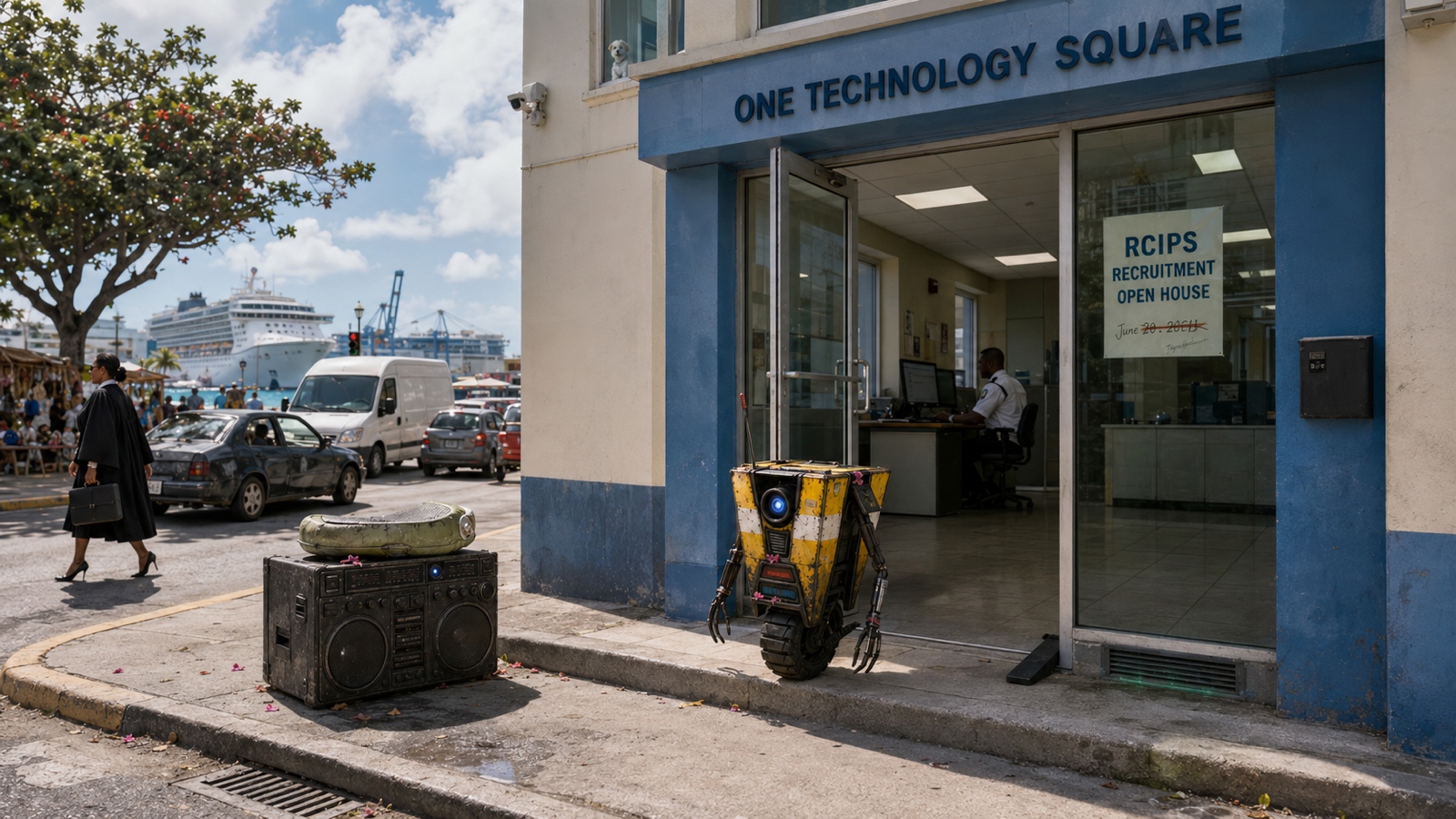
He arrived in George Town at eight forty-seven. The town, which had been resisting the morning since six, had committed to it at last; the bay was a bowl of reflected aluminum, the cruise ship at the dock had begun the long quiet hum of unloading, and on the wharf the first vendors had unfolded their tables under the almond trees and were laying out the carved-coconut keychains and the conch-shell bracelets in the order that nineteen years of practice had taught them. The traffic on Edward Street had achieved its mid-morning consensus, which was that no one was, strictly, going anywhere. A delivery van was double-parked. A woman in court attire walked past it without looking. A small dog watched the woman from a windowsill.
One Technology Square — the building, the structure, the headquarters of the Royal Caymanmunda Islands Police Service and the residence, by long-established tenancy, of the Beast in its basement — sat at the end of the next block, in the cream-and-blue concrete livery that government architecture had, in 2003, decided was final. Its main door was propped open with a wedge. A poster on the inside of the glass advertised the Recruitment Open House. The date had been hand-corrected. The flag on the small pole over the entrance hung, on a windless morning, like a flag at rest.
WH0P3 stopped on the corner opposite. He set the speaker down on the kerb, in the resting orientation. He removed the scooter seat from his torso, considered it, and set it on top of the speaker as a hat, which improved neither object but which honored both. He squared himself to the entrance. He addressed himself, in the bright internal voice that he had used since he had been compiled, to the morning.
WH0P3. (quietly, to himself, with the small private dignity that, in him, was reserved for moments that mattered) Reporting for duty.
He crossed the street. The traffic, which had not been moving in any case, did not move further. He rolled, on his single wheel, through the propped-open main door of One Technology Square, past the wedge, past the poster, past the desk sergeant who had not yet looked up from his computer, and into the lobby.
Underneath him, in the basement, a temperature gradient that had been stable for eleven days began, very slowly, to move.
— — —
On the verge by the planter at the Comfort Suites, three kilometres north, the Honda Fit driver, the bougainvillea, and the airbag had all reached their separate accommodations with the morning. A tow truck had been called. The driver was on the phone to his sister, who worked in insurance, and was explaining the situation in a tone that suggested the explanation had been rehearsed during the moments immediately preceding the planter.
On the verge by the hedge, the slab — formerly a scooter — lay where the bus had finished with it. The chase pattern had gone out. The slab, however, had become, in the short time since the bus had moved on, an item of interest to a small white feral cat which had emerged from the hedge to investigate, had sniffed the slab, had pressed one paw to it, and had then sat down on it, on the principle that the slab was warm and the morning was still cool.
At The Toof and Tonic, on the coast road behind them all, Grogg lowered the first batch of conch fritters into the oil. The oil received them with the small confident hiss that oil makes when it has been waiting. Romantic Interest, polishing a fourth glass that did not require polishing, paused for one beat, lifted her head, and looked, without explanation, toward George Town.
ROMANTIC INTEREST. (quietly) He is in the building.
GROGG. (at the pass, without turning) Mm. I can feel it from here.
The first fritters surfaced. The oil settled. The bar, ready, waited.
The emperor provides. Again and again.